The Fourth Cookbook of Christmas: Mediterranean Harvest

IMG_0268

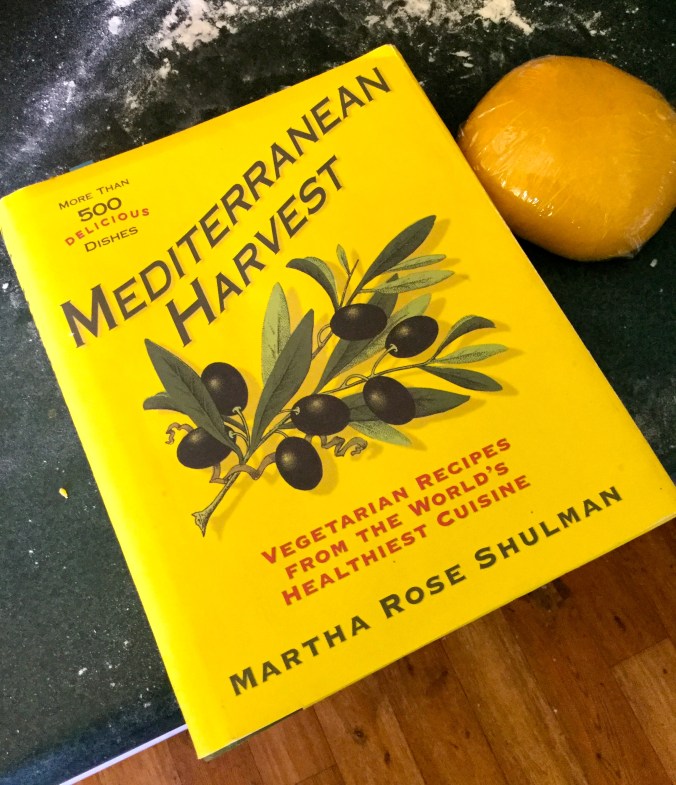
It’s Tuesday. I need to use up the two pounds of asparagus I bought at the market on Saturday. My plan to pickle it has been foiled by my inability to find dill seed in the Hutt Valley. (This year, I’ll remember to hang on to the end-of-summer dill flowers.) So, I just whipped up a batch of fresh pasta to make Asparagus Pasta with Herbed Béchamel, a recipe from one of my all-time favourite cookbook authors, Martha Rose Schulman. Under the circumstances, it seems appropriate that today’s cookbook recommendation is her Mediterranean Harvest: Vegetarian Recipes from the World’s Healthiest Cuisine (Rodale, 2007).

While I consider myself a culinary adventurer when it comes to trying new cuisines, I must confess that my heart lies in Italy. For me, food is merely a delivery system for olive oil and garlic. One of the very first cookbooks I ever bought was a Gilroy Garlic Festival cookbook. Schulman’s recipe for garlic broth — which, I promise, tastes almost exactly like chicken stock — is worth the price of the book all on its own. It’s my failsafe for when I need vegetable stock and the freezer is bare. It’s also a good way to use up slightly past its prime garlic. You know, the ones with the green shoots about an inch long. As my Dad used to quip, no one needs to worry about vampires at my house.

Come to think of it, though, I’m also quite fond of vampires. REAL vampires — Dracula, Lestat, Barnabus Collins, and Spike — not today’s domesticated, broody teenage angst vampires. Which reminds me, you must immediately get on Netflix and add What We Do in the Shadows to your watch list. It is the perfect marriage of old-world Vampires and new world New Zealand. Nosferatu meets The Flight of the Conchords. It will make you want to move here, just for the vampires. And the werewolves. And there really was a bar called The Big Kumara, but it’s closed now. Sorry.

What_We_Do_in_the_Shadows_poster

Now, where was I?

Mediterranean cuisine is among the most vegetarian-friendly in the world, given its emphasis on fresh ingredients and simple preparations. Mediterranean Harvest is by no means limited to the food of Italy. It includes recipes from around the greater Mediterranean region: Algeria, Bosnia, Bulgaria, Croatia, Egypt, France, Greece, Iran, Italy, Lebanon, Morocco, Spain, Syria, Tunisia, and Turkey. The book is organised topically — Breads, Little Foods, Pasta, Sweets, etc. — rather than geographically, but there is a list of recipes by country in the back. The lion’s share of the recipes here are French, Greek, Italian, Spanish, and Turkish, but it does include some important outliers. Schulman includes a (slightly) slimmed-down version of one of my favourites, Persian Rice, that uses four tablespoons instead of the usual quarter pound. In my opinion, it needs fresh fava beans or baby limas mixed in, but you can do what you like.

My favourite chapter is “Little Foods: Starters, Snacks, Mezze, and More.” Here’s where you will find all those delicious little tapas and other tidbits that are such fun: filo pastries, dips, spreads, and marinated things. A few of these, a cold bottle of prosecco, and some lovely fresh strawberries and you have a party. Okay, maybe a few bottles of prosecco. I’ve been over hummus since 1993 when I traveled to Palestine and ate hummus every breakfast, lunch, and dinner for nearly three weeks. You’ll find traditional hummus here (if you really must), but also some nice alternatives: White Bean Brandade (a vegetarian version of the classic French white bean and salt cod puree), Turkish Hummus (spicier, with no tahini), and Fresh Fava Bean Puree. There is also a useful section of suggested toppings for bruschetta and crostini.

Do you love risotto but never make it for company because you don’t want to be stuck in the kitchen stirring over a hot stove during cocktails while your guests are snarfing up all antipasti? Schulman will tell you how to cook it part of the way in advance, reducing the final prep to 15 minutes. And her easy polenta will save you the ordeal of stirring polenta (in one direction only) for 30 minutes and blistering your thumb. Perhaps a purist could tell the difference, but I sure can’t. Except that I don’t have a painful blister on my thumb.

While I’m on the topic of polenta, a word about grits. If you adore grits as much as I do, and live outside the Southern US, polenta can be your saviour. You can do pretty much anything with polenta that you can do with grits. It’s not going to be the same as real, stone ground grits; but it will be way better than <gasp> instant grits. On Masterchef Australia last year, the eventual winner — Brent Owens — made grits out of popcorn. I’ve been meaning to try that. I’ll let you know how it turns out. Sadly, if hominy exists in New Zealand, I haven’t found it.

Martha Rose Schulman is also a food columnist for The New York Times. Her focus has long been on healthy eating, and her column, like Mediterranean Harvest, is replete with meatless, lower fat versions of classic international dishes. But don’t mistake healthy for worthy and boring. I have her recipe box bookmarked in the Times Cooking app on my iPad. (If you don’t have the Times Cooking app yet, download it immediately. Even if you aren’t a vegetarian.)

Every vegetarian cookbook collection should have at least one good Mediterranean cookbook, mine has several, including others by Schulman. Her newest, The Simple Art of Vegetarian Cooking (Rodale, 2014), is prettier — with loads of lovely colour photographs.  But in terms of culinary breadth and basic kitchen knowledge, Mediterranean Harvest is a must have.

And Remember: eat garlic every day to keep the vampires away.

43ff0db565cccd3145dbc91e9a2d3464

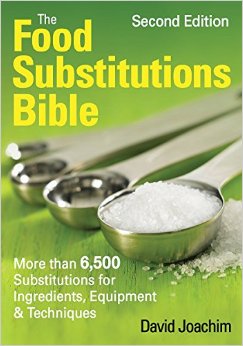
The Third Cookbook of Christmas: The Food Substitutions Bible

Food Substitutions

So, you just harvested your rhubarb and you are making The Smitten Kitchen’s delicious rhubarb snacking cake (Smitten Kitchen Rhubarb Snacking Cake), and you discover that you don’t have any ground ginger. What do you do? Cry? Immediately jump in the car and drive to the supermarket for a can of ground ginger that you might never use again? Leave it out and hope for the best? Any or all of these could work, but what I recommend is that you pull down your copy of David Joachim’s The Food Substitutions Bible, turn to page 236, and discover that you can substitute ground ginger with: minced crystallised ginger (rinsed to remove the sugar), minced or grated fresh ginger, or ginger juice. You will also find that, failing those options, you can very the flavour slightly with pumpkin pie spice, ground allspice, or ground cardamom. I’ve tried the cardamom, which works nicely, as well as the fresh and crystallised ginger options. And don’t forget to double the crumb topping.

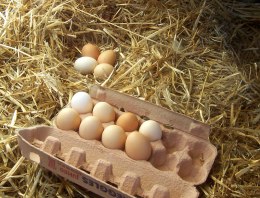
The Kale Whisperer’s Third Cookbook of Christmas is not a cookbook at all, but it is absolutely indispensable. Really. If you have a kitchen, and you do anything more in it than boiling eggs, buy this book immediately, if not sooner. Speaking of eggs, turn to “Egg, Whole” in this handy guide, and you will find that 1 large egg = 3 tablespoon (45ml) of egg yolk and whites = 1 3/4 ounces (52g). This is important information to have on hand if you 1) live outside the US and have no idea if 1 large egg = 1 standard size 6 or size 7 New Zealand egg, 2) you live in the US but only have jumbo or medium eggs in your fridge, or 3) you use your or someone else’s free range barnyard eggs and your hens are creative souls who lay whatever size egg they feel like laying.

Freerange_eggs

Does your typical carton of barnyard eggs look like this? Here’s the solution!

While any kitchen, vegetarian or not, could benefit from the wealth of information easily available in The Food Substitutions Bible, it is a godsend for any vegetarian or vegan cook. Vegans, for example, will find that they can substitute 1 cup (250ml) of whole 3.5% milk with a similar amount of soy, rice, almond, or oat milk. It will also remind them that they may need to compensate for added sugar. It also suggests vegan substitutes for eggs, butter, and honey. With this book on hand, it is a relatively simple matter to convert non-vegan recipes to vegan.

I live in New Zealand, but most of my cookbooks were Born in the USA. Not infrequently, I discover that key ingredients for some of my favourite recipes are simply not available here. Take cake flour. Cake flour is not a thing in New Zealand. But I have learned the hard way that substituting cake flour 1:1 with all purpose flour in a recipe that calls for cake flour can be a recipe for disaster. What to do? Look up cake flour and you’ll find that you can substitute 1 cup of cake flour with 1 cup (250ml or 142g) minus 3 tablespoons (45ml) all-purpose flour plus 3 tablespoons (45g) corn or potato starch (corn or potato flour, as they are known here in NZ). You’ll need to sift the flour and starch several times before you do your final measurement, and your cake might not have as fine a crumb, but it’s a pretty darn good substitute.

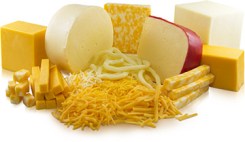
making-cheeseAnd what if you are making a potato and tomato gratin, and your recipe calls for a topping made with 1 cup (4 oz; 120g) of grated Gruyere cheese, but you don’t want to lay out the cash for an expensive chunk of Gruyere for a weeknight dinner? Look up Gruyere, and you’ll find that you can substitute Comte, Beaufort, or Emmental. OK, still pricey. But you know that Emmental is a Swiss-type cheese, so turn there and you find that, yes, indeed, you can substitute Jarlsburg (usually cheaper than Emmental) or Swiss cheese. I find the cheese substitutions particularly useful here in New Zealand. It can be difficult, and expensive, to buy the more obscure regional cheeses. And even if you can find Riccotta Salata, you might not want to shell out for it for an everyday meal.
If all this doesn’t convince you to run immediately to Amazon.com or Fishpond.co.nz to order (NZD$39.49 on fishpond; sadly, it is not yet available on Kindle — go to Amazon and complain!) a copy of The Food Substitutions Bible, let me close the deal. You want to make an apple pie. You go to the market and are faced with umpteen different varieties. Which one makes the best pie apple? What variety makes the best applesauce to go with your Hanukkah latkes? Grab your copy of FSB, turn to the back, and you’ll find a comprehensive guide to “Picking Apples.”

Do you have Celiac Disease? Can’t eat gluten? You will find here an exhaustive table of alternative flours that tells you 1) their best uses (yeast breads? quick breads?), 2) their gluten content (medium, low, gluten-free) and 3) their flavour.

Do you live in New Zealand and want to make pickles? Turn to “Trading Salts” and you’ll find that you can substitute Kosher Salt (not widely available here) with coarse or flaked sea salt. Thank goodness, your pickles won’t get cloudy and soggy from using iodised table salt!

For expats and those who don’t keep every possible size and shape of pan in their kitchen, or those who find a recipe that calls for a 28oz can of tomato puree and live where tomato puree comes only in metric cans, there are numerous useful tables: Can and Package Size Equivalents, Pan Size Equivalents (will a Bundt cake recipe fit in my Tube pan? yes), Temperature Equivalents (what is an “extremely hot oven” for pizza in metric? 260C), and Volume Equivalents (what the heck is a metric “pinch”, or a non-metric “pinch” for that matter? less than 1/8 teaspoon, or .5ml).

Downsize your spice rack. Go ahead and buy those organic free-range medium eggs when they are on sale. Don’t buy a quart of whole milk when you only need 1 cup. Don’t pay the outrageous supermarket price for creme fraiche. Buy this book instead.

improvise_adapt_overcome_bbq_apron

The Second Cookbook of Christmas: The Tao of Cooking

IMG_0267In August 1981, my then soon-to-be first husband and I loaded up a U-Haul trailer and moved from Athens, Georgia to Bloomington, Indiana. Our first apartment was a grim little efficiency all done up in 1970’s olive green and gold. The galley kitchen was in the living room, which had a giant grease stain in the middle of the carpet. It had only two positives: it was a short walk to the Indiana University campus, where I was working on a Master’s Degree in History, and it was just a couple of blocks away from the Tao Restaurant and Rudi’s Bakery.

The Tao, which was run by the members of a yoga ashram, got its start in the early 1970s as a worthy, hippie-vegetarian cafe — all brown rice, soy burgers, and sprouted things. By the time I arrived, it had grown up into a quite classy and refined (and not cheap) vegetarian restaurant. We were starving graduate students, but were also both budding foodies (although I hate the term, which technically hadn’t been invented yet). We scrimped and saved so we could splurge, once a month or so, on a nice meal at the Tao.

Rudi’s Bakery was more accessible, and there was no better comfort for a rotten day — I had a lot of those in Bloomington — than a slice of Rudi’s poppy seed cake with cream cheese frosting. I don’t have very many happy memories of those years, but the Tao and Rudi’s are among the happiest.

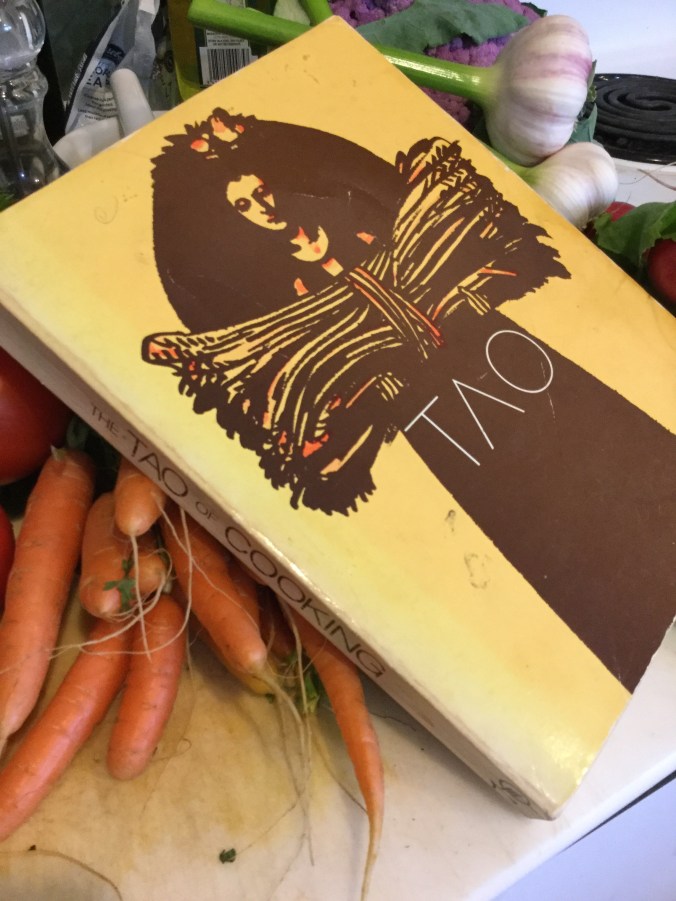
My first husband grew up in a restaurant family and was the one who really introduced me to the joy of cooking and eating well. We spent many happy hours in the kitchen together. Every weekend we undertook a new culinary adventure. I was not loving graduate school, and decided not to pursue a Ph.D. and left after my MA. I spent our final year in Bloomington, while my partner finished his degree, working at a soul-destroying job at the University Archives and taking cooking classes. The instructor for my first cooking class was Sally Pasley, the author of The Tao of Cooking (Indiana University Press, 1998), the Kale Whisperer’s Second Cookbook of Christmas.

Sally Pasley was one of a group of ashram members who had been mentored by a classically-trained French chef at the ashram’s original restaurant, Rudi’s Big Indian Restaurant, in upstate New York. She moved to the Bloomington restaurant in 1977, bringing a more classical vibe to the hippie eatery. Much to my delight, she also taught cookery classes. Under her steady guidance, I learned to make pastry and started my first foray into vegetarianism.

My copy of The Tao of Cooking is the original paperback, published in 1982 by Ten Speed Press, for which I paid $7.95 at Rudi’s (the current publishers price is $24.00 — cheaper at Amazon).  It has followed me from Indiana to Ohio, California, Georgia, Virginia and, finally, to the Southern Hemisphere.  IMG_0265It is splattered, dog-eared, and its spine is shot — as a well-loved cookbook should be. It was my first vegetarian cookbook and it is still on the top shelf of my cookbookcase. When I need a quick vegetable side, or a snappy salad, here’s where I go.

The Tao of Cooking represents its time. In the early 1980s, vegetarian cooking was making its transition from counter-culture to mainstream. You can find Hippie here: the Big Veg soy bean burger and Hobbit Pie (a personal favourite). But most of the recipes are refined, meat-free versions of European and Asian classics. Refined, but accessible, even to a beginning cook — as I was when I first bought my copy. The most exotic ingredient you’re likely to find is agar-agar (a vegetarian substitute for gelatine). Even for the Asian recipes, you are likely to find everything you need at a well-stocked supermarket. It doesn’t require any high-tech gadgets — the food processor was cutting edge, in those days.

My favourite recipes? My copy opens automatically to the Spaghetti with Eggplant, long a favourite, until I married my beloved but eggplant averse husband. The Pasta e Fagiole is classic and easy. I already mentioned the Hobbit Pie, whose mushroom and cheese filling I use in my Kiwi Pies (not made with actual kiwis). And because. . . you know. . .Wellington? Middle Earth? Hobbits?

IMG_0069

My not-yet-world-famous Kiwi Pies not made with actual kiwis

The fussiest recipe I’ve found is the Lasagne Verdi, which requires two sauces and homemade pasta. But it is well worth the effort. So is the Country Pate with Cold Tomato Sauce.The side dishes and salads are simple and tasty. The Tao Dressing is a must-try. You’ll never look at Ranch Dressing again.

The best thing about The Tao of Cooking? It includes, amongst many delicious cake and pastry recipes I learned to make in Sally’s pastry class, the recipe for Rudi’s Poppy Seed Cake. So whenever I need to, I can bake my own little slice of midwestern comfort, even here in far away New Zealand. And on a really bad day, there’s the Poppy Seed Cake Hot Fudge Sundae. That will brighten up the stormiest of Wellington days.

7784108

The First Cookbook of Christmas

My first essential cookbook suggestion is really a category. Every vegetarian kitchen needs one, basic, all purpose cookbook. The kind of cookbook whose first sentence reads: Stand facing the stove. This is the cookbook you will go to when (like me) you can’t remember how long it takes to hard boil and egg. I hate hardboiled eggs. I don’t eat hardboiled eggs. And I don’t want to take up vital brain space remembering how long to cook hard boiled eggs.

This is also the cookbook you will go to if you live in New Zealand, which is metric, and most of your cookbooks are from the US and, consequentially, not metric.

This is also where you will go if you come home from the farmer’s market with a huge bunch of Cavolo Nero, and you don’t know what it is or how to cook it. Actually, if that happens, you will come to the Kale Whisperer. But you know what I mean.

When I was learning to cook, that cookbook was The Joy of Cooking by Irma S. Rombauer and Marion Rombauer Becker. I read it cover to cover. Several  times. It was my mother’s default wedding gift. Every new bride needed a copy of Joy. When I got married, in 1981, I got at least five copies. In my mind, it remains the essential all-purpose cookbook. If you aren’t a rigid vegetarian, and you might want to know how to poach a salmon, you’ll want this as your basic cookbook. Be sure to get the 75th anniversary edition, not the controversial 1997 “All New” version. It lacks the vital “Know Your Ingredients” section and some of the more “quaint” sections, like canning, pickling, and preserving. If you can find a used copy of the original, preferably with someone’s notes scribbled in it, all the better.Old-and-New-Joy

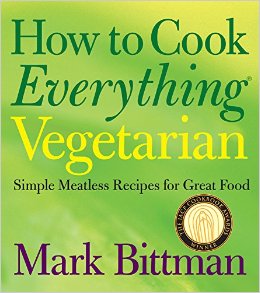
A newer, cooler, more vegetarian-focussed option is Mark Bittman’s How to Cook Everything Vegetarian (Wiley, 2007). Bittman is a food journalist and a leading advocate of sustainable cooking. How to Cook Everything Vegetarian includes two excellent introductory chapters on equipment and techniques, numerous instructive sidebars offering variations, lists, and charts by ingredient. It uses an icon system, so you can quickly identify Fast, Make-Ahead, and Vegan recipes, and includes a table of “Recipes by Icon.” There are a few menus, and an extensive and useful index, so it is easy to find what you are looking for. Even if you are not vegetarian, you can’t go wrong with this one; although, if you prefer a more all-purpose cookbook, his How to Cook Everything is also excellent. Obviously, however, you will lose some of the specialised vegetarian cooking content.

51Bx7KIzyjL._SX258_BO1,204,203,200_

My third recommended option is Deborah Madison’s The New Vegetarian Cooking for Everyone (Ten Speed Press, 2014). This one is weaker than Joy and How to Cook Everythinon technique, but its excellent first chapter, “Becoming a Cook,” includes valuable advice on Composing a Vegetarian Menu, Menus for Holidays and Special Occasions, and Wine with Vegetables. Chapter Two: Foundations of Flavor is also excellent and includes sections on various types of ingredients — herbs, chills, cheese, dairy and dairy substitutes, to name just a few. The thing I like best about Madison’s cookbook is that she includes flavour matches for individual vegetables and fruits. This is where you turn if you want to know what goes with Brussels Sprouts — butter, olive oil, mustard oil, cream, béchamel, blue cheese, cheddar, mustard, capers, lemon, vinegar, caraway, oregano, parsley, dill, curry spices, and juniper.

51YDEuBwJBL._SX258_BO1,204,203,200_

Depending on where you live, you may have other, preferred all-purpose cookbooks.  If so, please tell us about it! For my mother’s generation, the classics  were the Good Housekeeping or Fanny Farmer Cookbooks. In France, it would be the classic Larousse Gastronomique (1938). Times change, and different cultures have different basics. The important thing is to have one. It will be your touchstone and security blanket. Years from now, it will be splattered, scribbled on, and held together with duct tape and rubber bands. It will be the outward and visible sign of your cooking journey.

too many cookbooks

The Twelve Cookbooks of Christmas

I am powerless over cookbooks.

When, in 2013, Simon and I faced the challenge of reducing all our worldly goods to a volume that would fit in a 20-foot shipping container, the hardest chore for me was triaging my massive cookbook collection. The kitchen gadgets were easy: anything with a plug wouldn’t work in New Zealand. So, out went the waffle iron I never used (meh), the raclette grill (fun, but not essential), the Cuisinart (sniff), and the Kitchen Aide Mixer (gasp).

The cookbooks were hard. Which of my children would I re-home? Which would make the long journey to the Southern Hemisphere? Could I part with my copies of Julia Child’s Mastering the Art of French Cooking: Volumes One and Two even though they are decidedly not vegetarian friendly? (No) Could I leave behind my complete set of Cook’s Illustrated Best Recipes series? (yes) How could I cull the flock without leaving something essential behind? (I couldn’t) My amazing cousin, Barb, who had come to Virginia with her equally amazing sister, Linda, to flog me out of moving-denial, made the job much easier. She took most of the cast-offs to sell in her antique shop, which specialises in kitchen things and cookbooks (even though she doesn’t cook; all the better to avoid attachments). At least I knew the orphans would find loving homes.

I passed some of the favourites to friends. Susan got most of the non-vegetarian  and entertaining books, including my copy of Please to the Table: The Russian Cookbook. Anita, our loyal dog auntie, took a few. In the end, I probably left for New Zealand with 10% of my original cookbook library.

Regrets? I have a few. Somehow, my beaten-up old copy of the original The Joy of Cooking was left behind in favour of my copy of the vastly inferior The All New Joy of Cooking. Because I culled my  copy of The Italian Country Table by Lynne Rosetto Kasper, I’ve lost her astonishingly delicious, best cookie ever recipe for pine nut shortbread. I meant to bring the ancient copies of The Betty Crocker Cookbook and The Good Housekeeping Cookbook that I inherited from my mother. I never cooked from them, but they were precious mementos. I’m still hoping I’ll dig to the bottom of one of the few unpacked boxes that remain, and find that they wandered in amongst the CDs and DVDs. I was also sad to lose the copy of Marcella Hazan’s The Classic Italian Cookbook that Shakespeare (my dog, not the Bard) chewed the cover off when he was a wee puppy (which almost found him being re-homed). I suspect someone decided it was trash. It was pretty sad looking.

For the most part, however, I started my culinary life in New Zealand with a lean and mean set of vegetarian cooking essentials. I have also learned the beauty of downloadable cookbooks which, while they lack the tactile magic of actual printed books, enable me to continue my cookbook addiction without having to purchase numerous additional book cases.

Over the course of my vegetarian life, various people have asked me to recommend the best vegetarian cookbooks. So, seeing as Christmas is coming, it seems like an ideal time to present my list of the twelve most essential cookbooks for vegetarians. If you, or someone you love, is launching off on the vegetarian path, perhaps you will find an appropriate gift idea here. If you are building your own cookbook library, maybe you’ll find a gift for yourself. You can do that, you know!

We are two weeks away from Christmas. Twelve cookbooks. Fourteen days. Here goes. . . . !

IMG_0260