On 2 August 2013, at the age of 55, I entered New Zealand as a new migrant.
Five years earlier, I met the love of my life on a train crossing the Nullabor Plain – 2,300 miles of mostly nothing in the Australian outback. The trip was an homage to my train-buff Dad, who had died of Alzheimer’s a few months earlier. Before I left the States, my mother, fretting as she always did before one of my many work-related trips, said she just knew I was going to meet someone and move to the other side of the world. “Mom,” I replied, “You’re worrying about nothing. No one really travels halfway around the world to meet the love of their life on a train. That only happens in movies.” Famous last words.
Simon was living in Invercargill, on New Zealand’s South Island. Leave it to me to find a soul mate who lived as far away from my home and job as geographically possible. After a brief courtship consisting largely of sleepy, 5am trans global phone conversations, we navigated the treacherous frozen terrain of ICE (Immigration and Customs Enforcement), secured a fiancé visa for Simon, and married on Waimanolo Beach, Hawaii in July 2009 – almost exactly a year after we met. Shortly before the wedding, my mother passed away leaving me – an only child – a rootless orphan.
Simon is an ethical vegetarian. He hasn’t eaten meat or worn leather for most of his adult life. I’m a slacker vegetarian. I like the idea of living “cruelty-free,” but over the years I’ve lost the plot, done in by convenience (it is easier to grab a burger and fries at MacDonald’s than to cook vegetarian meals in an electric kettle in the graduate student dorm), travel (how can I say no to a platter of fried fish heads or roast goat offered in a spirit of hospitality by Palestinians or Africans who barely have enough to eat themselves), genetics (I’m part German and part Italian: sausage is in my blood!), and, of course, the universal bane of vegetarians everywhere – BACON.

Wee Charlie, one of our kune kune pigs.
[Now that I am the proud mother of three kune kune pigs, I wouldn’t even think about eating bacon. Really, Wee Charlie, I promise!] Since my first husband and I decided to go veg after reading Frances Moore Lappé’s Diet for a Small Planet, in 1982, I reckon I’ve lived about half of the time as an herbivore.
While I have not always been a vegetarian eater, I have – for the most part (excluding the odd bit of bacon thrown into a nice mess o’ greens) – been a vegetarian cook. Again, I can’t claim the moral high ground. I just prefer to cook vegetables. Raw chicken gives me the creeps. While I do occasionally eat seafood, the only thing I know to do with a raw fish is Monty Python’s fish-slapping dance. My bestie, Susan, taught me to cook live lobsters; but if I cook them, I can’t eat them. And I usually cry. I grew up in terror of dying horribly, consumed by worms, as a result of undercooked pork. I haven’t even thought about eating beef since I saw those slaughterhouse videos – you know the ones. Offal? We won’t even go there. [Although I accidentally ate sweetbreads once, at a three star restaurant in France, when my French companion translated ris de veau, misleadingly vaguely, as a special cut of meat. I resolved, on the spot, to learn French.]
Over the years since I bought my first vegetarian cookbook (Mollie Katzen’s The Moosewood Cookbook), I’ve developed into a competent and, I think, creative vegetarian cook. I’ve taken cooking courses to master the basics, and spend almost as much time reading cookbooks as I do reading detective novels. Liberated from the tyranny of recipes, I can go to the farmers’ market, buy what looks fresh and beautiful, and turn it into something good to eat. I embrace the challenge of creating meat-free versions of classic comfort foods and pub grub. And PIZZA.

All our worldly goods packed into a shipping container in Annandale, Virginia to make the long voyage to New Zealand.
By the time Simon and I married, I had become disillusioned with my career as a Washington, DC-area policy analyst. In the midst of what had become increasingly common collapses in my professional morale, I would joke (usually after my second or third glass of wine) that, perhaps, I should just quit my job and write a pizza blog. Instead, I decided to move to New Zealand to try my hand at education. In the ensuing, not always pretty and, ultimately, disastrous process of discovering that tertiary education is definitely not my calling I discovered that food is.
So, in the space of two years, I’ve come from being a defense analyst with a six-figure salary, to being an academic with a five-figure salary, to end as an amateur vegetarian cook and part-time food blogger with a zero-figure salary. I live on the top of a hill with Simon, three dogs, three pigs, six alpacas, and uncounted Tuis, geckos, hedgehogs, and the occasional morepork.
I’ve never been happier.

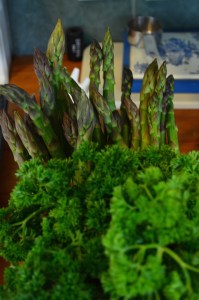 if somewhat bent (it’s very windy here in the springtime) Levin asparagus lasts at least two months, sometimes longer. Ditto: strawberries. So, it is possible to be a confirmed locavore and ethically serve asparagus and strawberries for Christmas dinner.
 The Kale Whisperer