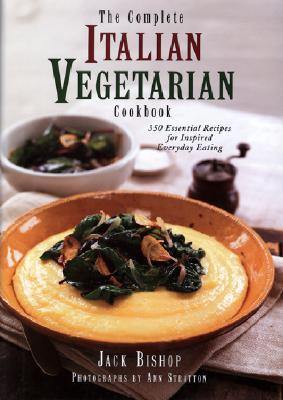
The Eleventh Cookbook of Christmas: The Complete Italian Vegetarian Cookbook

Jack Bishop

I am a simple soul. I wear jeans and t-shirts. I prefer Chucks to heels. I don’t wear make-up.  And my favourite ice cream flavour is vanilla. Less is more. When watching Masterchef, I am frustrated when the judges and contestants yammer on about “technique” and “plating.” And what is the point of foam? My cooking mantra is “Let the food be the food.” DSC01787My favourite foods are simple: mashed potatoes with butter, salt, and pepper; tomato sandwiches with tarragon mayonnaise; pasta with sautéed vegetables and a little parmesan; pizza margarita with sweet tomatoes, basil from the garden, and milky, fresh mozzarella cheese. I am also a great believer in cooking what’s in season. There is nothing more delicious than a perfectly sun-ripened tomato; and there are few things less appealing than a pale, flavourless winter hot-house tomato — no amount of technique will make it taste good.  I defy anyone to come up with anything more exquisite than an ear of sweet corn straight off the stalk with a bit of butter, salt, and pepper.

I prefer food that is only one degree of separation from the soil.  I’ve dined at three-Michelin-starred restaurants, but too often the experience left me cold.  DSC01792I appreciate the art and science behind modernist cuisine, but I cannot warm to a dining experience that puts so much technology between me and the food. I’m suspicious of “fusion” cooking that confuses me with too many moving parts. Dining in the dark? Spare me. If a recipe has forty steps, I reckon that is about 35 steps too many. I don’t have a single squeeze bottle in my kitchen, unless you count the ones Simon’s HP Sauce comes in.  As my adorable partner put it, I have no time for precious food.

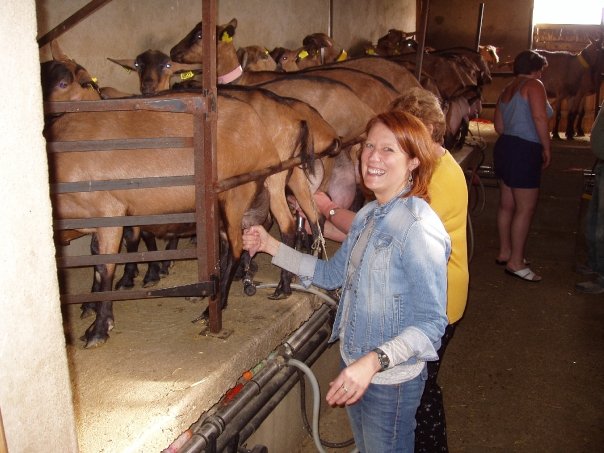
A few years ago, I  spent a month in Sancerre, a picture book medieval walled city in the Loire valley. 1929893_15495843409_3121_nI was immersing myself in French at the Coeur de France Ecole des Langues.  Every morning, I walked into town and bought my food for the day.   A croissant or petit pan au chocolate for petit dejeuner. A baguette at the boulangerie, a handful of haricot verts and champignons at the greengrocer, a wedge of cheese here, a bottle of wine there. We went on a field trip to a chèvre farm where I milked my first goat.1929893_15495833409_2522_n  Most days, I lunched at the Cafe des artes, where the friendly staff would patiently suffer my feeble French (I’m sure I saw their ears bleed). Once, I had a long and spirited argument with the veg vender from the market about George W. Bush. He loved him. I didn’t. 1929893_15495858409_4008_nI rarely ate dinner out. My evenings were given over to homework and working on my vocabulary by watching badly dubbed episodes of NCIS and CSI. And I cooked, simply, and with whatever looked good at the market on the day. It was spring, so the market was teeming with some of my favourite things: asparagus, tiny artichokes, and haricot verts.
224622_10150235916608410_259745_n

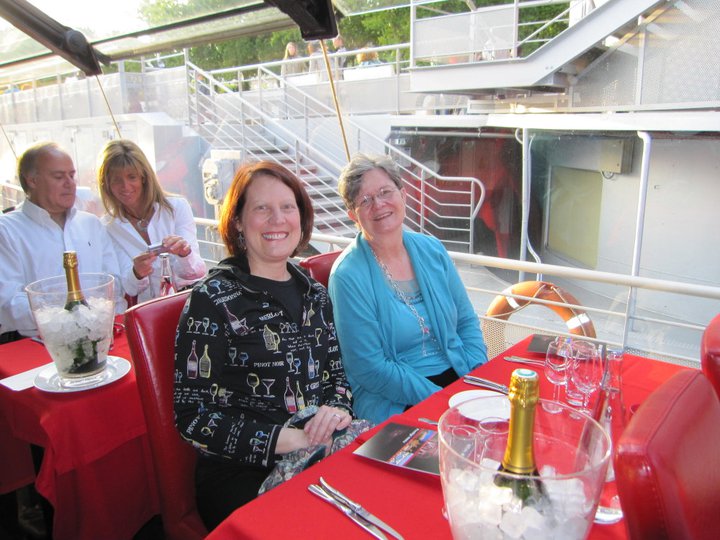
The Bubbles were pretty nice, too!

My neighbour, Anita, and I spent a long weekend in Paris in 2011. I think she would agree that one of the best meals we had there was a simple omelette, salad, and a glass of house red wine at a corner cafe near our hotel. I had a similarly memorable meal in Giverny, just outside Monet’s house. In Lisbon, sardines grill over open wood fires all over the city, and the aroma is tantalising. My favourite meal in Brussels was pommel frites with mayonnaise.

I visited Venice briefly in 2013, and spent much of my time wandering around side streets and exploring the fruit and vegetable markets. I got lost. I got hungry. I stopped for a plate of linguine con vongole and a glass of Orvieto at a cafe at the edge of the vegetable and seafood market. I walked more. I got lost again. I met a lovely man who made carnival masks. I chatted with another artist selling his watercolours outside one of Venice’s ancient churches. I bought two. I walked more.

Got lost more. Ate lemon gelato. Finally, having managed to find my way back to the train station, hot, footsore, and happy, I drank the best mug of beer I’ve ever had. The most expensive, too, but that didn’t matter. It was a golden day.

The Kale Whisperer’s Eleventh Cookbook of Christmas, Jack Bishop’s The Complete Italian Vegetarian Cookbook, honours the beauty of simple food.  This book is full of the kind of simple, fresh food that I love: polenta, pasta, and rice with seasonable vegetables; frittatas, tortas, and pizza; salads and bruschetta. Bishop is an editor at America’s Test Kitchen, and he provides plenty of good, practical advice.  His step-by-step instructions mean the recipes here are manageable by even a beginner. I particularly appreciate the serving suggestions that follow each recipe. None of these recipes require any special equipment. Not a foam canister in sight.

I probably cook from The Complete Italian Vegetarian Cookbook more than any other single book on my cookbook shelf. I especially enjoy it in the summertime, when no one wants to eat hot, heavy food. Packing a picnic for an outdoor concert? This is your cookbook. One of my favourite picnics consists of a vegetable frittata (my favourite is the Zucchini Frittata with Parmesan and mint), the Roasted Potato Salad with Herbs and Red Wine Vinegar, and a loaf of crusty country bread. I am a huge fan of pasta e fagioli, and Bishop’s version, with lots of garlic and rosemary, is among my favourites. I also love the Chickpea Soup with Fennel and Orange Zest. I have borrowed that flavour combination — chickpea, fennel, and orange — as a pizza topping, too.
IMG_0276

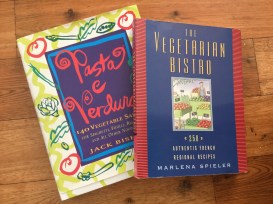
Jack Bishop wrote another excellent cookbook, Pasta e Verdure (Morrow, 1994). Sadly, it is out of print, but there are used copies for sale on Amazon. In it, Bishop presents 250 recipes for simple pasta and vegetables. The books has chapters for 27 different vegetables, so if you come him from the farmers’ market with fresh, spring favas, or all you have for dinner one winter night is some pasta and cauliflower, you can find something delicious to cook. I often use Bishop’s flavour combinations as pizza toppings. If you can put it on pasta, why not pizza? Each chapter opens with advice on how to choose, clean, and store each vegetable. Many of the combinations he presents here have become standards for me: the hot pink sauces (tomato + red pepper flakes + a little cream) is a particular favourite. My mother used to make what we called “crummy spaghetti”, which was simply spaghetti tossed with bread crumbs toasted in a little butter.  Bishop has several scrummy variations on that theme: Spaghetti with Wilted Spinach and Breadcrumbs and Linguine with Asparagus, Toasted Breadcrumbs, Lemon, and Garlic. My biggest deliciousness surprise was the Fusilli with Shredded Brussels Sprouts, Orange, and Almonds. Think you hate Brussels’ Sprouts? You won’t if you try this!

Let me finish by mourning another much-loved but tragically out-of-print cookbook: Marlena Spieler’s The Vegetarian Bistro (Chronicle Books, 1997). Spieler does for simple French cooking what Bishop does for Italian Vegetarian cooking. I haven’t even bothered to flag the “to cook” recipes here, because I can literally open the book to any random page and happily cook whatever I find there, knowing it will be delicious. If you can track down a used copy (they are available on Amazon, too), buy it. Then cook the Lentilles “Dom Perignon” (Lentils cooked in Champagne — don’t worry if you don’t have left over bubbles, it works with any dry white wine). Just lentils, shallots, garlic and white wine.

Simply. Delicious. Food.

229782_10150235876298410_6273561_n

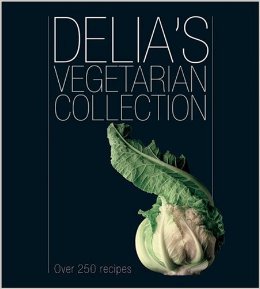
The Tenth Cookbook of Christmas: Delia’s Vegetarian Collection

Delia

It is almost Christmas and I am remembering Christmases past. Christmas with my father was a winter wonderland. When I was very small, we had a very large spruce tree in our front yard. Every Christmas he would string those big, old-fashioned coloured lights on the tree so Santa could find our house from way up high in the sky. CCI22122015Every night, before bed, he would pack me into my red snow snuit and we would stand out in the cold and admire the lighties. Those are some of my earliest memories.

For several years after Dad died of Alzheimer’s disease, I couldn’t bear Christmas. My Mom made it through two more Christmases, and she couldn’t bear them either. The two of us would hunker down in her little apartment at the assisted living facility and watch endless versions of Jane Austen on her VCR. How many times did we watch Colin Firth dive into the pond at Pemberley? Oh, hundreds!Darcy I stopped laying down new Christmas memories when Dad died. For me, Christmas was about family, and our little family had dwindled to one.

Don’t get me wrong. I am blessed with a wonderful extended family on both sides, and I love my cousins like siblings. But, I have written before about the importance of chosen families, and I have such a lovely one that I want to celebrate them. There is Dorothy from Norwich, who was my roommate through a nearly three-week adventure in Palestine in 1993. My soul sister, Joani, in Virginia — check out her excellent blog, http://unorthodoxunhinged.com.  And my besties, Susan in Virginia and Elizabeth in Oxford. We three musketeers have shared so many adventures. Now we are joined by my beautiful fairy goddaughter, Alex.

I’ve traveled all over the world with my Elder Sis, Katy, and I’ve drowned many a sorrow with our bro, Tony.

12138422_10153735349873410_4048053769020431464_o

With Katy and Tony, after drowning a sorrow or two

And I cannot leave out my sourdough starter’s foster parents, Mary and Wade. In Athens, there are Carolyn and Kline, and Nash and France who all supported my parents, and then me, in their final years. Nash and France adopted my Dad’s beloved cockapoo, Maxwell, and gave him the loving retirement he so richly deserved. Nash still keeps me posted on the goings on at my old high school. Pete and Anita, our dogs’ uncle and auntie, are soon moving from Virginia to Minnesota — near my family in Northern Wisconsin.

My Southern Hemisphere chosen family is growing and multiplying, too. Thanks to Julian and Anna in Sydney, I have a new “niece,” Ayla. Peter is the crusty old uncle I never had. I did have an amazing Uncle, Billy, but he was too funny and loveable to qualify as crusty. Carl is the pesky little brother I never had. Chris has long been Simon’s chosen family in New Zealand, and now he’s part of mine.

I discovered the Kale Whisperer’s Tenth Cookbook of Christmas, Delia’s Vegetarian Collection (BBC Books, 2002) while visiting another branch of my chosen family in Sydney, the lovely Lise, her husband Cahn, and my “nephew” Jacob and his brand new baby sister, Eliana.

IMG_1080

Pizza by Jacob, I’m pretty sure those are slices of beetroot, not pepperonis!

Having essentially invited myself to visit en route to the United States earlier this year, I would not have been surprised (or disappointed) to dine on take away food. But Lise, despite juggling an active (and, as it happens, sick) three year old and an adorable six-month old, spoiled me with delicious and beautifully prepared vegetarian fare from Delia’s Vegetarian Collection. Even before I left Sydney, I ordered myself a copy from fishpond.com. It has already become a favourite in my kitchen, too.

There haven’t been any celebrity chefs or cookbooks with lots of gorgeous, full colour illustrations among the The Kale Whisperer’s Twelve Cookbooks of Christmas.  It’s not that I have anything against celebrity chefs or beautiful photographs of food. It’s just that I find those sorts of cookbooks, for the most part, disappointing. It’s as though they are written for people who don’t cook and don’t really intend to start, but who want to have some attractive cookery books as accent pieces in their designer kitchens. And I’ve had some real disasters. Take the celebrity chef cookbook I bought most recently, which shall remain nameless. So far, not a single recipes I’ve tried has worked as advertised. I ended up serving my beloved a zucchini pie with raw rice. Do these people even cook the food they put into their cookbooks? A word of advice: if the directions don’t make sense to you (trust me, the liquid from the zucchini will cook the raw rice), they probably don’t make sense. I’ve had good experiences with the few Jamie Oliver recipes I’ve downloaded, but I haven’t bought his books either because, frankly, I find him a bit preachy and annoying.

But Delia is different. How can you not trust and respect a woman who is willing to make a public spectacle of herself in support of her beloved Norwich Canaries?

Would I make a spectacle of myself in support of my beloved All Blacks? You betcha. In fact, to hear Katy tell it, I did that already while watching the 2012 Rugby World Cup Final with a group of Aussies in Bali.

296352_10150439680413410_1705544069_n

Offering up a word of thanks in Ubud, Bali

Which brings me to a digression. I had a long argument with myself (I do that — it’s an introvert thing) about whether or not to include Julia Child’s original Mastering the Art of French Cooking (Knopf, 1961). I really think every cook should read it, often, but I don’t actually cook from it very much. Julia is pretty meat-centric. That said, I just got out my copy — which was previously my mother’s copy — and it fell right open to the recipe for Soufflé au Fromage. My Mom made heavenly soufflés. I don’t. But seeing as the book is out, and I accidentally bought 32 eggs at the farmer’s market last week, I think I’ll give it another shot, with Julia on my shoulder.IMG_0275

But back to Delia. This is a gorgeous book. If you are looking for a gift for your favourite vegetarian, and want to split the difference between useful and pretty, this is your book. The illustrations are stunning. There are a few I’d like to tear out of the book and hang on the wall. And the recipes work. I have a massive rosemary bush in my herb garden, so I can make the Tuscan Bean and Pasta Soup, all year round. Simon grew up in the UK, and this book has vegetarian versions of his childhood comfort foods, including Shepard’s Pie, Spinach Pasties, and Not-Pork Pies (which will please our Kune Kune pigs). Everything Lise prepared from Delia’s collection was wonderful, and only tasted better for being made with love and eaten in the best of company.

I’m not folding down the corners of this book, but it is full of multicoloured post-it flags. I gave up on the cheese chapter. I’ll just cook, and eat, my way through the whole thing. There are two oven-baked risottos, for those nights when your feet are tired or you have blisters on your thumbs and don’t want to stand at the stove and stir. I rarely cook sweets — neither of us eat them much — but as soon as I send this off, I’m headed out to the garden to see if I have enough rhubarb for the Rhubarb, Almond, and Ginger Crumble.

Wait. I just re-read the recipe for Crumpet Pizzas, with blue cheese, walnuts, olive oil and sage. I’m off to the grocery, now, to buy some crumpets. The rhubarb will have to wait.

IMG_0109


The Fifth Cookbook of Christmas: Bernard Clayton’s New Complete Book of Breads

IMG_0269

Today would have been my Dad’s 93rd birthday. He wasn’t a vegetarian. His favourite foods were: fried eggs (sunny side up), Campbell’s Pork and Beans (Mom spiffed them up with green peppers, mustard, and various other secret bits of magic), and pretty much anything made with ground beef. According to family legend, Mom and Dad went in with friends once to buy a steer. When the butcher called to find out how they wanted their half cut up, Dad told him to just grind the whole beast into hamburger. Fortunately, Mom was able to intervene. Dad was an avid gardener and produced bushels of tomatoes, green peppers (capsicum), tender little yellow crookneck squash, okra, eggplant, raspberries and figs. But, at heart, he was a meat-and-potatoes sort of guy.

Like most meat-and-potatoes guys, Dad also loved bread. Good, hearty, stick to your ribs, Olde Worlde bread: rye, pumpernickel, crusty Kaiser rolls, and the absolutely delicious, chewy hard rolls from the Black Forest Bakery in Athens, Georgia. When our family moved from Virginia to Georgia in 1967, we entered the black hole of bread. European style bread simply didn’t exist. Not even mass-produced rye bread. Certainly not the kind of peasant breads that work your jaws and have the fortitude to mop up the remains of a hearty soup. Roman Meal Bread was the closest to whole wheat available. Our choices were pretty much Sunbeam (“It’s batter whipped”) and Wonder Bread. It was at this point that Mom went back to baking bread in a serious fashion.

It wasn’t easy. These were the days before supermarkets sold Bread Flour, and most flour sold in the South was made from soft, summer wheat. Flours like White Lilly are indispensable for making biscuits, cornbread, and cakes, but lack the complex gluten structures that are needed for hearty, crusty European loaves. Eventually, Mom found a commercial source of hard wheat flour, which she bought in twenty pound bags and she was off. Every three weeks or so, I’d come home to a kitchen full of dough and the smell of fresh baked bread. It was heaven. Some would go in the freezer, but Dad and I usually devoured at least one loaf on the spot.

Mom was famous for her breads. At the Annual Christmas Auction at St. Gregory the Great Episcopal Church, her “coffee cake of the month” and “bread of the month” offerings raised a pretty penny. When she teamed up with our friends Kline and Carolyn to offer a catered German dinner party, folks pulled out their check books and dug deep.

CCI16122015

One of the legendary St. Gregory’s Auction German dinners, cooked and hosted by Carolyn, Kline, Dad, and Mom, circa late 1980s

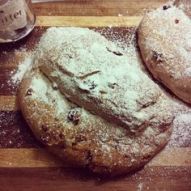
At this time of year, she’d be in full Christmas Stollen baking mode. She was famous for her stollen — the traditional german fruited bread that is baked and sugared to look like the Christ child’s swaddling clothes. This is NOT fruitcake, it is Christmas manna. Mom’s recipe came out of her head — handed down from her mother and aunt. In mid-December, our kitchen became an assembly line, with sweet, fruity loaves at various stages of development. While I’m no longer big into Christmas, I still honour this one family tradition and bake a batch or two around Christmas time from Bernard Clayton’s recipe. stollenIt tastes like my childhood and makes me happy, a little bit sad, and very grateful. And when it is a little stale, its makes the best toast ever.

I reckon today is an appropriate day to add Bernard Clayton’s New Complete Book of Breads to the Kale Whisperer’s Twelve Cookbooks of Christmas. My well-worn copy is the 1987 edition. There have been subsequent revisions, the most recent in 2006, that incorporate newer technology, like bread machines. But the basic spirit that makes this cookbook an all time great remains.

Bernard Clayton gave up a high-powered journalistic career in New York and Chicago after a mystical bread experience during a bike trip around Europe in the mid-1960s. He moved to Bloomington, Indiana, worked for Indiana University, and pursued his fascination with bread. His wonder at the art and science of bread making shines through this book. He prefaces many of the recipes with an introduction, perhaps describing the bread’s history, how it fits in to the wider world of breads, and how he discovered it. Clayton was not professionally trained — he taught himself to bake — and the un-jaded joy of the gifted amateur is contagious. I defy you to pick up this book and not immediate begin tagging recipes. This is one of those cookbooks you’ll want to sit down and read, cover-to-cover.

In addition to the Christmas Stollen (my copy automatically opens to that page), I love the Dilly Casserole Bread (a 1960s staple), the Sour Dill Rye Bread (which uses pickle brine as the liquid), the Portuguese Sweet Bread, and the German White Bread with Caraway. My New Zealand sourdough starter, which has been going for two years, now, began with his Honey Starter.  Our sourdough starter is like a member of the family. It’s less demanding than the dogs. It only needs is to be fed and cuddled once a week. And it doesn’t have accidents in the house. I had to leave my previous starter in the US when we moved to New Zealand.

IMG_0270

My New Zealand Honey Sourdough Starter, freshly fed and happy

The Ministry of Primary Industries here was unlikely to look kindly upon a glob of dough teeming with microbes, no matter how yummy. It found a happy home with my friends Mary and Wade. They let me visit when I go back to Virginia. Mary gave up baking bread for Lent one year, so I know she is a good mother (and her dogs are way better behaved than mine).


This is the most comprehensive handbook for the home bread baker I’ve ever found. It was written based on thousands of hours of Clayton’s own trial and error in his own home kitchen. I’m reasonably confident that there is nothing that a home baker needs to know about bread making that isn’t in this book. If you try to bake bread, and something goes wrong, Clayton will tell you why. Most of the recipes include separate instructions for mixing the doughs by hand, in a stand mixer, or in a food processor.

My copy does not include bread machine instructions or recipes, which is fine by me. If you want to make bread, make bread. Don’t be afraid of it. Hold the dough, knead it, throw it, slam it — as Clayton advises, “don’t gentle the dough” — watch it rise, punch it down, knead it some more, and feel it come to life under your warm touch. Bread making, unlike some other kinds of baking, is very forgiving. And much cheaper than therapy.

And nothing beats a slice of hot, fresh bread with butter. It tastes like love.


The Fourth Cookbook of Christmas: Mediterranean Harvest

IMG_0268

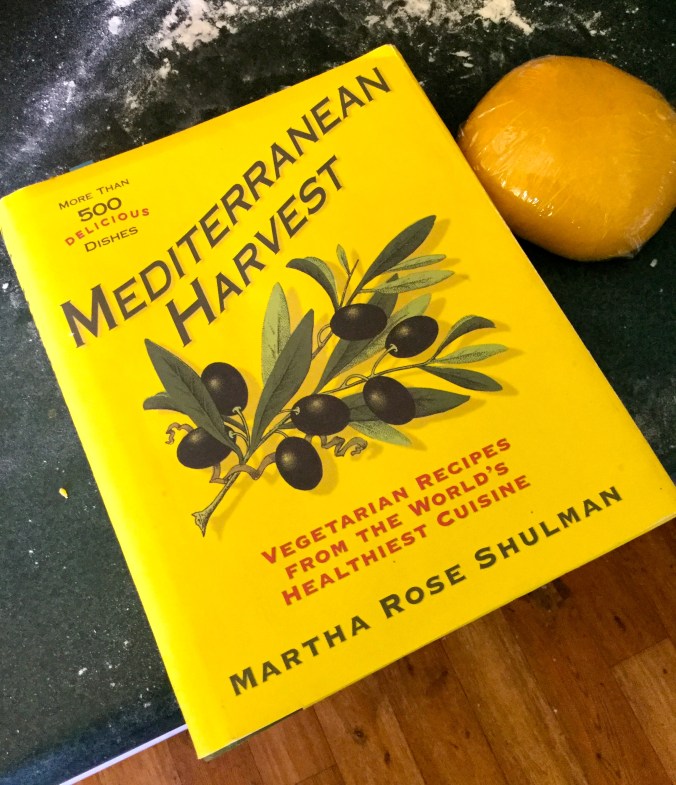
It’s Tuesday. I need to use up the two pounds of asparagus I bought at the market on Saturday. My plan to pickle it has been foiled by my inability to find dill seed in the Hutt Valley. (This year, I’ll remember to hang on to the end-of-summer dill flowers.) So, I just whipped up a batch of fresh pasta to make Asparagus Pasta with Herbed Béchamel, a recipe from one of my all-time favourite cookbook authors, Martha Rose Schulman. Under the circumstances, it seems appropriate that today’s cookbook recommendation is her Mediterranean Harvest: Vegetarian Recipes from the World’s Healthiest Cuisine (Rodale, 2007).

While I consider myself a culinary adventurer when it comes to trying new cuisines, I must confess that my heart lies in Italy. For me, food is merely a delivery system for olive oil and garlic. One of the very first cookbooks I ever bought was a Gilroy Garlic Festival cookbook. Schulman’s recipe for garlic broth — which, I promise, tastes almost exactly like chicken stock — is worth the price of the book all on its own. It’s my failsafe for when I need vegetable stock and the freezer is bare. It’s also a good way to use up slightly past its prime garlic. You know, the ones with the green shoots about an inch long. As my Dad used to quip, no one needs to worry about vampires at my house.

Come to think of it, though, I’m also quite fond of vampires. REAL vampires — Dracula, Lestat, Barnabus Collins, and Spike — not today’s domesticated, broody teenage angst vampires. Which reminds me, you must immediately get on Netflix and add What We Do in the Shadows to your watch list. It is the perfect marriage of old-world Vampires and new world New Zealand. Nosferatu meets The Flight of the Conchords. It will make you want to move here, just for the vampires. And the werewolves. And there really was a bar called The Big Kumara, but it’s closed now. Sorry.

What_We_Do_in_the_Shadows_poster

Now, where was I?

Mediterranean cuisine is among the most vegetarian-friendly in the world, given its emphasis on fresh ingredients and simple preparations. Mediterranean Harvest is by no means limited to the food of Italy. It includes recipes from around the greater Mediterranean region: Algeria, Bosnia, Bulgaria, Croatia, Egypt, France, Greece, Iran, Italy, Lebanon, Morocco, Spain, Syria, Tunisia, and Turkey. The book is organised topically — Breads, Little Foods, Pasta, Sweets, etc. — rather than geographically, but there is a list of recipes by country in the back. The lion’s share of the recipes here are French, Greek, Italian, Spanish, and Turkish, but it does include some important outliers. Schulman includes a (slightly) slimmed-down version of one of my favourites, Persian Rice, that uses four tablespoons instead of the usual quarter pound. In my opinion, it needs fresh fava beans or baby limas mixed in, but you can do what you like.

My favourite chapter is “Little Foods: Starters, Snacks, Mezze, and More.” Here’s where you will find all those delicious little tapas and other tidbits that are such fun: filo pastries, dips, spreads, and marinated things. A few of these, a cold bottle of prosecco, and some lovely fresh strawberries and you have a party. Okay, maybe a few bottles of prosecco. I’ve been over hummus since 1993 when I traveled to Palestine and ate hummus every breakfast, lunch, and dinner for nearly three weeks. You’ll find traditional hummus here (if you really must), but also some nice alternatives: White Bean Brandade (a vegetarian version of the classic French white bean and salt cod puree), Turkish Hummus (spicier, with no tahini), and Fresh Fava Bean Puree. There is also a useful section of suggested toppings for bruschetta and crostini.

Do you love risotto but never make it for company because you don’t want to be stuck in the kitchen stirring over a hot stove during cocktails while your guests are snarfing up all antipasti? Schulman will tell you how to cook it part of the way in advance, reducing the final prep to 15 minutes. And her easy polenta will save you the ordeal of stirring polenta (in one direction only) for 30 minutes and blistering your thumb. Perhaps a purist could tell the difference, but I sure can’t. Except that I don’t have a painful blister on my thumb.

While I’m on the topic of polenta, a word about grits. If you adore grits as much as I do, and live outside the Southern US, polenta can be your saviour. You can do pretty much anything with polenta that you can do with grits. It’s not going to be the same as real, stone ground grits; but it will be way better than <gasp> instant grits. On Masterchef Australia last year, the eventual winner — Brent Owens — made grits out of popcorn. I’ve been meaning to try that. I’ll let you know how it turns out. Sadly, if hominy exists in New Zealand, I haven’t found it.

Martha Rose Schulman is also a food columnist for The New York Times. Her focus has long been on healthy eating, and her column, like Mediterranean Harvest, is replete with meatless, lower fat versions of classic international dishes. But don’t mistake healthy for worthy and boring. I have her recipe box bookmarked in the Times Cooking app on my iPad. (If you don’t have the Times Cooking app yet, download it immediately. Even if you aren’t a vegetarian.)

Every vegetarian cookbook collection should have at least one good Mediterranean cookbook, mine has several, including others by Schulman. Her newest, The Simple Art of Vegetarian Cooking (Rodale, 2014), is prettier — with loads of lovely colour photographs.  But in terms of culinary breadth and basic kitchen knowledge, Mediterranean Harvest is a must have.

And Remember: eat garlic every day to keep the vampires away.

43ff0db565cccd3145dbc91e9a2d3464

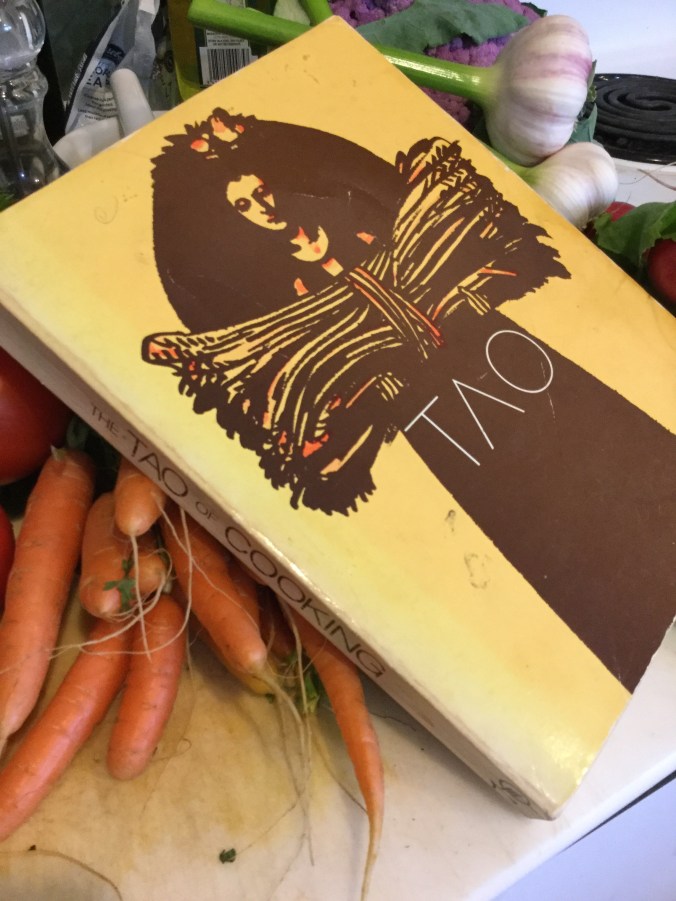
The Second Cookbook of Christmas: The Tao of Cooking

IMG_0267In August 1981, my then soon-to-be first husband and I loaded up a U-Haul trailer and moved from Athens, Georgia to Bloomington, Indiana. Our first apartment was a grim little efficiency all done up in 1970’s olive green and gold. The galley kitchen was in the living room, which had a giant grease stain in the middle of the carpet. It had only two positives: it was a short walk to the Indiana University campus, where I was working on a Master’s Degree in History, and it was just a couple of blocks away from the Tao Restaurant and Rudi’s Bakery.

The Tao, which was run by the members of a yoga ashram, got its start in the early 1970s as a worthy, hippie-vegetarian cafe — all brown rice, soy burgers, and sprouted things. By the time I arrived, it had grown up into a quite classy and refined (and not cheap) vegetarian restaurant. We were starving graduate students, but were also both budding foodies (although I hate the term, which technically hadn’t been invented yet). We scrimped and saved so we could splurge, once a month or so, on a nice meal at the Tao.

Rudi’s Bakery was more accessible, and there was no better comfort for a rotten day — I had a lot of those in Bloomington — than a slice of Rudi’s poppy seed cake with cream cheese frosting. I don’t have very many happy memories of those years, but the Tao and Rudi’s are among the happiest.

My first husband grew up in a restaurant family and was the one who really introduced me to the joy of cooking and eating well. We spent many happy hours in the kitchen together. Every weekend we undertook a new culinary adventure. I was not loving graduate school, and decided not to pursue a Ph.D. and left after my MA. I spent our final year in Bloomington, while my partner finished his degree, working at a soul-destroying job at the University Archives and taking cooking classes. The instructor for my first cooking class was Sally Pasley, the author of The Tao of Cooking (Indiana University Press, 1998), the Kale Whisperer’s Second Cookbook of Christmas.

Sally Pasley was one of a group of ashram members who had been mentored by a classically-trained French chef at the ashram’s original restaurant, Rudi’s Big Indian Restaurant, in upstate New York. She moved to the Bloomington restaurant in 1977, bringing a more classical vibe to the hippie eatery. Much to my delight, she also taught cookery classes. Under her steady guidance, I learned to make pastry and started my first foray into vegetarianism.

My copy of The Tao of Cooking is the original paperback, published in 1982 by Ten Speed Press, for which I paid $7.95 at Rudi’s (the current publishers price is $24.00 — cheaper at Amazon).  It has followed me from Indiana to Ohio, California, Georgia, Virginia and, finally, to the Southern Hemisphere.  IMG_0265It is splattered, dog-eared, and its spine is shot — as a well-loved cookbook should be. It was my first vegetarian cookbook and it is still on the top shelf of my cookbookcase. When I need a quick vegetable side, or a snappy salad, here’s where I go.

The Tao of Cooking represents its time. In the early 1980s, vegetarian cooking was making its transition from counter-culture to mainstream. You can find Hippie here: the Big Veg soy bean burger and Hobbit Pie (a personal favourite). But most of the recipes are refined, meat-free versions of European and Asian classics. Refined, but accessible, even to a beginning cook — as I was when I first bought my copy. The most exotic ingredient you’re likely to find is agar-agar (a vegetarian substitute for gelatine). Even for the Asian recipes, you are likely to find everything you need at a well-stocked supermarket. It doesn’t require any high-tech gadgets — the food processor was cutting edge, in those days.

My favourite recipes? My copy opens automatically to the Spaghetti with Eggplant, long a favourite, until I married my beloved but eggplant averse husband. The Pasta e Fagiole is classic and easy. I already mentioned the Hobbit Pie, whose mushroom and cheese filling I use in my Kiwi Pies (not made with actual kiwis). And because. . . you know. . .Wellington? Middle Earth? Hobbits?

IMG_0069

My not-yet-world-famous Kiwi Pies not made with actual kiwis

The fussiest recipe I’ve found is the Lasagne Verdi, which requires two sauces and homemade pasta. But it is well worth the effort. So is the Country Pate with Cold Tomato Sauce.The side dishes and salads are simple and tasty. The Tao Dressing is a must-try. You’ll never look at Ranch Dressing again.

The best thing about The Tao of Cooking? It includes, amongst many delicious cake and pastry recipes I learned to make in Sally’s pastry class, the recipe for Rudi’s Poppy Seed Cake. So whenever I need to, I can bake my own little slice of midwestern comfort, even here in far away New Zealand. And on a really bad day, there’s the Poppy Seed Cake Hot Fudge Sundae. That will brighten up the stormiest of Wellington days.

7784108

The Twelve Cookbooks of Christmas

I am powerless over cookbooks.

When, in 2013, Simon and I faced the challenge of reducing all our worldly goods to a volume that would fit in a 20-foot shipping container, the hardest chore for me was triaging my massive cookbook collection. The kitchen gadgets were easy: anything with a plug wouldn’t work in New Zealand. So, out went the waffle iron I never used (meh), the raclette grill (fun, but not essential), the Cuisinart (sniff), and the Kitchen Aide Mixer (gasp).

The cookbooks were hard. Which of my children would I re-home? Which would make the long journey to the Southern Hemisphere? Could I part with my copies of Julia Child’s Mastering the Art of French Cooking: Volumes One and Two even though they are decidedly not vegetarian friendly? (No) Could I leave behind my complete set of Cook’s Illustrated Best Recipes series? (yes) How could I cull the flock without leaving something essential behind? (I couldn’t) My amazing cousin, Barb, who had come to Virginia with her equally amazing sister, Linda, to flog me out of moving-denial, made the job much easier. She took most of the cast-offs to sell in her antique shop, which specialises in kitchen things and cookbooks (even though she doesn’t cook; all the better to avoid attachments). At least I knew the orphans would find loving homes.

I passed some of the favourites to friends. Susan got most of the non-vegetarian  and entertaining books, including my copy of Please to the Table: The Russian Cookbook. Anita, our loyal dog auntie, took a few. In the end, I probably left for New Zealand with 10% of my original cookbook library.

Regrets? I have a few. Somehow, my beaten-up old copy of the original The Joy of Cooking was left behind in favour of my copy of the vastly inferior The All New Joy of Cooking. Because I culled my  copy of The Italian Country Table by Lynne Rosetto Kasper, I’ve lost her astonishingly delicious, best cookie ever recipe for pine nut shortbread. I meant to bring the ancient copies of The Betty Crocker Cookbook and The Good Housekeeping Cookbook that I inherited from my mother. I never cooked from them, but they were precious mementos. I’m still hoping I’ll dig to the bottom of one of the few unpacked boxes that remain, and find that they wandered in amongst the CDs and DVDs. I was also sad to lose the copy of Marcella Hazan’s The Classic Italian Cookbook that Shakespeare (my dog, not the Bard) chewed the cover off when he was a wee puppy (which almost found him being re-homed). I suspect someone decided it was trash. It was pretty sad looking.

For the most part, however, I started my culinary life in New Zealand with a lean and mean set of vegetarian cooking essentials. I have also learned the beauty of downloadable cookbooks which, while they lack the tactile magic of actual printed books, enable me to continue my cookbook addiction without having to purchase numerous additional book cases.

Over the course of my vegetarian life, various people have asked me to recommend the best vegetarian cookbooks. So, seeing as Christmas is coming, it seems like an ideal time to present my list of the twelve most essential cookbooks for vegetarians. If you, or someone you love, is launching off on the vegetarian path, perhaps you will find an appropriate gift idea here. If you are building your own cookbook library, maybe you’ll find a gift for yourself. You can do that, you know!

We are two weeks away from Christmas. Twelve cookbooks. Fourteen days. Here goes. . . . !

IMG_0260