When I was a kid, my fellow Episcopalian and Catholic pals and I spent weeks thinking about what we would give up for Lent. I tended to lean toward such noble sacrifices as Brussels Sprouts — which as far as I remember my Mother never, ever cooked — or liver and onions– which my Dad loved meaning we had it about once a week. I tried very hard to score an invitation to eat at a friend’s house on those days. I remember being in awe of my best friend, Jeannie, the year she gave up watching TV.


I don’t honestly know whether she stuck with it for the whole 40 days, but I do remember her sitting with her back to the set on our regular Saturday Porter Wagner and hot dogs nights. My usual fall back was chocolate, which was sort of a sacrifice — I do like chocolate — but as we seldom had chocolate in the house, not much of one.
As I got older, the whole ritual of giving something up for Lent fell by the wayside. I guess this was because, once we moved to Georgia, most of my friends were Baptists and Methodists for whom Lent didn’t really seem much of an issue, although Easter certainly was.
Once I became an adult, I again embraced the notion of a Lenten discipline, Most years, I  decided to take up something — meditation, daily prayer, volunteering, swimming — in the hope that what started as a seasonal discipline would become a habit. It worked the year I challenged myself to go to the gym every day. I initially took up yoga as a Lenten discipline. That stuck too, for a while.
For several years, I gave up meat for Lent. This is, of course, a time-honoured Lenten discipline. The whole idea of Fat Tuesday or Pancake Day had to do with using up all your indulgent foods — butter, cream, eggs, bacon — in preparation for the lean, disciplined days of fasting that lay ahead. 
For me, the Lenten meat fast would end with the Easter Vigil — the Saturday night service that begins in the dark (at least until Congress moved Daylight Savings Time, meaning it didn’t get dark at Easter until 8pm or so) with a cantor and Old Testament lessons and ends with with bright lights and festive music, representing Jesus’ resurrection. It is my absolutely favourite service of the entire year — far surpassing Christmas. One year, we were encouraged to make animal sounds during the Noah’s Ark story, rattle our keys during the reading of Ezekiel 37:1-14 — the Valley of the Dry Bones — and ring bells or toot horns during Psalm 98 — Sing to the Lord a New Song.
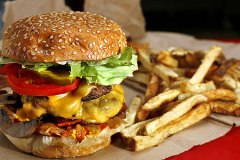
No, I don’t eat meat anymore, but that doesn’t mean I don’t miss it.
After the Easter Vigil, I would head straight to Five Guys Burgers and Fries for a gloriously greasy bacon cheeseburger with the works and a bog of their miraculously delicious fries then head home to eat it accompanied by a bottle of bubbly. Now that’s breaking a fast!
One year, I gave up wine. I’ll never make that mistake again.
Ditto: coffee.
 Another year, I pledged to read Moby Dick, my lifelong literary bête noir. The. Most. Boring. Novel. Ever. Written. I failed. I’d rather spend forty days wearing a hair shirt. Note to l’Académie française: I’ll give up my circonflexe when you pry it from my cold, dead fingers. If for no other reason, because without it, my spell checker keeps changing bête to bets or beets.
My friend Mary earned my everlasting admiration the year she gave up baking bread for Lent. When we were preparing to move to New Zealand and it came time to find a foster mother for my beloved sourdough starter, I reckoned that someone who loved baking so much that she would give it up for Lent would treat my sourdough baby with all the love it deserved.
God and I had a parting of the ways some years ago. I am now what I call a philosophical Christian, with some Judaism, Buddhism, and Church of the Flying Spaghetti Monster mixed in. While I no longer believe in an afterlife or a loving God, I still believe that Jesus’ teaching — the stuff he actually said — is as good a guide for living a decent and rewarding life as any other. Feed the hungry. House the homeless. Care for the sick. Embrace outsiders. Keep only what you need and share the rest with those who have less than you. Judge not lest ye be judged. This is all good. Are you listening, Donald Trump?


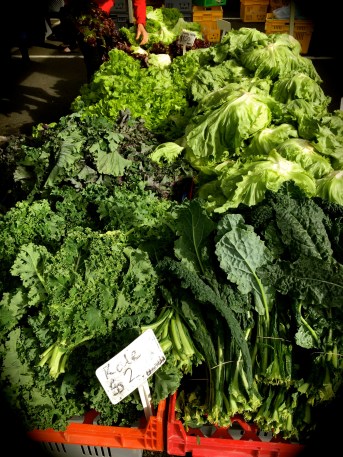
This Lent, a year after my soul fell to pieces, I am once again embracing the value of a discipline for restoring mindfulness and spiritual resilience. For most of the last year, just getting out of bed was an exercise in discipline. It would be disingenuous for me to give up meat — that is already gone. Chocolate? Not enough of a sacrifice. Wine?  Too much of a sacrifice. As much as I admire Mary, giving up baking would rob me of one of my most important emotional outlets. Simon and the boys might appreciate my giving up the accordion, but I wouldn’t want to lose my place with my lovely accordion teacher, Katie. The Kale Whisperer can’t give up Kale.
So, what’s a girl to do?
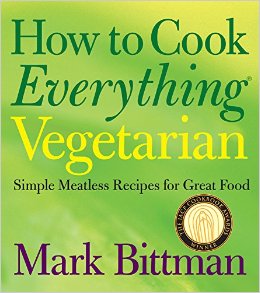
After long deliberation and utterly without consulting my devoted partner, I have decided to give up cookbooks for Lent. Not only will I not buy any new ones, I won’t use them. For the next forty days, I will be a totally improvisational cook. Because this is my discipline and I’m making the rules, I will leave myself three exceptions. I’ll allow myself to use Karen Page’s The Vegetarian Flavor Bible [see “The Seventh Cookbook of Christmas”], to ensure I check before pairing radishes and chocolate. I’ll also allow one all purpose book to look up basic recipes, like choux pastry, that I don’t carry around in my head. For this, I’ll use Mark Bittman’s How to Cook Everything Vegetarian. I’ll also use cookbooks for any pickling and preserving I do because I don’t want to kill anyone. Starting at sunrise on Ash Wednesday until sundown Easter Saturday, all other cookbooks will remain closed.


Note that I am giving up cookbooks, not necessarily recipes. In addition to improvising my own recipes using whatever seasonal ingredients are available, I will, on occasion, revisit some of the old recipes I inherited from my mother, Aunties, Grandma, and Tante Ida. I hope, in so doing, I will stretch my kitchen creativity as well as knitting my cooking more tightly to my new home.
I pledge to include ingredients that are new to me: Maori yams, feijoas, Asian greens. Maybe even these things. 
My hope is that at the end of this exercise, I will have a greater appreciation for living in tune with the seasons, greater culinary creativity, and a better food blog.
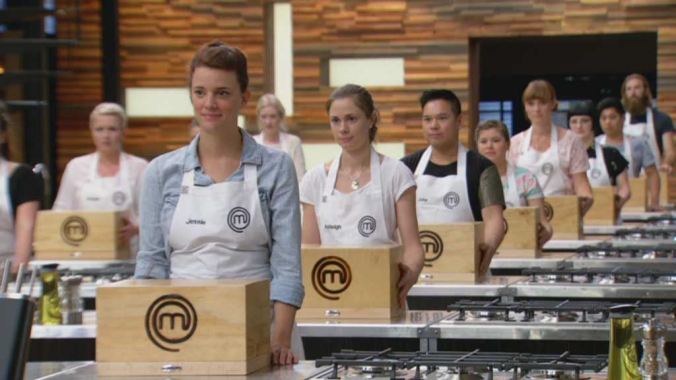
I’ll share the successes. When there are failures — as there are bound to be — I’ll share those, too. I promise, though, that I’ll only consult the ones I have on paper. Consulting the internet; that would be cheating. I am setting off on a forty day Master Chef Invention test. The Pantry is open.


 I appreciate the art and science behind modernist cuisine, but I cannot warm to a dining experience that puts so much technology between me and the food. I’m suspicious of “fusion” cooking that confuses me with too many moving parts. Dining in the dark? Spare me. If a recipe has forty steps, I reckon that is about 35 steps too many. I don’t have a single squeeze bottle in my kitchen, unless you count the ones Simon’s HP Sauce comes in. As my adorable partner put it, I have no time for precious food.
 I was immersing myself in French at the Coeur de France Ecole des Langues. Every morning, I walked into town and bought my food for the day. A croissant or petit pan au chocolate for petit dejeuner. A baguette at the boulangerie, a handful of haricot verts and champignons at the greengrocer, a wedge of cheese here, a bottle of wine there. We went on a field trip to a chèvre farm where I milked my first goat.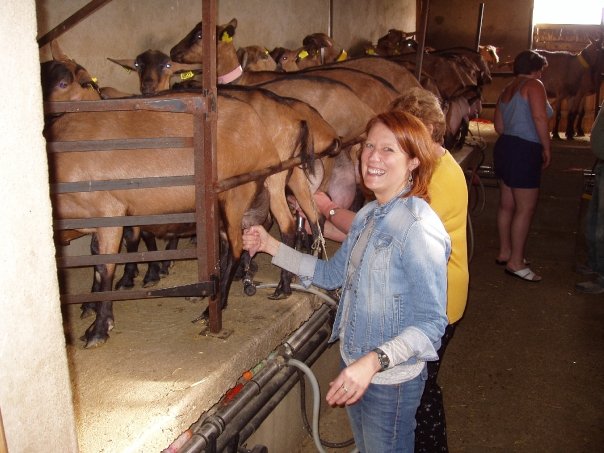






 Today is Monday. As my hero, Bloom County’s Bill the Cat, would put it: Blech! Ack! Thbbft! Granted, it’s the Monday before Christmas, not your usual, run-of-the-mill, shoot the alarm clock Monday. Still, Monday is Monday. Before I had a nervous breakdown and opted out of the rat race, I’d start dreading Monday about 5 pm on Saturday. The biggest advantage of Monday holidays was that I could enjoy spending half of Sunday with a pot of coffee and the Sunday New York Times without a pit in my stomach. I was a Monday hater of the first order. So much so that I started hating Sunday because all I had to look forward to on Sunday was Monday. I hated Monday even when I was enjoying my job.

 with both. I can resolve my misgivings about battery chickens and my suspicion that in New Zealand, as in the US, the “free-range” designation on eggs is dubious by keeping my own chooks. But it is highly unlikely that we will adopt our own cow. And recent exposés concerning cruelty in the New Zealand dairy industry make it increasingly difficult to look the other way.
  So, I try to cook vegan often and am constantly on the lookout for amazing vegan recipes so that, if and when we make the leap, I will have a solid cooking foundation. Most of the time, I am disappointed. Thug Kitchen, and the website from which it is compiled,
 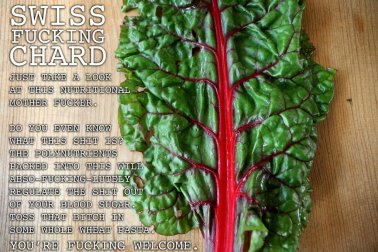 The Thugs really are speaking to an audience of people who probably never cooked and quite possibly never ate food that didn’t come from a drive-in, a box or a can. The thug life is about overcoming struggles, disadvantages, and bad influences to succeed and thrive despite any obstacles. The Thug Kitchen is “a fucking wake-up call. This for that section of the grocery store that you avoid. This is for the drive-thru lines so long that they block traffic. This is for ketchup and pizza qualifying as fucking vegetables. This is for everyone who wants to do better but gets lost in the bullshit.” The Thugs understand what Jamie Oliver doesn’t: Have a f-ing sense of humour!
 The Thugs are absolutely spot on when they warn that the Chickpeas and Dumplings could cause a “f-ing food coma.” It really is that good. So is the Wedding Soup with White Bean Balls and Kale, a more than plausible veg version of traditional Italian Wedding Soup — especially if you make it with the Garlic Broth from the Kale Whisperer’s Fourth Cookbook of Christmas, Mediterranean Harvest, which you will have bought by now.




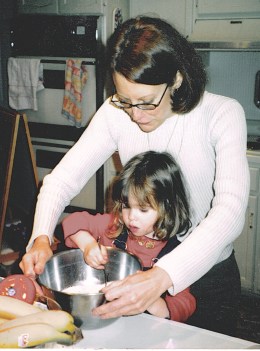


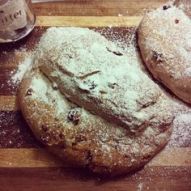 It tastes like my childhood and makes me happy, a little bit sad, and very grateful. And when it is a little stale, its makes the best toast ever.

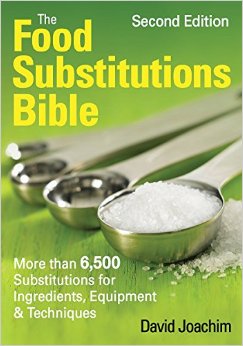
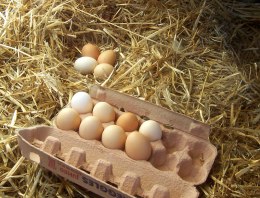
 And what if you are making a potato and tomato gratin, and your recipe calls for a topping made with 1 cup (4 oz; 120g) of grated Gruyere cheese, but you don’t want to lay out the cash for an expensive chunk of Gruyere for a weeknight dinner? Look up Gruyere, and you’ll find that you can substitute Comte, Beaufort, or Emmental. OK, still pricey. But you know that Emmental is a Swiss-type cheese, so turn there and you find that, yes, indeed, you can substitute Jarlsburg (usually cheaper than Emmental) or Swiss cheese. I find the cheese substitutions particularly useful here in New Zealand. It can be difficult, and expensive, to buy the more obscure regional cheeses. And even if you can find Riccotta Salata, you might not want to shell out for it for an everyday meal.

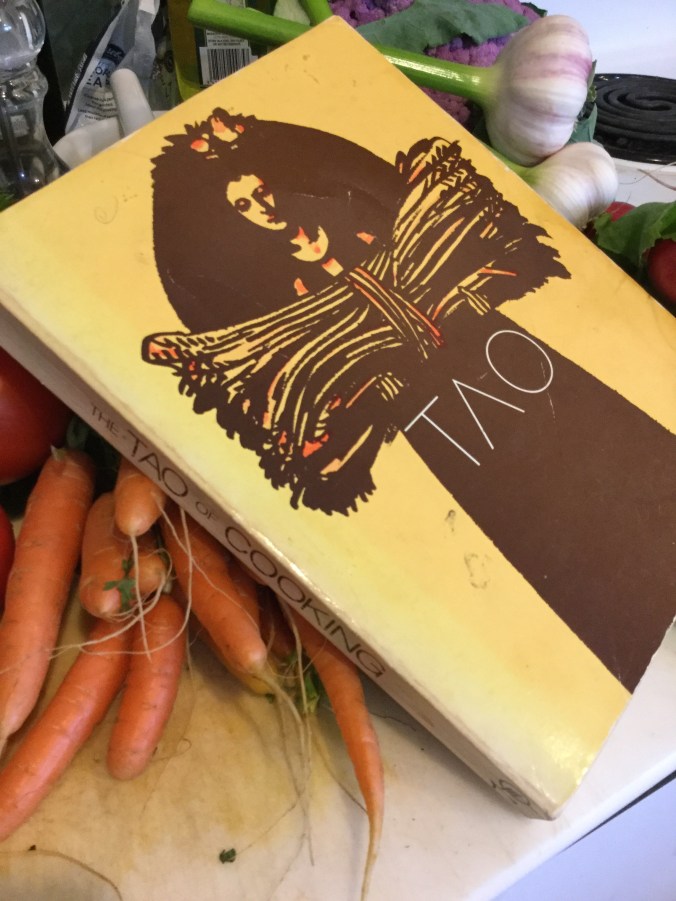 In August 1981, my then soon-to-be first husband and I loaded up a U-Haul trailer and moved from Athens, Georgia to Bloomington, Indiana. Our first apartment was a grim little efficiency all done up in 1970’s olive green and gold. The galley kitchen was in the living room, which had a giant grease stain in the middle of the carpet. It had only two positives: it was a short walk to the Indiana University campus, where I was working on a Master’s Degree in History, and it was just a couple of blocks away from the Tao Restaurant and Rudi’s Bakery.
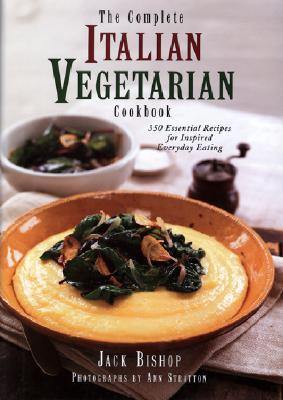
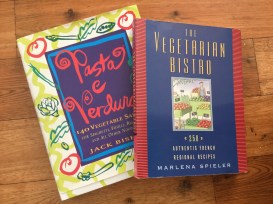
 It is splattered, dog-eared, and its spine is shot — as a well-loved cookbook should be. It was my first vegetarian cookbook and it is still on the top shelf of my cookbookcase. When I need a quick vegetable side, or a snappy salad, here’s where I go.




 The Kale Whisperer