The Eighth Cookbook of Christmas: Sundays at Moosewood Restaurant

Sundays at Moosewood

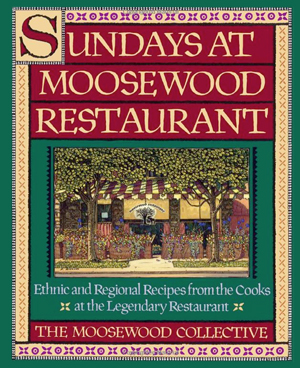
I first made rumpledethumps for Christmas dinner in 1990. I made rumpledethumps for every subsequent Christmas dinner for at least 16 years at the request of my father. I’ve also made them for the occasional Thanksgiving dinner as well as for countless cold winter nights curled up in my jimjams after particularly stressful days. Before I met the love of my life, Rumpledethumps nursed me through several broken hearts and other singleton tragedies. Rumpledethumps are my chicken soup.  Rumpledethumps have the advantage of being both fun to say (really, try to say rumpledethumps without smiling) and delicious to eat. And they combine two of my favourite foods: mashed potatoes and brassicas. My rumpledethumps recipe comes from the Kale Whisperer’s Eighth Cookbook of Christmas, Sundays at Moosewood Restaurant, by the Moosewood Collective (Fireside/Simon and Schuster, 1990).

As I sit here on the last Sunday afternoon before Christmas, waiting for Paul and Oliver to come shear the alpacas (our new pre-Christmas tradition), I’m paging through Sundays at Moosewood and being reminded of meals I’ve cooked and countries I’ve visited. This book is a compilation of recipes from the Moosewood Restaurant’s Sunday “ethnic nights.” Sunday is pizza night here, but if it weren’t, I could prepare a meal honouring the alpacas with Chilean Garlic Soup, Torta de Papas, Ensalada Olimipica, and Pan de Navidad. Maybe I’ll do that next year, if the shearing isn’t on a Sunday. Rules are rules. Or perhaps I’d try to recreate the delicious Apfel Kuchen Simon and I ate when we visited the German settlement of Fruitillar during our too-brief visit to Chile in 2012.

When I first bought this book, in 1990, I hadn’t yet discovered the joys of those handy little, bright coloured Post-it flags for tagging recipes to try in a new cookbook.
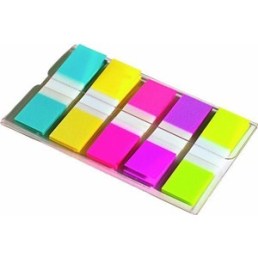
post it flags

Sometimes I colour code my flags: say, pink for must try immediately, green for ways to cook things I can never find recipes for. Trouble is, I usually forget the code.


In those days, I folded down the corners. I can hear all you bibliophiles groaning, but folded corners are far from the worst abuses my cookbooks suffer, what with all the drips, splashes, and the occasional dog attack. As I look at my copy of Sundays, it seems like every other page is turned down. I’ve tried many of those recipes. Others, I’ve yet to get around to making. But I don’t remember a clunker from this collection, and that it saying something.IMG_1233

Sundays at Moosewood is organised into 18 regional chapters, that include countries or regions from every continent except Antarctica, plus a few very useful appendices. Now that my consciousness has been raised, I note the absence of a Pacific Islands chapter. But this is likely to reflect the fact that Moosewood never had a Pacifika chef. Chile, China, Finland, India, Italy, Japan, Mexico and France (Provence) all get their own chapters. Africa is divided into sub-Saharan and North African chapters. The British Isles, the Middle East, the Caribbean, Eastern Europe, and Southeast Asia are treated regionally. The Jewish diaspora gets its own chapter, separated again into Ashkenazi and Sephardic recipes. And from the United States, New England and the Southern US are singled out for special attention. I’ve relied heavily on the Southern US chapter over the years.

Coca-Cola-Salad

Cocola salad traditionally involves cherry Jello, canned cherries, crushed pineapple, chopped pecans, and cream cheese. I live in horror of jelled anything, but try it if you feel brave.

It includes a vegetarian version of that beloved (said with a touch of irony) Southern Christmas favourite, Cocola Salad. That’s how Southern it is.

In addition to rumpledethumps, among the pages in my copy that are either curly or to which the book opens on its own are: Yellowman’s Banana Lime Bread, Mu Shu Vegetables with Mandarin Pancakes, Buddha’s Garden (with my favourite vegetarian stir-fry sauce), Hernerakkaa (Finish Yellow Split Pea Soup), Dal and Tomato Kachumber (a sort of Indian salsa), Mother Wolff Soup (a Jewish paprikash), Sopa de Lima (Mexican Tomato, Lime, and Tortilla Soup), New England Corn Bisque, My Favorite Philippine Breakfast (a sort of fried rice concoction with vinegar, pickled peppers, and a fried egg that is also excellent for dinner on a night when you need comfort food and all you have in the pantry is rice, eggs, and a jar of jalapeño peppers). I wonder if that last has a proper name in Tagalog. Maybe one of my Fillipino readers will tell us.

The appendices are useful, too. The menu planning section, in addition to a nice collection of suggested menus, includes a page of Related Cuisines so you can mix and match on your own. It also includes a few examples of how to build interesting menus combining divergent cuisines. There is a Guide to Ingredients, Techniques, and Equipment and my all-time-favourite-ever-in-a-cookbook appendix, What We Mean When We Say, “One Medium Onion. . ..”

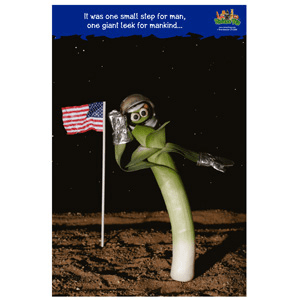
New Zealand produces enormous leeks. Giant_Leek_Photographic_Prints.jpgIt would not be an exaggeration to say that in the high season, the leeks here approach the size of a baseball bat (but not a cricket bat). When I come across a recipe that calls for “4 leeks, white and light green parts only,” that could easily amount to about a ton of chopped leeks. Okay, maybe not a ton, but a lot more than you’d get from your standard, American, grocery store leek. What We Mean helpfully tells you that 1 medium leek = 3/4 cup chopped or 3 ounces (85 grams).
Do you ever find yourself, wanting to throw your arms in the air and cry “what the hell constitutes a medium zucchini?” as you cope with summer zucchini ranging from wee ones with the flower attached to a giant suitable for Wallace and Grommit’s Giant Vegetable contest? Wallace and GromitHere’s your answer: 1 medium zucchini weighs 10 oz (285 grams). The most useful thing I’ve learned from What We Mean: a medium bunch of spinach leaves, 10 ounces (285 grams) of fresh spinach by weight will turn into 1 cup (236 ml) of cooked, squeezed dry spinach. There are also weight equivalents of various cheeses and nuts by volume and a handy customary / metric conversion chart.

If you love to travel, but don’t always have the money or the time, Sundays at Moosewood is a good way to wander the globe in your own kitchen. Or just to explore new cuisines without having to buy a new cookbook. All the Moosewood Collective books are good, but this one remains my favourite.

Now, off to Chile to shear the alpacas, then back to Naples to eat some pizza.


The Seventh Cookbook of Christmas: The Vegetarian Flavor Bible

flavor bible

I want to be Australia’s next Masterchef. This is highly unlikely for at least two reasons. First, I don’t live in Australia. Second, the Masterchef competition is extremely vegetarian unfriendly. Last week, the contestants were required to essentially butcher a lamb carcass. One of my favourite Masterchef moments occurred in the 2014 competition when nearly-vegetarian Renae Smith reacted the way I have would when she discovered a whole eel in her mystery box — tears, panic attack, and horror.  It was clear she wasn’t going to be able to go through with her cook when my favourite contestant of the seasons, Colin Sheppard rode to the rescue and offered to give up some of his cook time to clean and filet the horrifying primal beast. Filleted, the meat didn’t trigger her phobia, and Renae was able to cook. I was heartbroken when Colin went home.

Which points, perhaps, to a third reason I’ll never be Australia’s (or anyone else’s) next Masterchef: Colin, 51, was referred to as “Pappa”. A similarly gentle male contestant, Richard Harris, 55, chose eel for an invention challenge because he reckoned the other contestants might find it intimidating. Richard was eliminated from 2015’s New Zealand Masterchef to questions about why he waited until it was too late in his life to pursue his dream. <sound of gnashing teeth and forehead pounding on desk> Colin and Richard: You are Masterchefs in my heart!

Masterchef New Zealand has been cancelled; so, it looks like I must settle for being an armchair master chef. When the contestants are set invention tests or mystery boxes, Simon and I play “what would you cook?” This works out nicely for me, of course, because my imagined masterpiece is always tastier and more spectacularly beautiful than anything the contestants put up.

OK. Today’s mystery box ingredient is: KALE. What would you cook?

IMG_1217

The Kale Whisperer’s Seventh Cookbook of Christmas will help you figure that out, whether you are practicing for Masterchef, or not. Although, if you are, I would advise studying this book front-to-back and side-to-side. Karen Page’s The Vegetarian Flavor Bible (Little Brown, 2015) is subtitled “the essential guide to culinary creativity.” And it is all that. This is my second non-cookbook Cookbook of Christmas, but if I had to pick a desert island cookbook, this would be it. With this cookbook, you don’t need cookbooks at all, really.

Page’s goal in compiling this guide, which is both informative and simple to use, was to provide useful nutritional and health information for those seeking to either to become vegetarians or shift to a whole-foods, plant-based diet, with our without occasional meat. Her first two chapters — For the Love of Plants, and Maximizing Flavor — make the case for a plant-based diet and chronicle the shift of vegetarian cuisine from the counter-culture to the mainstream. Of particular interest to me were the comments from some of America’s top chefs who, increasingly, are shifting toward culinary styles that depend more and more heavily on vegetables as the focus rather than the background.

Page’s discussion of the key elements of flavour in vegetarian cooking is eye opening, even for the most experienced cook, and has vastly increased my confidence as an improvisational cook. The formula? Flavor = Taste + Mouthfeel + Aroma + The X-Factor (senses + heart, mind, spirit).  She even has a handy “craving” table.  Vegetarian? Craving crab dip? Add some kelp and Old Bay Seasoning to your favourite white bean dip. Miss that magic zing of anchovy paste? I know I do. Use dark miso paste. I’m not a fan of play meat, so her suggestions of tofurkey and Soyrizo leave me cold. But most of the suggestions here are at least worth a think.

All this information is fascinating, and important to know, but the part of  The Vegetarian Flavor Bible  that you will use often — in my case, daily — is the “A to Z Listings.” It is truly exhaustive. You won’t find some local specialties here. No feijoas but you will find their cousin, guava. So far, I haven’t stumped this list. And I’ve tried. Each listing starts with some general information: nutrient concentration, season, flavour, volume (flavour loudness), what it is, nutritional profile, cooking techniques, tips, and botanical relatives. Look up Kale, and here is some of what you will learn: kale is a leafy, green vegetable, it has an extremely high nutrient content, it’s bitter but can be sweet in winter, it’s 72% carbs / 16% protein / 12% fat,  and 1 cup of raw, chopped kale has 35 calories and 2 grams of protein. Kale likes to be blanched, boiled, braised, grilled, slow cooked, marinated, pureed, eaten raw (but I’m not a fan, unless its very young and tender), sautéed, stewed, steamed and stir fried. Kale’s cousins include broccoli, Brussels sprouts, collard greens, radishes, and watercress.

What you will also learn is anything and everything that matches well with kale. Page built her flavour suggestions through an exhaustive compilation of  recommendations and wisdom of hundreds of American cooks and chefs specialising in cuisines from around the world. There is a ranking system for the flavour matches. Flavour matches recommended by at least one expert appear in normal type. BOLD CAPS indicate recommendations made by a larger number of experts. BOLD CAPS with an asterisk (*) are what Page calls “Holy Grail” pairings — most highly recommended by the largest number of experts. Particular types of preparations (soups, casseroles) and cuisines use of an ingredient appear in italics. Those in bold italics or BOLD ITALIC CAPS are those most highly recommended for the particular ingredient.

What will I cook with my Kale? Were it winter, I might make a hearty soup or my favourite lentil and kale spag bol. But it is early summer here in New Zealand, so I’m thinking a frittata or stir-fry. Maybe a salad. I look up kale and find that some of its strongest flavour partners are beans, chilli, garlic, lemon, olive oil, and red onions. As I’ve mentioned before, I don’t care for raw kale, no matter how long you massage it. But if it is young and fairly tender, all it needs is a quick blanch. I’m thinking a salad of blanched kale tossed with a dressing  of lemon juice, olive oil, some thinly sliced new season garlic, a pinch of dried chilli to give it some bite, salt and pepper. I’ll marinate some white beans in the same vinaigrette (minus the chilli)  and some chopped fresh oregano from my garden and a thinly sliced red onion. Then I’ll make a composed salad of the dark green kale, the white beans and red onions, with some crispy parmesan croutons made with the end of the loaf of sourdough bread I baked last week.

I’ll let you know if the judges like it!

brain

The Sixth Cookbook of Christmas: Twelve Months of Monastery Soups

monastery soups

I am a spiritual seeker. My mother always called me her “otherworldly child.” My favourite movie, for a while, was “The Song of Bernadette.” I read St. Augustine’s Confessions and Thomas Merton’s The Seven Story Mountain as a teenager. The interfaith nature of Merton’s spirituality has shaped my own spiritual journey to this day.  In the spring of 1977, Dr. John Granrose took our Honors Ethics class on a field trip to visit the Monastery of the Holy Spirit, a Trappist monastery near Conyers, Georgia. That day has stayed with me all these years. Ever since, I’ve felt drawn to a quiet life of contemplation. That appeal of that lifestyle was, I remember, exemplified in the meal the brothers served us at their guest house — vegetable potage, monastery cheese, and rustic bread. While my faith in organised religion has evaporated over the decades, my yearning for the quiet contemplative life has not. Many years later, now that I’ve stepped away from the noise of my career as a defense analyst, I am beginning to live a quiet life of contemplation. Thinking and writing about food is bringing me the peace and happiness that organised religion or proximity to power never did.

monastery

The Monastery of the Holy Spirit, Conyers, Georgia

In cooking, as in life, sometimes the greatest beauty is found in simplicity. For me, the simple meal of soup, cheese, and bread is restorative in a way that no other meal can be. When loved ones are sick, or sad, we make them soup. When I’m sick and sad, I want someone to make me soup. Before she died, my mother was sick and sad — for too long — and our friends Kline and Carolyn brought her matzo ball soup. I will never forget that soup. It might not have cured all that ailed Mom, but it restored me and my Dad and was, quite simply, my most unforgettable soup. It tasted like love. Thank you, Kline and Carolyn.

CCI17122015

Alex and her fairy godmother making matzo balls

A few years later my Goddaughter Alex borrowed a book from the library called How Many Matzos Make a Soup?  She loved it. I haven’t been able to track it down, but I remember the punch line was that what makes a good soup isn’t the number or size of the matzos, but the love that goes into making them. Inspired by the story, and my duties as fairy godmother, Alex and I made our own matzo soup. It was delicious.

As a child, I loved Marcia Brown’s classic children’s book Stone Soup. I was captivated by the notion that with an onion here, a carrot there, it was possible to create food for a village. It’s not that different from my frequent Saturday morning ritual combining trimmings from this week’s purchases (leek and green inion tops, celery leaves, a carrot or two) with the things that didn’t make into last week’s dinners (slightly past their prime mushrooms, the other halves of onions, pea pods, a lonely potato) in the stock pot to simmer away.  In its way, soup is the secular equivalent to the feeding of the five thousand. With a handful of beans, a potato, and onion, a carrot, and some garlic, I can make a warm, tasty, satisfying meal.  IMG_0249

As I’ve traveled over the years, my most memorable meals have involved simple soups: Portugal’s Caldo Verde (just potatoes, kale, and linguica), Thailand’s gorgeous Tom Yom soups, Pho from Vietnam, miso soup  from Japan, and the hearty bean and vegetable soups of Italy. Singapore’s Night Market offers too many options to name, as do the Bistros of Paris and the Pubs of England. I’ve loved nettle soup in Scotland and seafood chowder on Stewart Island. I can’t say I loved the goat neck soup in Ghana, but I certainly loved the generous spirit in which it was offered. And the simple bean and vegetable soups prepared by out Masai cook at Freeman’s Safaris in Kenya were the perfect end to hard day on the Mara.

The Kale Whisperer’s Sixth Cookbook of Christmas, Brother Victor-Antoine d’Avila-Latourette’s Twelve Months of Monastery Soups (Triumph Books, 1996), encompasses both my fascination with the contemplative life and my love for soup in a unique and tasty way. This is not strictly vegetarian, there are a few recipes that include a bit of meat or seafood, but most of those can be easily adapted to vegetarian versions. Obviously, you probably won’t want to make the Shrimp Soup de Luxe without shrimp. On the other hand, one of my favourite recipes here is the French Cream of Lentil Soup, calls for two strips of bacon, but it is just as delicious without the pig. I’ve cooked it both ways, I can personally vouch for that. The book is peppered with notes and quotes about soup, things that go into soup, people who make soup, and people who eat soup. If you aren’t Catholic, you will still love this book. If you aren’t Christian, you’ll love this book. If you love soup, you’ll love this book. This is another cookbook you’ll want to read, cover to cover.

Monastery Soups consists of twelve chapters: one for each month of the year. If you live in the northern hemisphere, you could probably cook right through the book chronologically. Down here in the antipodes, you’ll have to work inside out. Brother Antoine took care to match ingredients to availability. And as the gardener at Our Lady of the Resurrection Monastery in upstate New York, he understands locavore cooking. Ever wondered what you could do with those gorgeous greens attached to your bright red radishes you couldn’t resist at the market? Brother Antoine has a soup for that: Soupe Pelou. It’s delicious. Is your garden overrun by sorrel? He has five soups for that. The recipes are simple and come from all around the world. Adapted from the monastery kitchen, they don’t require fancy equipment or exotic ingredients. These are weekday soups, not simmer on the back of the stove all day soups. Some vegetables, some herbs, broth, wine, garlic and a pinch of salt. And love; lots of love.

Some of my earliest childhood memories involve soup: chicken noodle with oyster crackers, cream of tomato with cheese toast, potato soup with lots of celery from the German restaurant I only remember as “the potato soup place.” I’m sure the very last meals I’ll enjoy will also be soups. And so many soups — humble and glorious — along the way. To paraphrase T.S. Elliot, I will measure out my life in soup spoons.

stone soup

The Second Cookbook of Christmas: The Tao of Cooking

IMG_0267In August 1981, my then soon-to-be first husband and I loaded up a U-Haul trailer and moved from Athens, Georgia to Bloomington, Indiana. Our first apartment was a grim little efficiency all done up in 1970’s olive green and gold. The galley kitchen was in the living room, which had a giant grease stain in the middle of the carpet. It had only two positives: it was a short walk to the Indiana University campus, where I was working on a Master’s Degree in History, and it was just a couple of blocks away from the Tao Restaurant and Rudi’s Bakery.

The Tao, which was run by the members of a yoga ashram, got its start in the early 1970s as a worthy, hippie-vegetarian cafe — all brown rice, soy burgers, and sprouted things. By the time I arrived, it had grown up into a quite classy and refined (and not cheap) vegetarian restaurant. We were starving graduate students, but were also both budding foodies (although I hate the term, which technically hadn’t been invented yet). We scrimped and saved so we could splurge, once a month or so, on a nice meal at the Tao.

Rudi’s Bakery was more accessible, and there was no better comfort for a rotten day — I had a lot of those in Bloomington — than a slice of Rudi’s poppy seed cake with cream cheese frosting. I don’t have very many happy memories of those years, but the Tao and Rudi’s are among the happiest.

My first husband grew up in a restaurant family and was the one who really introduced me to the joy of cooking and eating well. We spent many happy hours in the kitchen together. Every weekend we undertook a new culinary adventure. I was not loving graduate school, and decided not to pursue a Ph.D. and left after my MA. I spent our final year in Bloomington, while my partner finished his degree, working at a soul-destroying job at the University Archives and taking cooking classes. The instructor for my first cooking class was Sally Pasley, the author of The Tao of Cooking (Indiana University Press, 1998), the Kale Whisperer’s Second Cookbook of Christmas.

Sally Pasley was one of a group of ashram members who had been mentored by a classically-trained French chef at the ashram’s original restaurant, Rudi’s Big Indian Restaurant, in upstate New York. She moved to the Bloomington restaurant in 1977, bringing a more classical vibe to the hippie eatery. Much to my delight, she also taught cookery classes. Under her steady guidance, I learned to make pastry and started my first foray into vegetarianism.

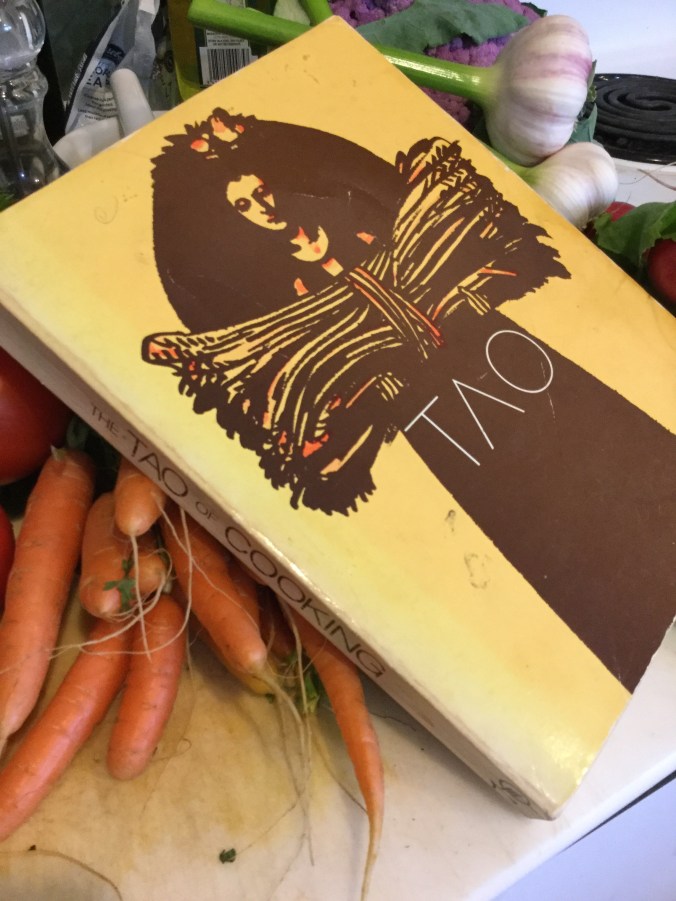
My copy of The Tao of Cooking is the original paperback, published in 1982 by Ten Speed Press, for which I paid $7.95 at Rudi’s (the current publishers price is $24.00 — cheaper at Amazon).  It has followed me from Indiana to Ohio, California, Georgia, Virginia and, finally, to the Southern Hemisphere.  IMG_0265It is splattered, dog-eared, and its spine is shot — as a well-loved cookbook should be. It was my first vegetarian cookbook and it is still on the top shelf of my cookbookcase. When I need a quick vegetable side, or a snappy salad, here’s where I go.

The Tao of Cooking represents its time. In the early 1980s, vegetarian cooking was making its transition from counter-culture to mainstream. You can find Hippie here: the Big Veg soy bean burger and Hobbit Pie (a personal favourite). But most of the recipes are refined, meat-free versions of European and Asian classics. Refined, but accessible, even to a beginning cook — as I was when I first bought my copy. The most exotic ingredient you’re likely to find is agar-agar (a vegetarian substitute for gelatine). Even for the Asian recipes, you are likely to find everything you need at a well-stocked supermarket. It doesn’t require any high-tech gadgets — the food processor was cutting edge, in those days.

My favourite recipes? My copy opens automatically to the Spaghetti with Eggplant, long a favourite, until I married my beloved but eggplant averse husband. The Pasta e Fagiole is classic and easy. I already mentioned the Hobbit Pie, whose mushroom and cheese filling I use in my Kiwi Pies (not made with actual kiwis). And because. . . you know. . .Wellington? Middle Earth? Hobbits?

IMG_0069

My not-yet-world-famous Kiwi Pies not made with actual kiwis

The fussiest recipe I’ve found is the Lasagne Verdi, which requires two sauces and homemade pasta. But it is well worth the effort. So is the Country Pate with Cold Tomato Sauce.The side dishes and salads are simple and tasty. The Tao Dressing is a must-try. You’ll never look at Ranch Dressing again.

The best thing about The Tao of Cooking? It includes, amongst many delicious cake and pastry recipes I learned to make in Sally’s pastry class, the recipe for Rudi’s Poppy Seed Cake. So whenever I need to, I can bake my own little slice of midwestern comfort, even here in far away New Zealand. And on a really bad day, there’s the Poppy Seed Cake Hot Fudge Sundae. That will brighten up the stormiest of Wellington days.

7784108

The Twelve Cookbooks of Christmas

I am powerless over cookbooks.

When, in 2013, Simon and I faced the challenge of reducing all our worldly goods to a volume that would fit in a 20-foot shipping container, the hardest chore for me was triaging my massive cookbook collection. The kitchen gadgets were easy: anything with a plug wouldn’t work in New Zealand. So, out went the waffle iron I never used (meh), the raclette grill (fun, but not essential), the Cuisinart (sniff), and the Kitchen Aide Mixer (gasp).

The cookbooks were hard. Which of my children would I re-home? Which would make the long journey to the Southern Hemisphere? Could I part with my copies of Julia Child’s Mastering the Art of French Cooking: Volumes One and Two even though they are decidedly not vegetarian friendly? (No) Could I leave behind my complete set of Cook’s Illustrated Best Recipes series? (yes) How could I cull the flock without leaving something essential behind? (I couldn’t) My amazing cousin, Barb, who had come to Virginia with her equally amazing sister, Linda, to flog me out of moving-denial, made the job much easier. She took most of the cast-offs to sell in her antique shop, which specialises in kitchen things and cookbooks (even though she doesn’t cook; all the better to avoid attachments). At least I knew the orphans would find loving homes.

I passed some of the favourites to friends. Susan got most of the non-vegetarian  and entertaining books, including my copy of Please to the Table: The Russian Cookbook. Anita, our loyal dog auntie, took a few. In the end, I probably left for New Zealand with 10% of my original cookbook library.

Regrets? I have a few. Somehow, my beaten-up old copy of the original The Joy of Cooking was left behind in favour of my copy of the vastly inferior The All New Joy of Cooking. Because I culled my  copy of The Italian Country Table by Lynne Rosetto Kasper, I’ve lost her astonishingly delicious, best cookie ever recipe for pine nut shortbread. I meant to bring the ancient copies of The Betty Crocker Cookbook and The Good Housekeeping Cookbook that I inherited from my mother. I never cooked from them, but they were precious mementos. I’m still hoping I’ll dig to the bottom of one of the few unpacked boxes that remain, and find that they wandered in amongst the CDs and DVDs. I was also sad to lose the copy of Marcella Hazan’s The Classic Italian Cookbook that Shakespeare (my dog, not the Bard) chewed the cover off when he was a wee puppy (which almost found him being re-homed). I suspect someone decided it was trash. It was pretty sad looking.

For the most part, however, I started my culinary life in New Zealand with a lean and mean set of vegetarian cooking essentials. I have also learned the beauty of downloadable cookbooks which, while they lack the tactile magic of actual printed books, enable me to continue my cookbook addiction without having to purchase numerous additional book cases.

Over the course of my vegetarian life, various people have asked me to recommend the best vegetarian cookbooks. So, seeing as Christmas is coming, it seems like an ideal time to present my list of the twelve most essential cookbooks for vegetarians. If you, or someone you love, is launching off on the vegetarian path, perhaps you will find an appropriate gift idea here. If you are building your own cookbook library, maybe you’ll find a gift for yourself. You can do that, you know!

We are two weeks away from Christmas. Twelve cookbooks. Fourteen days. Here goes. . . . !

IMG_0260