The Fifth Cookbook of Christmas: Bernard Clayton’s New Complete Book of Breads

IMG_0269

Today would have been my Dad’s 93rd birthday. He wasn’t a vegetarian. His favourite foods were: fried eggs (sunny side up), Campbell’s Pork and Beans (Mom spiffed them up with green peppers, mustard, and various other secret bits of magic), and pretty much anything made with ground beef. According to family legend, Mom and Dad went in with friends once to buy a steer. When the butcher called to find out how they wanted their half cut up, Dad told him to just grind the whole beast into hamburger. Fortunately, Mom was able to intervene. Dad was an avid gardener and produced bushels of tomatoes, green peppers (capsicum), tender little yellow crookneck squash, okra, eggplant, raspberries and figs. But, at heart, he was a meat-and-potatoes sort of guy.

Like most meat-and-potatoes guys, Dad also loved bread. Good, hearty, stick to your ribs, Olde Worlde bread: rye, pumpernickel, crusty Kaiser rolls, and the absolutely delicious, chewy hard rolls from the Black Forest Bakery in Athens, Georgia. When our family moved from Virginia to Georgia in 1967, we entered the black hole of bread. European style bread simply didn’t exist. Not even mass-produced rye bread. Certainly not the kind of peasant breads that work your jaws and have the fortitude to mop up the remains of a hearty soup. Roman Meal Bread was the closest to whole wheat available. Our choices were pretty much Sunbeam (“It’s batter whipped”) and Wonder Bread. It was at this point that Mom went back to baking bread in a serious fashion.

It wasn’t easy. These were the days before supermarkets sold Bread Flour, and most flour sold in the South was made from soft, summer wheat. Flours like White Lilly are indispensable for making biscuits, cornbread, and cakes, but lack the complex gluten structures that are needed for hearty, crusty European loaves. Eventually, Mom found a commercial source of hard wheat flour, which she bought in twenty pound bags and she was off. Every three weeks or so, I’d come home to a kitchen full of dough and the smell of fresh baked bread. It was heaven. Some would go in the freezer, but Dad and I usually devoured at least one loaf on the spot.

Mom was famous for her breads. At the Annual Christmas Auction at St. Gregory the Great Episcopal Church, her “coffee cake of the month” and “bread of the month” offerings raised a pretty penny. When she teamed up with our friends Kline and Carolyn to offer a catered German dinner party, folks pulled out their check books and dug deep.

CCI16122015

One of the legendary St. Gregory’s Auction German dinners, cooked and hosted by Carolyn, Kline, Dad, and Mom, circa late 1980s

At this time of year, she’d be in full Christmas Stollen baking mode. She was famous for her stollen — the traditional german fruited bread that is baked and sugared to look like the Christ child’s swaddling clothes. This is NOT fruitcake, it is Christmas manna. Mom’s recipe came out of her head — handed down from her mother and aunt. In mid-December, our kitchen became an assembly line, with sweet, fruity loaves at various stages of development. While I’m no longer big into Christmas, I still honour this one family tradition and bake a batch or two around Christmas time from Bernard Clayton’s recipe. stollenIt tastes like my childhood and makes me happy, a little bit sad, and very grateful. And when it is a little stale, its makes the best toast ever.
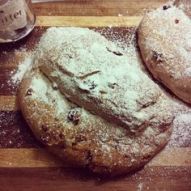
I reckon today is an appropriate day to add Bernard Clayton’s New Complete Book of Breads to the Kale Whisperer’s Twelve Cookbooks of Christmas. My well-worn copy is the 1987 edition. There have been subsequent revisions, the most recent in 2006, that incorporate newer technology, like bread machines. But the basic spirit that makes this cookbook an all time great remains.

Bernard Clayton gave up a high-powered journalistic career in New York and Chicago after a mystical bread experience during a bike trip around Europe in the mid-1960s. He moved to Bloomington, Indiana, worked for Indiana University, and pursued his fascination with bread. His wonder at the art and science of bread making shines through this book. He prefaces many of the recipes with an introduction, perhaps describing the bread’s history, how it fits in to the wider world of breads, and how he discovered it. Clayton was not professionally trained — he taught himself to bake — and the un-jaded joy of the gifted amateur is contagious. I defy you to pick up this book and not immediate begin tagging recipes. This is one of those cookbooks you’ll want to sit down and read, cover-to-cover.

In addition to the Christmas Stollen (my copy automatically opens to that page), I love the Dilly Casserole Bread (a 1960s staple), the Sour Dill Rye Bread (which uses pickle brine as the liquid), the Portuguese Sweet Bread, and the German White Bread with Caraway. My New Zealand sourdough starter, which has been going for two years, now, began with his Honey Starter.  Our sourdough starter is like a member of the family. It’s less demanding than the dogs. It only needs is to be fed and cuddled once a week. And it doesn’t have accidents in the house. I had to leave my previous starter in the US when we moved to New Zealand.

IMG_0270

My New Zealand Honey Sourdough Starter, freshly fed and happy

The Ministry of Primary Industries here was unlikely to look kindly upon a glob of dough teeming with microbes, no matter how yummy. It found a happy home with my friends Mary and Wade. They let me visit when I go back to Virginia. Mary gave up baking bread for Lent one year, so I know she is a good mother (and her dogs are way better behaved than mine).


This is the most comprehensive handbook for the home bread baker I’ve ever found. It was written based on thousands of hours of Clayton’s own trial and error in his own home kitchen. I’m reasonably confident that there is nothing that a home baker needs to know about bread making that isn’t in this book. If you try to bake bread, and something goes wrong, Clayton will tell you why. Most of the recipes include separate instructions for mixing the doughs by hand, in a stand mixer, or in a food processor.

My copy does not include bread machine instructions or recipes, which is fine by me. If you want to make bread, make bread. Don’t be afraid of it. Hold the dough, knead it, throw it, slam it — as Clayton advises, “don’t gentle the dough” — watch it rise, punch it down, knead it some more, and feel it come to life under your warm touch. Bread making, unlike some other kinds of baking, is very forgiving. And much cheaper than therapy.

And nothing beats a slice of hot, fresh bread with butter. It tastes like love.


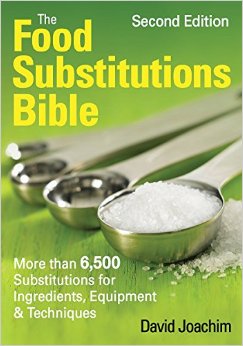
The Third Cookbook of Christmas: The Food Substitutions Bible

Food Substitutions

So, you just harvested your rhubarb and you are making The Smitten Kitchen’s delicious rhubarb snacking cake (Smitten Kitchen Rhubarb Snacking Cake), and you discover that you don’t have any ground ginger. What do you do? Cry? Immediately jump in the car and drive to the supermarket for a can of ground ginger that you might never use again? Leave it out and hope for the best? Any or all of these could work, but what I recommend is that you pull down your copy of David Joachim’s The Food Substitutions Bible, turn to page 236, and discover that you can substitute ground ginger with: minced crystallised ginger (rinsed to remove the sugar), minced or grated fresh ginger, or ginger juice. You will also find that, failing those options, you can very the flavour slightly with pumpkin pie spice, ground allspice, or ground cardamom. I’ve tried the cardamom, which works nicely, as well as the fresh and crystallised ginger options. And don’t forget to double the crumb topping.

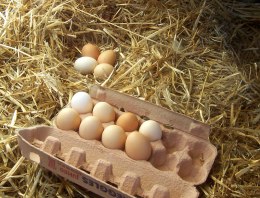
The Kale Whisperer’s Third Cookbook of Christmas is not a cookbook at all, but it is absolutely indispensable. Really. If you have a kitchen, and you do anything more in it than boiling eggs, buy this book immediately, if not sooner. Speaking of eggs, turn to “Egg, Whole” in this handy guide, and you will find that 1 large egg = 3 tablespoon (45ml) of egg yolk and whites = 1 3/4 ounces (52g). This is important information to have on hand if you 1) live outside the US and have no idea if 1 large egg = 1 standard size 6 or size 7 New Zealand egg, 2) you live in the US but only have jumbo or medium eggs in your fridge, or 3) you use your or someone else’s free range barnyard eggs and your hens are creative souls who lay whatever size egg they feel like laying.

Freerange_eggs

Does your typical carton of barnyard eggs look like this? Here’s the solution!

While any kitchen, vegetarian or not, could benefit from the wealth of information easily available in The Food Substitutions Bible, it is a godsend for any vegetarian or vegan cook. Vegans, for example, will find that they can substitute 1 cup (250ml) of whole 3.5% milk with a similar amount of soy, rice, almond, or oat milk. It will also remind them that they may need to compensate for added sugar. It also suggests vegan substitutes for eggs, butter, and honey. With this book on hand, it is a relatively simple matter to convert non-vegan recipes to vegan.

I live in New Zealand, but most of my cookbooks were Born in the USA. Not infrequently, I discover that key ingredients for some of my favourite recipes are simply not available here. Take cake flour. Cake flour is not a thing in New Zealand. But I have learned the hard way that substituting cake flour 1:1 with all purpose flour in a recipe that calls for cake flour can be a recipe for disaster. What to do? Look up cake flour and you’ll find that you can substitute 1 cup of cake flour with 1 cup (250ml or 142g) minus 3 tablespoons (45ml) all-purpose flour plus 3 tablespoons (45g) corn or potato starch (corn or potato flour, as they are known here in NZ). You’ll need to sift the flour and starch several times before you do your final measurement, and your cake might not have as fine a crumb, but it’s a pretty darn good substitute.

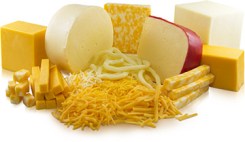
making-cheeseAnd what if you are making a potato and tomato gratin, and your recipe calls for a topping made with 1 cup (4 oz; 120g) of grated Gruyere cheese, but you don’t want to lay out the cash for an expensive chunk of Gruyere for a weeknight dinner? Look up Gruyere, and you’ll find that you can substitute Comte, Beaufort, or Emmental. OK, still pricey. But you know that Emmental is a Swiss-type cheese, so turn there and you find that, yes, indeed, you can substitute Jarlsburg (usually cheaper than Emmental) or Swiss cheese. I find the cheese substitutions particularly useful here in New Zealand. It can be difficult, and expensive, to buy the more obscure regional cheeses. And even if you can find Riccotta Salata, you might not want to shell out for it for an everyday meal.
If all this doesn’t convince you to run immediately to Amazon.com or Fishpond.co.nz to order (NZD$39.49 on fishpond; sadly, it is not yet available on Kindle — go to Amazon and complain!) a copy of The Food Substitutions Bible, let me close the deal. You want to make an apple pie. You go to the market and are faced with umpteen different varieties. Which one makes the best pie apple? What variety makes the best applesauce to go with your Hanukkah latkes? Grab your copy of FSB, turn to the back, and you’ll find a comprehensive guide to “Picking Apples.”

Do you have Celiac Disease? Can’t eat gluten? You will find here an exhaustive table of alternative flours that tells you 1) their best uses (yeast breads? quick breads?), 2) their gluten content (medium, low, gluten-free) and 3) their flavour.

Do you live in New Zealand and want to make pickles? Turn to “Trading Salts” and you’ll find that you can substitute Kosher Salt (not widely available here) with coarse or flaked sea salt. Thank goodness, your pickles won’t get cloudy and soggy from using iodised table salt!

For expats and those who don’t keep every possible size and shape of pan in their kitchen, or those who find a recipe that calls for a 28oz can of tomato puree and live where tomato puree comes only in metric cans, there are numerous useful tables: Can and Package Size Equivalents, Pan Size Equivalents (will a Bundt cake recipe fit in my Tube pan? yes), Temperature Equivalents (what is an “extremely hot oven” for pizza in metric? 260C), and Volume Equivalents (what the heck is a metric “pinch”, or a non-metric “pinch” for that matter? less than 1/8 teaspoon, or .5ml).

Downsize your spice rack. Go ahead and buy those organic free-range medium eggs when they are on sale. Don’t buy a quart of whole milk when you only need 1 cup. Don’t pay the outrageous supermarket price for creme fraiche. Buy this book instead.

improvise_adapt_overcome_bbq_apron

Chosen Families, Chosen Homes

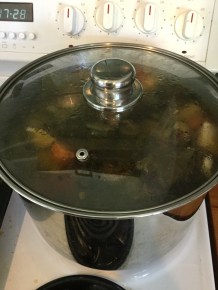
As on most Saturdays, I have a batch of vegetable stock simmering away on the stove. Today, the pot includes the trimmings from a couple of enormous leeks I bought at the market this morning, a couple of slightly overripe hothouse tomatoes, a bulb of fennel that failed to make it into last week’s dinners, the other half of a celery root (the first half went into a roasted vegetable pizza), a huge carrot, a few less-than-perfect green IMG_0249beans, an onion, three small potatoes, a couple of orphan courgettes (zucchini), a handful of garlic cloves that were too tiny to bother peeling, some odds and ends of dried mushrooms, sprigs of parsley, coriander, and mint, some sea salt, a bay leaf, and a few peppercorns. This is a pretty typical spring stock. By summer, the celery root and carrots will go, to be replaced with corn cobs, basil, and bright summer tomatoes.

Before 2013 — the year I emigrated to New Zealand — this would be the weekend I would be making hearty, autumn stock with caramelised onions, carrots, parsnips, turnips, celery, and mushrooms. That bold, dark, flavourful stock would then get reduced to become the foundation of Thanksgiving dinner. It would flavour the cheese and nut loaf that filled in for turkey at our vegetarian celebration, as well as provide the base for mushroom or sage and onion gravy. Some would go into a hearty vegetable soup for the night before. During Thanksgiving week, it seemed there was stock simmering on the stove all the time. It smelled like comfort. And home.

All the time I was growing up, my parents and I lived far from our extended family in Wisconsin. So, traveling there for Thanksgiving was impractical. We were just three — Dad, Mom, and I — and Dad hated turkey, so a big Thanksgiving bird presented something of a challenge as well. But, wait. This (mostly) isn’t a sad story of Thanksgiving deprivation. Rather, it is a story about chosen families.

CCI21112015

An early Thanksgiving. My first, perhaps?

My first chosen family consisted of my mother’s best friend in Washington, Aunt Suzie, her daughter, Kamie, and Suzie’s mother, Grandma Ambler. [One year, when I was living at their house during an internship, I made the mistake of mentioning to Grandma Ambler that I liked popcorn. I was, subsequently, nearly loved to death by popcorn. I still can’t eat popcorn without thinking of her.] Kamie was , and remains, the pesky little sister I never had. In latter years, Suzie became my Mom-away-from-Mom. And when I was little, every year, we rode “over the river and through the woods” to Suzie’s house for Thanksgiving. And Christmas. And Easter. July 4th was at our house — fireworks and all.

In 1967, my Dad got a job teaching German History at the University of Georgia and we moved south. WAY south. So far south that they still had dry counties. Mom threatened to call and having the moving van turned around. Eventually, Dad became a sort of bootlegger, driving to Fulton County — the closest county where one could purchase hard liquor — once a month to lay in a supply for all the boozers in our neighbourhood. arcadeBeer, fortunately, was a bit closer. For that, we drove to Arcade, Georgia:  a town in nearby Jackson County with a population of 229, according to the 1970 census, no liquor tax, and one package store that sold whatever beer had fallen off the back of the truck for deeply discounted prices. Apart from cheap beer, Arcade’s other claim to fame was as one of Georgia’s notorious speed traps. Athens is much bigger, now. So, I gather, is Arcade.
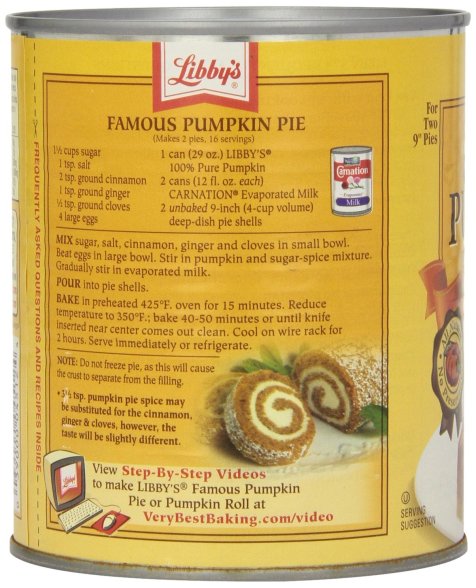
It took a while, but we gradually built a new chosen family in Athens: Dad’s best bud, Jim, his wife Betsye, and their daughter, Lexi (the second pesky little sister I never had) and Ben and Neva and their various grown daughters. The holidays rotated. Ben and Neva did Christmas. Jim and Betsye did New Year’s Eve. And we did Thanksgiving. The bird, gallons and gallons of mashed potatoes and gravy, and pumpkin pie. Always pumpkin pie: the one on the back of the Libby’s pumpkin can, which is the last pumpkin pie recipe you’ll ever need. Trust me.

Libbys pumpkin pie

The Libby’s Famous Pumpkin Pie recipe. Now you know everything you need to know about making pumpkin pie.

My contribution was the stuffing. Next to mashed potatoes and gravy, for me, the best part of Thanksgiving dinner was the stuffing. Which, in my lexicon, is stuffing, even if it never sees the inside of a bird (or anything else). You may choose to call it dressing. I’ll forgive you. My Dad had a fabulously productive chestnut tree in the front yard. And yes, it was spreading (but not spreading enough for a village smithy). So, starting in the early 1980s, when the tree started producing fruit, I started making chestnut stuffing, and never looked back. At least, not until Dad, growing old and tired of picking up the prickly outer shells, cut down the tree. Turns out, when run over by a lawn mower, they become potentially lethal projectiles.

Chestnut stuffing — chestnut anything — is a labor of love. First you have to cut an X in the shell (not even as close to as easy as it sounds), then either roast or steam the chestnuts, then peel off the still really, really tough shells. But it is worth it. The meat of the chestnut is rich, musky, and a bit chewy. It makes gorgeous turkey stuffing, but it is an even more rewarding vegetarian stuffing, cooked in a dish instead of a bird.

Apart from the chestnuts, there was nothing tricky about my stuffing. It had all the usual suspects: a package of Pepperidge Farm dry stuffing mix (I’ve tried making my own croutons for stuffing out of home baked bread. It isn’t worth it. I don’t sew my own shoes, either), a couple of chopped celery stalks, an apple or two, some poultry seasoning, a lightly sautéed chopped largish yellow onion, and enough vegetable stock. How much is enough? Enough. It depends on how wet (or dry) you like your baked stuffing. I like mine pretty mushy; more like bread pudding than pilaf, if that makes sense. With lots and lots on gravy on.

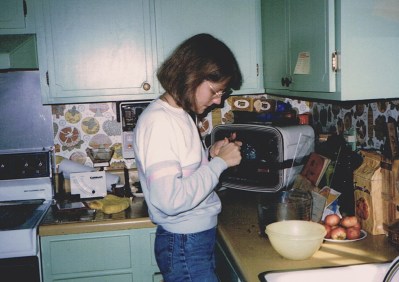
CCI21112015_2

Preparing chestnuts for chestnut stuffing. Judging from the hair and the vintage 1970s decor, this was early 1980s. As 70s wallpaper goes, though, this wasn’t bad.

When I moved back to Washington to pursue my brilliant career, I found that the trip between DC and Georgia was a bit too long to make twice in a month’s time. My priority was to go home for Christmas, so I was a Thanksgiving orphan. Most years, I returned to the folds of my original chosen family — Suzie and Kamie.  I spent Thanksgiving 2000 glued to CNN, following the unfolding drama of the “hanging chads” (in case you missed it, Bush won in a TKO) unfold in Florida, with a great bottle of wine, and a turkey TV dinner. A couple of years, I flew out to spend Thanksgiving with my friends Karen and John in Corvallis, Oregon. A long weekend of eating beautiful Oregon produce and tasting Willamette Valley Pinot Noir. Heaven. The year my father died, Mom and I spent Thanksgiving (and Christmas) at home, watching Jane Austen DVDs, trying not to cry and pretending the holidays weren’t happening. I don’t remember what we ate. If we ate. Grief made everything taste like sand.

In 2009, I married the love of my life, and we built our own little chosen family with our neighbours (and dog sharers) Pete and Anita, some years, with their son Mike and his lovely bride, Mary Beth. As Mike and Mary Beth are almost vegetarians, we established a new Thanksgiving tradition. I made the cheese and nut loaf and gravy, they provided sides, and Anita made the pumpkin pie. Most years, I also made some roasted brussels sprouts. In addition to kale, I fancy myself an evangelist for all misunderstood brassicas. We proved that it is possible to eat yourself into a coma without a single turkey being harmed.

339558_10150484805768410_1525651690_o

Our last Thanksgiving in Virginia, with Pete and Anita. And that is not a dog at the table.

This will be the first Thanksgiving since we moved to New Zealand that I won’t be out of the country on travel on the fourth Thursday in November. It won’t be Thanksgiving here. It will just be the fourth Thursday in November. I have an accordion lesson scheduled. It’s just another day. Moreover, it will be just another spring day. There are no environmental triggers here that say : Hey! You! It’s almost Thanksgiving! The farmers’ market was full of fresh asparagus, favas, spinach, and strawberries — none of which rode here on airplanes or cargo ships. There are no specials on turkeys, or cans of Libby’s pumpkin stacked in the aisles at the grocery store. In fact, cans of pumpkin are hard to come by, here. You have to find a store with a special “American food” section, and then, you may or may not find a can of Libby’s pumpkin.

I think I will try, though. Maybe a Libby’s pumpkin pie is just the right thing to bring a little Thanksgiving to my new chosen home in New Zealand. In her touching new memoir/cookbook, My Kitchen Year, Ruth Reichl mentions that she roasts her Libby’s pumpkin a bit to caramelise it and intensify the flavour. While, in general, my position is “don’t mess with the Libby’s pumpkin pie,” maybe I’ll try that. A new pumpkin pie for a new chosen home in a land without Thanksgiving. And, in time, we will build a new chosen family. We are making a good start. They know who they are. And perhaps, in another, year, our new chosen family will come together for a chosen Thanksgiving, not to honour the autumn’s bounty, but to celebrate the promise of spring.

turkeys

Iced Tea

Let me start by warning that, as much a I love him in SVU, I will not be writing about this guy:

Ice-T

We’re just talkin’ a different sort of Iced Tea here. But he does deserve a shout out.

When it comes to per capita tea drinking, New Zealanders are right up there with the British Motherland. I am an enthusiastic convert to the afternoon cuppa — my favourite is Yorkshire tea with a little milk, no sugar. It is a cup that aspires to be coffee, but without the jittery after effects. I like Earl Grey, too, but with lemon, no milk. My all time personal favourite is Lapsong Suchong, which is the closest thing to non-alcoholic Islay Single Malt. But as my beloved is a strict traditionalist, and since it is he that usually puts the kettle on in the afternoon, my usual is English Breakfast, milk, no sugar.  It is important to note that Brits (and Kiwis, in general) believe that strong, hot, very sweet tea, is the cure to whatever ails you. And they’re usually right. I’m not a biscuit dunker, but, Judi Densch’s description of the process of Builder’s tea dunking in “The Best Exotic Marigold Hotel” has me thinking twice.

And, just for the record, an oreo cookie just screams for a glass of ice cold milk. I’m a twist-lick-dunk-dunk girl.oreo dunking

I now drink my tea almost exclusively hot, out of a mug. This is a great departure from the South of my upbringing, where tea is drunk only one way: iced and sweet. This shift doesn’t reflect any dampening of my love of iced tea; rather, it is a function of living in New Zealand, where iced tea is just another sugary drink sold in bottles with strange and unwelcome flavours like peach and mango. In most of the world, outside the Southeastern United States, you can’t walk into a restaurant or cafe, order iced tea, and just assume they know what you mean. You are likely to get brewed hot tea poured over ice with some sugar packets or Splenda on the side.

sweet tea

Even where I have to settle for unsweetened iced tea, it is my restaurant beverage of choice. It is more festive that just plain water, less intoxicating (and usually cheaper) than beer or wine, goes with almost any cuisine, and because you actually pay for it, waiters are less cross if you choose to linger over an additional glass after you’ve finished your meal. It plays the same important social function as that last little bit of wine in the bottle. And if you choose not to drink alcohol, you don’t feel quite so awkward hanging around. I costs next to nothing to make, so everyone wins!

Proper iced tea has three ingredients: water, tea, and optional sugar. A slice of lemon is acceptable, as long as I have the option of picking it out. No ginger. No lemonade. No peach, mango, raspberry, or — please GOD — frappe.

Kool Aid pitcher

My Grandpa and Grandma Saltenberger had this plastic Kool Aid pitcher and cup set that made the Kool Aid taste even better

I didn’t grow up with iced tea. My family came from Europe via the Upper Midwest, where the whole point of drinking things was, for the most part, keeping warm. Or intoxicated. When we moved to Georgia, where it is hot . . . DAMN hot . . . for at least six months a year, the refreshing beverage of choice at our house was Kool-Aid. The old fashioned kind that didn’t come with sugar.  And ours didn’t get sugar. It was, to say the least, tart.

I learned about iced tea from my southern friends, who drank the stuff by the gallons.  And iced tea in Georgia is sweet. I mean really sweet. As in make your cavities SING sweet. While the iced tea nation pretty much starts at the Mason & Dixon Line (essentially the border between Pennsylvania and Maryland), the Sweet Tea Nation begins at the Virginia – North Carolina border). If you grew up in Virginia, and you’re accustomed to ordering iced tea and adding your own sugar, you’ll need to change your strategy in the Sweet Tea Nation. Here, tea is sweet. And cold. Even in winter. If you want that other stuff, you will have to ask for it. You will have to say, out loud, in front of God and everybody, ” I would like unsweetened tea, please” and immediately brand yourself as an Yankee. You can also order hot tea, but I won’t promise what you’ll get. It is (sort of) acceptable, and slightly less suspicious, to order half-and-half (iced tea, half sweet, half unsweet).

Now, I know I said I don’t approve of lemon-flavored iced tea, but there is an exception: the Arnold Palmer, which is half iced tea and half lemonade. This is best made with unsweetened tea and real (ONLY real, squeezed) lemonade (not the instant stuff, and not the pub lemonade you get in your shandy). This is not, however, southern. Arnold Palmer is from Pennsylvania.

If you happen to find yourself at Zeb Dean’s Bar-b-que in Danielsville, Georgia, you’ll get: a loaf of Sunbeam Bread (in the bag), a plastic pitcher of sweet tea (you can also get one of unsweetened tea, if you have the courage to ask for it — then you can make your own half-and-half), a serving of “Stew” (aka Brunswick stew, but made with the barbecue detritus instead of the traditional squirrel), a pitcher of Zeb’s peppery, vinegary sauce, and the best damned pulled pork barbecue in the whole wide world. Strictly speaking, however, Zeb’s barbecue is not vegetarian. So this is not an official Kale Whisperer endorsement. But really, if you are ever headed south on I-85, and you eat pork and/or are a slacker vegetarian like me (Shame on you!) it is well worth the 45 minute or so detour. (Sorry, Wee Charlie.) zebs

So, what makes southern sweet tea unique? There are two key factors: the tea, and the sugar delivery system.

First, the tea. Most commercial teas — Lipton, Tetley, PG Tips, etc. — are for brewing and drinking hot with milk. So they are WAY to strong for iced tea. When you chill them, as you must do with iced tea, the tea turns cloudy. Not only does it look awful, but it makes the tea too tanniny. When I was growing up, the mainstream tea companies hadn’t caught on to this yet, so the iced tea brand of choice was Lusianne: “Alway clear as a bell.”

Nowadays, most of the big companies offer special iced tea blends that address the cloudiness issue, but for those who live in non-iced tea cultures, like New Zealand, there is still an alternative to those horrid iced teas in bottles. The answer is sun-brewed tea. I don’t understand the science, but it you brew regular tea in the sun, instead of with boiling water, it doesn’t get cloudy. It works like this:

Sun Tea:

  • Find a large glass container with a fairly tight lid and fill it with the desired amount of COLD water.
  • Add 2 or 3 regular teabags (or the equivalent amount of loose tea) per litre (or quart) of water.
  • Place the jar in the sun for no more than 4 hours (obviously, this only works on sunny days).
  • Then remove the teabags (or strain out the loose tea) and chill the brewed tea as soon as possible.
  • Sweeten (or not) to taste. This works with regular or green tea).

The sugar delivery system for proper sweet tea is easy peasy, and absolutely crucial. You can sweeten your sun tea with Sweet and Low or Splenda, but I don’t want to know about it. Unless you like your tea cloyingly sweet, you aren’t going to add that much sugar anyway. You may, however, add artificial sweetener if you send me a doctor’s note. Here’s the process:

Simple Sugar Syrup for Southern Iced Tea:

  • Put one cup of sugar and three cups of cold water in a saucepan that is high enough not to boil over.
  • Watch it carefully.
  • Bring the sugar and water to a boil and AS SOON as the water starts to boil, turn it down to a simmer.
  • Simmer the water and sugar, stirring constantly, until the sugar has completely dissolved. This usually takes about 5 minutes. Cool for 4 hours.
  • Done. But,
  • If you like flavoured tea, you can, at this point, add mint, basil, a little lemon or orange peel, or fresh ginger — whatever flavour you like — and steep until the syrup is cool. Again, about 4 hours. Pour the syrup through a sieve, and press the flavouring to get out all the essential oils and yumminess. This way, your sugar syrup will taste better and last a long time in the fridge without moulding.
  • You can use the mint syrup to make that other Southern Classic, the Mint Julep, which involves: a mint julep cup (or an old fashioned-sized glass) filled to the brim with crushed or shaved ice to which you add a TBS (or two if you have a sweet tooth or don’t like whiskey), and 1 1/2 jiggers of whiskey — Bourbon or Tennessee mash are traditional, but mild blended scotch works too. What you get is a sort of alcoholic shave-ice. I haven’t tried this with Single Malt because, why would you? But you can try it if you want.
  • Basil syrup makes a nice change, but then you are absolutely not allowed to call it a Mint Julep. Really, though, the cocktail possibilities are endless. Once you try it, you won’t want any other cocktail in the heat of summer, except, perhaps, a nice G & T (with bitters).

And remember:

Sweet Tea Keep Calm


Home

New Zealand is my new home. I felt at home here almost from the start. Kiwis get my sense of humor in ways that my fellow Americans never did. Simon and I can live 20 minutes from the center of the nation’s capital and keep pigs, alpacas, and (coming soon), chickens. Work-life balance is a real thing here, not just an aspiration. It is possible to drive from our home in the hills to the beach in 20 minutes or less. Almost nobody here goes back to work on January 2nd. New Zealand is closed in January. The January “blahs” that used to knock me sideways every year just aren’t a thing.

There has been much to learn: driving on the “wrong” side; the metric system; Kiwi English; spelling; that horizontal rain makes umbrellas pretty much pointless; that July isn’t summer, and January isn’t winter; that there are 18 hours of daylight on Christmas and 8 hours of daylight on the 4th of July; the rules of cricket; that the number 10 is pronounced “tin” while 7 is pronounced “seevin.” Footy games are “matches”, the field is the “pitch”, and it takes rugby players roughly 80 minutes to play an 80-minute match. And there are no TV time-outs, special teams, shoulder pads or helmets. So you’d better have your beer and chips ready before play starts.

New Zealand is my home. For me, though, the notion of home is bit slippery. You see, I have many “homes” in places where I’ve never actually lived. In addition to my actual homes (Virginia, Georgia and Wisconsin, New Zealand), I get homesick for, inter alia: New Orleans, Edinburgh, Paris, the Masai Mara, and Antarctica. In pondering how this is possible, I’ve come to understand for me, “home” is about memorable experiences and the people with whom I shared them.

And I remember those experiences in terms of food.

I discovered my love for jazz and zydeco over coffee and biegnets with my parents at the Café du Monde. My friend Anita and I kicked off a long-weekend sharing our love of art with glasses of red wine and the best omelets ever for breakfast (well, an early lunch) at a sidewalk café on the Rive Gauche after an all-night flight to Paris. My two chosen sisters – Susan and Elizabeth – and I ate great piles of mussels and chips (but not haggis) after exploring ruined castles in Scotland, and drank gallons of vino verde in the hot, dusty Alentejo in Portugal. I ate delicious grilled langoustines in Bali while my venerable Elder Sister, Katy, fed her grilled fish to the street cats. Simon and I drank gorgeous Argentine and Chilean wines while watching the penguins and icebergs in Antarctica. And I reveled in quaffing Tusker beers with my fellow campers after a hard day tracking wildlife with my intrepid Masai guide, Josh, at Freeman Safaris in Kenya.

In fact, sharing memorable meals is, for me, the way I end up expanding my chosen family. Conversations and experiences can create acquaintances, but for me, breaking bread creates family. And family is home.

Taste is my most evocative sense. Music is a distant second. Christmas isn’t Christmas until I’ve had one of Auntie Janice’s nutmeg logs and a slice of my mother’s stöllen. Passion fruit (a key ingredient in New Orleans’ famous hurricane cocktail and also popular in New Zealand) makes me hear Dixieland jazz and zydeco. My cheese and nut loaf evokes Thanksgiving dinner with Pete, Anita, Mike and Mary Beth, even in New Zealand in July. Peaches take me take me back to the battered old formica kitchen table at my grandparents’ farm where Tanta comforted me with peach küchen after a run-in with the wasps in the outdoor privvy. Every time I eat oatmeal, I hear Grandpa Saltenberger saying: “If you don’t eat your oatmeal, you won’t grow hair on your chest.” Somehow, that arugment worked for him: I ate the oatmeal. It never occurred to me, at 7, that I might not want hair on my chest.

Not all the memories are happy. I was eating baklava the moment my appendix ruptured, and I still can’t face the stuff. When I was about 6, I ate whipped cream until I was sick (they warned me), and it still gives me pause. At about the same age, I went to the fridge and took a big slug out of what I thought was ice water. It was martinis. Please, never order me a martini! And tuna casserole will forever take me back to the hours and days I spent by my father’s bedside when he was dying in hospice.

1069140_10151793653433410_1120628792_n

Dad’s winter greenhouse, circa 1969.

With absolutely no disrespect to my loving and all-around-wonderful mother, my Dad was (and remains, eight years after his death) the center of my universe. He was a World War II veteran, a brilliant scholar, and a venerated teacher. But in his heart of hearts, he was a farmer. Not a gardener – he had no truck with roses or posies. That was my mother’s realm. He grew food. Every summer we drowned in bell peppers (capiscums), green beans, snap peas, shelly beans, okra, eggplants, radishes, spinach, and lettuces. He even grew summer squash (courgettes) – crooknecks and zucchini – even though he hated it, because he knew I loved it. Half of the back yard was covered in raspberries – because Mom loved them. His fig tree was legendary – it was the fig tree equivalent of the loaves and fishes. It fed the ten thousand hungry southerners with figs. And with my mom’s famous fig pizzas. Yum.

But what I most associate with my father and, hence, with love and family, is tomatoes: his huge, ugly, sweet, juicy heirloom tomatoes. When I moved away from home, he would pick them green, wrap them in newspaper, and ship them to me. One bite of a vine-ripened tomato, warm from the sun, transports me right back to summertime Saturday afternoons, when we three sat down with a couple of big, fat tomatoes, a jar of mayo, salt, pepper, and a loaf of squishy white bread – no lettuce, no bacon – and ate tomato sandwich after tomato sandwich, washed down with unsweetened grape Kool-Aid. I’m sure, when I die, my last thought of my father will be those tomato sandwiches.167185_10150125454908410_190088_n

I only know how to tell my story, and my family’s story, through food. Family, love, life, and home are all embodied, for me, in food: in the making of it and the sharing of it. In this blog, I will share what I have learned about living and cooking as a vegetarian, and living and cooking as a vegetarian in New Zealand. I will also share my stories: the ones I remember from my past homes and the ones I am making here in my new home. Some are funny, others are sad. All are, for me, full of the kind of meaning that makes ordinary food a meal, makes meals into memories, and makes memories into home.