My first essential cookbook suggestion is really a category. Every vegetarian kitchen needs one, basic, all purpose cookbook. The kind of cookbook whose first sentence reads: Stand facing the stove. This is the cookbook you will go to when (like me) you can’t remember how long it takes to hard boil and egg. I hate hardboiled eggs. I don’t eat hardboiled eggs. And I don’t want to take up vital brain space remembering how long to cook hard boiled eggs.
This is also the cookbook you will go to if you live in New Zealand, which is metric, and most of your cookbooks are from the US and, consequentially, not metric.
This is also where you will go if you come home from the farmer’s market with a huge bunch of Cavolo Nero, and you don’t know what it is or how to cook it. Actually, if that happens, you will come to the Kale Whisperer. But you know what I mean.
When I was learning to cook, that cookbook was The Joy of Cooking by Irma S. Rombauer and Marion Rombauer Becker. I read it cover to cover. Several times. It was my mother’s default wedding gift. Every new bride needed a copy of Joy. When I got married, in 1981, I got at least five copies. In my mind, it remains the essential all-purpose cookbook. If you aren’t a rigid vegetarian, and you might want to know how to poach a salmon, you’ll want this as your basic cookbook. Be sure to get the 75th anniversary edition, not the controversial 1997 “All New” version. It lacks the vital “Know Your Ingredients” section and some of the more “quaint” sections, like canning, pickling, and preserving. If you can find a used copy of the original, preferably with someone’s notes scribbled in it, all the better.
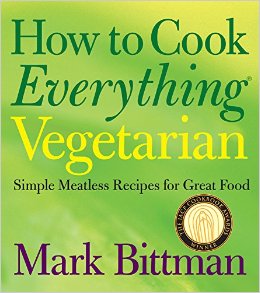
A newer, cooler, more vegetarian-focussed option is Mark Bittman’s How to Cook Everything Vegetarian (Wiley, 2007).Bittman is a food journalist and a leading advocate of sustainable cooking. How to Cook Everything Vegetarian includes two excellent introductory chapters on equipment and techniques, numerous instructive sidebars offering variations, lists, and charts by ingredient. It uses an icon system, so you can quickly identify Fast, Make-Ahead, and Vegan recipes, and includes a table of “Recipes by Icon.” There are a few menus, and an extensive and useful index, so it is easy to find what you are looking for. Even if you are not vegetarian, you can’t go wrong with this one; although, if you prefer a more all-purpose cookbook, his How to Cook Everything is also excellent. Obviously, however, you will lose some of the specialised vegetarian cooking content.
My third recommended option is Deborah Madison’s The New Vegetarian Cooking for Everyone (Ten Speed Press, 2014). This one is weaker than Joy and How to Cook Everything on technique, but its excellent first chapter, “Becoming a Cook,” includes valuable advice on Composing a Vegetarian Menu, Menus for Holidays and Special Occasions, and Wine with Vegetables. Chapter Two: Foundations of Flavor is also excellent and includes sections on various types of ingredients — herbs, chills, cheese, dairy and dairy substitutes, to name just a few. The thing I like best about Madison’s cookbook is that she includes flavour matches for individual vegetables and fruits. This is where you turn if you want to know what goes with Brussels Sprouts — butter, olive oil, mustard oil, cream, béchamel, blue cheese, cheddar, mustard, capers, lemon, vinegar, caraway, oregano, parsley, dill, curry spices, and juniper.
Depending on where you live, you may have other, preferred all-purpose cookbooks. If so, please tell us about it! For my mother’s generation, the classics were the Good Housekeeping or Fanny Farmer Cookbooks. In France, it would be the classic Larousse Gastronomique (1938). Times change, and different cultures have different basics. The important thing is to have one. It will be your touchstone and security blanket. Years from now, it will be splattered, scribbled on, and held together with duct tape and rubber bands. It will be the outward and visible sign of your cooking journey.
The early 1990s were a pivotal period in human history: the Soviet Union collapsed ending the Cold War, the United States became, for a while, the world’s unchallenged “hyperpower,” Bill Clinton was elected President of the United States, and Susan and I discovered Bobolis.
The late 1980s were the black hole in my pizza universe. The years between January 1985 and June 1989 were a wormhole of studying, drinking, and bad fast food . . . and drinking. After I separated from my first husband, I made it my personal goal to 1) get a Ph.D. in military history, and 2) drink all the beer in central Ohio. I eventually accomplished #1 and fell just short of #2. My two roommates and I were each living on the princely sum of $385/month, which paid for rent, utilities, books, beer and food, pretty much in that order. We lived on chicken wings (on BW3 nickel wing days), beer, White Castle burgers, beer, Mickey D’s Happy Meals (cheeseburger and strawberry shake for me), beer, and lots and lots of bad pizza and beer. Notice a pattern here?
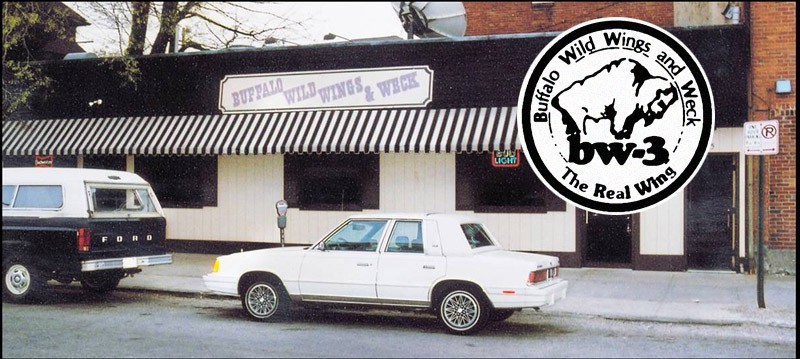
Historical note: BW3 — Buffalo Wild Wings and Weck — eventually dropped its third W and became the national chain, Buffalo Wild Wings. We ate at the very first one. Now they have a NCAA Bowl Game. I wish I’d bought stock.
The original BW3, including the satellite dish that beamed in MTV and enabled my lifelong adoration of Billy Idol.
The measure of a good pizza was size (the bigger the better) and price (the cheaper the better). Since I lived with two (male) roommates, fellow military history grad students, in a crappy apartment without a workable kitchen, making my own wasn’t an option. There was one excellent pizzeria, Panzera’s in Grandview, Ohio, a few miles outside of Columbus, but it was neither cheap nor close to campus (which meant driving, which meant gas) so it was definitely a special occasion thing. It was family run and had the best pizza I’d eaten since the sad demise of The Capri. Their vegetarian pizza (with green peppers (capsicum), onions, mushrooms, hot peppers, and black olives) opened my eyes to the possibilities of pizza without sausage or pepperoni. They also cut their pizzas into squares, which I thought was very cutting edge and sophisticated. Their crusts weren’t as good as The Capri’s, but they were pretty close: not to thick, not too thin, not overloaded, just right.
Panzera’s pizza: note the avant garde slicing style. I liked the ones on the “corners” with a low crust-to-topping ratio, the sign of how good the crust was.
Unlike Capri, Panzera’s is still in business. If you find yourself in Central Ohio, go there. Eat Pizza.
Eventually, I plodded through to the end of my eye-wateringly boring dissertation and headed to Washington DC with my shiny new Ph.D. to light up the policy analytical world with my brilliance. I landed at the Institute for Defense Analyses, where I finally met the sister I never had. Susan, our third chosen sister, Elizabeth, and I bonded over dogs. Specifically, over Peanut – my beautiful, blonde, but not too s-m-a-r-t rescue mutt – and (a bit later) Crackerjack – a pesky, willful, and smart-when-it-suited-him cockapoo with a highly-developed taste for shoes, blueberry muffins, and pizza crust.
Peanut and Crackerjack, circa 1993. Peanut was a beauty, but as our friend Elizabeth put it, not very “S-M-A-R-T.”
When I took off, in 1993, on a mission trip to Palestine, Peanut and Crackerjack (who was less than four months old at the time) stayed with Susan, who, amazingly, was still speaking to me when I returned three weeks later. Over the coming decades, we Three Musketeers — Susan, Elizabeth, and I — shared many adventures in travel, food, wine, and butterflies.
And Susan and I bonded over Bobolis. Specifically, Bobolis topped with fresh summer tomatoes, roasted sweet corn, basil, and fresh mozzarella. Sometimes we played around with the formula – goat cheese instead of mozzarella; frozen corn and canned tomatoes, or grape tomatoes, in winter; a little chicken here, a black olive there (but only on my side: Susan hates olives). But for the most part, about once a week, we would share Bobolis and a bottle (or two) of wine. It was a friendship made in heaven.
The Three Musketeers at the Virginia Wine Festival in 1994-ish.
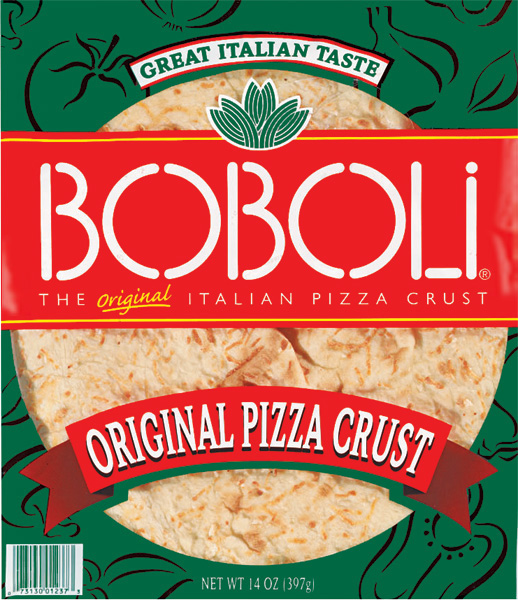
Now, Boboli pizza crusts – with their high sugar content, additives, and alarmingly long shelf life – are not the kind of food I generally advocate. I haven’t had one since I started making my own pizza crusts 20 or so years ago. But at the time, when I was still teaching myself to cook and intimidated by yeast, they seemed just the ticket. Way cheaper than a restaurant pie, they also provided control – at least – over toppings. I’m sure if I ate one now, I’d find it pretty revolting – sort of the way I feel about the other great junk foods of my past, like Twinkies and Kraft Macaroni and Cheese. But in 1993, they provided the most convenient and user-friendly canvas available for me to begin my homemade pizza journey.
And my journey moved steadily forward. After Boboli came the bread machine era. My Dad was a bread machine early-adaptor. Mom made awesome fresh bread, but she rarely went to the trouble of making it once I left home and it was only the two of them. The bread machine was their perfect solution – the loaves weren’t too big and the whole process was pretty easy. Over the years, Mom developed some plausible bread machine adaptations of classics. Eventually, I got one for Christmas, too. Sadly, the thermostat (or maybe it was the timer) on mine went fluey early on, resulting in whole-wheat hockey pucks. But I kept the lumbering beast around because it made some pretty awesome pizza dough. It was just the thing when I was living alone, becoming increasingly adventurous in the kitchen, and wanted to make the occasional pizza-for-one.
What I never seemed to be able to accomplish, though, was that crispy, blistery, slightly tangy crust that is – for me, at least – the pizza crust ideal. I tried switching out flours – bread flour made the crust too springy and hard to roll out. I tried special pizza crust flours – the best one is from King Arthur Flour, but you have to be organized enough to remember to order it.
I got a pizza stone, which improved my homemade pies dramatically. But then there was the problem of getting the pizza crust onto the stone. I bought a pizza peel, which looked impressive hanging in my kitchen, but which usually resulted in disaster. I tried cooking the pizza part of the way on a cookie sheet, then sliding it off directly onto the hot stone. That worked pretty well, but the crust still didn’t have that magical, blistery crispness.
Two developments sapped my motivation: Trader Joe’s came to Northern Virginia and a new pizzeria, Valentino’s, opened in Alexandria. Trader Joe’s sells a pretty darned good pre-made pizza dough. You can buy a package or two to have in the fridge for those spur-of-the-moment pizza cravings. Valentino’s is a New York-style pizzeria, and the pizza was awesome. It had the added benefit of being on my way home from work. And they had plenty of vegetarian options, so Simon and I didn’t end up eating the same pizza combo week after week. That, plus the fact that Simon and I had work schedules that meant that we usually only ate dinner together a couple of nights a week, put a pin in my pizza baking.
Moving to New Zealand reawakened my pizza mojo. There is an excellent local pizza chain, Hell Pizza. We are partial to “Purgatory” (feta, spinach, sun-dried tomato, garlic, mushrooms, onion and kalamata olives) and “Limbo” (blue cheese, mushrooms, caramelized onions, tomatoes, and kalamata olives). Hell now advertises that all their pizzas are free range, so we can take comfort that all the little pizzas run free before they are popped in the oven. But Hell pizza doesn’t have that perfect pizza crust that my pizza soul craves. It did, however, have one very awesome ad campaign:
So, once we settled into our little lifestyle block in the Western Hills of the Hutt Valley, I made it my mission to learn to play the accordion and master the perfect pizza crust. Not necessarily in that order. And with a little research and a lot of practice, I’ve got pretty damn close to the perfect pizza crust. The accordion will take a bit longer.
Here’s the bottom line: it turns out that all these years I’ve been trying too hard. Homemade pizza dough is easy. It’s not as easy as falling off a bike, but it is so easy that there is no excuse not to make your own.
Making your own pizza crust has numerous advantages that you’ve heard dozens of times before: its cheaper than restaurant pizza, it doesn’t have lots of baddititives, you can control the fat, salt, and sugar content, and you can top it with whatever you like. Even potato chips and pickles.
It is also fun and rewarding.
And if you serve it to your non-pizza-crust making friends, they will say “ooh and ahh” (because they will be too busy chewing to say more), and everyone will think you are very clever, indeed!
I have settled on a few basic things that you must remember when making your own version of perfect pizza crust:
You can make pizza crust at the last minute, but you cannot make perfect pizza crust at the last minute. You must plan ahead, at least 24 hours. They key to pizza crust that is the perfect combination of blistery, crispy, and tangy is time. But it takes less than five minutes to set the dough up, and then it just sits happily in your fridge for a day or two. Then, on the day you are planning to bake it, take the dough out early in the day and let it lounge around in your kitchen until it looks like a science experiment. This was, until recently, the greatest barrier to my achieving pizza crust nirvana.
Use plain old unbleached all-purpose flour. Bread flour has too much gluten and will make your crust harder to stretch and tougher. Fancy pizza flour blends are not worth the extra cost. And weigh your flour. That way the ratio of dry to wet ingredients will always be right.
Stretch your pizza dough onto a sheet of parchment or baking paper, and let it rest there. When its ready to bake, you can just shift the paper on to a baking sheet or pizza peel, and shift it directly onto the pizza stone. Don’t let anyone persuade you that you can do the same thing with cornmeal. It will end in tears. And who wants uncooked cornmeal all over their pizza crust?
Use a pizza stone, or baking tiles. The key to perfect pizza crust is to cook it fast at very high heat. If you don’t have a pizza stone and are too poor to go to the building supply store and buy a few unglazed ceramic tiles, you can start the pizza on a baking sheet and the transfer it midway through baking directly on to the oven rack. I leave my pizza stone on the bottom rack of my oven all the time.
So, here’s the drill:
Start by putting 1 teaspoon (5 ml) of active dry yeast in 1 1/4 cups (355 ml) warm (verging on hot) tap water. Don’t use quick rise (bread machine) yeast. Set it aside and let the little yeasties wake up and start farting. After a few minutes, it will look like this:
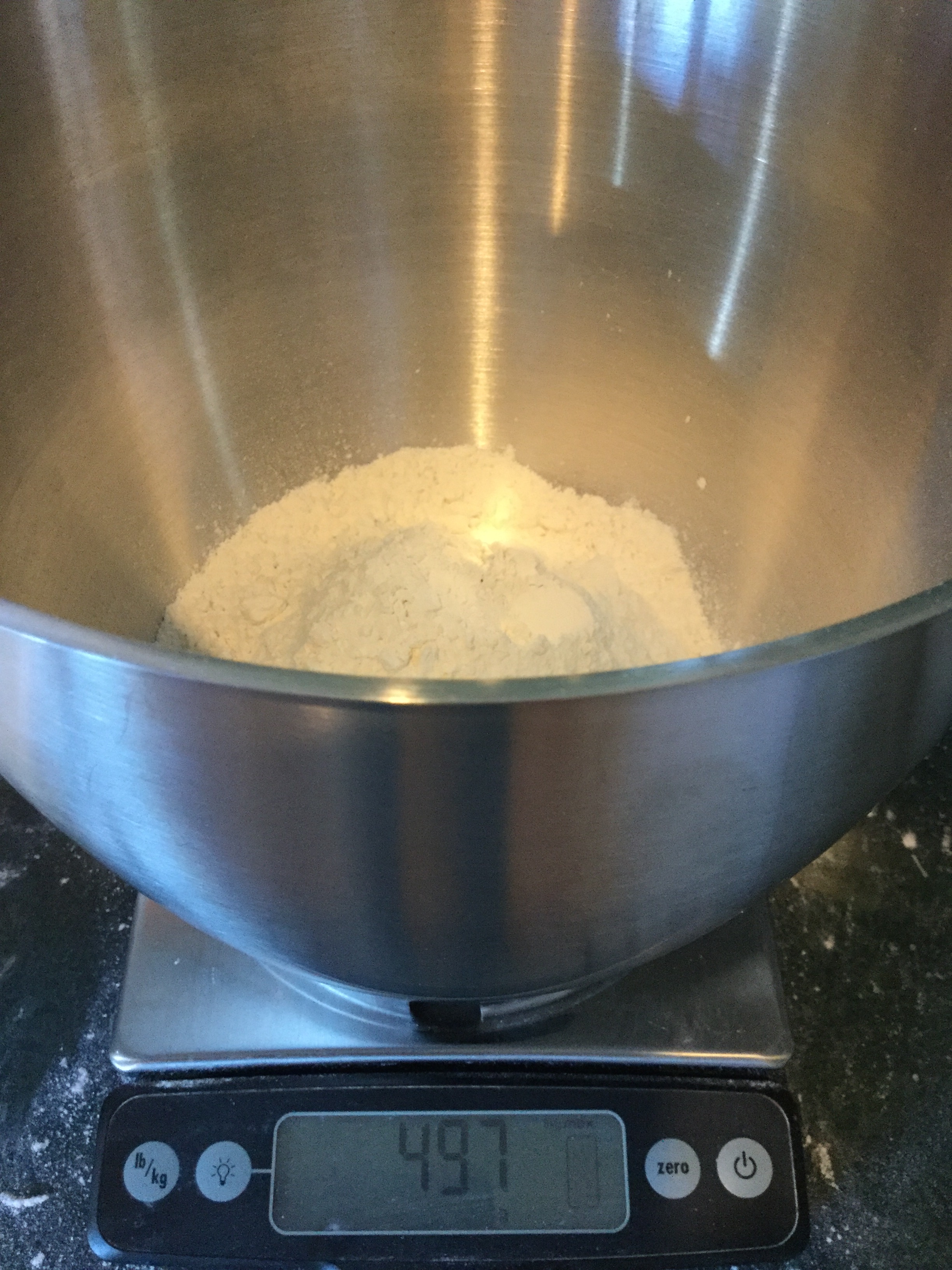
Measure 497 grams of all purpose flour into the bowl of a standing mixer or food processor. That’s 3 1/2 cups if you don’t have a kitchen scale.
Add 1 1/2 teaspoons (7.5 ml) salt (I used pink salt here, but kosher, table, or fine sea salt work just as well)
When the yeast has demonstrated its liveliness, add 2 Tablespoons (30 ml) of extra virgin olive oil. You’ll end up with a bubbly concoction that looks like this:
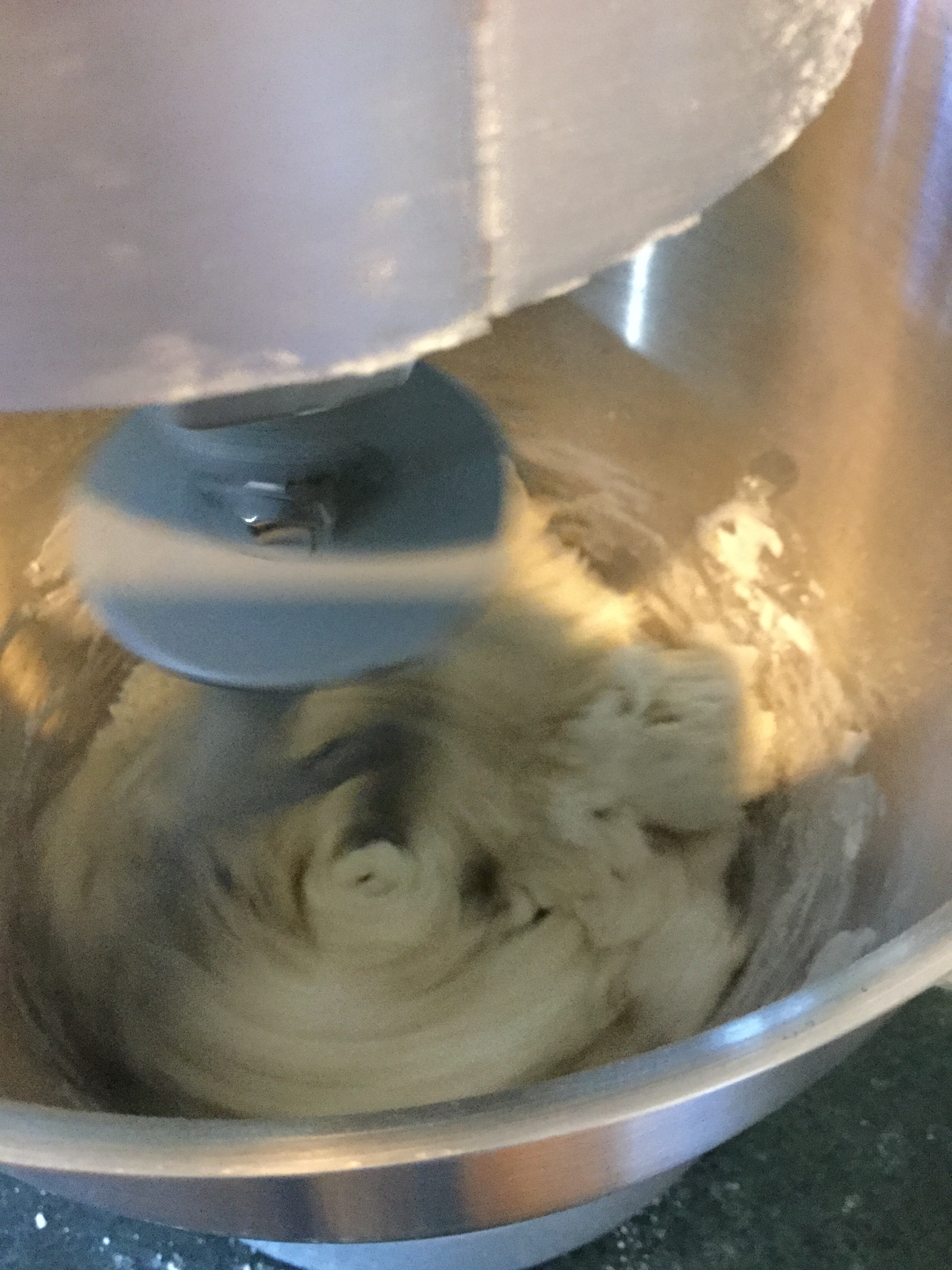
Attach the paddle to your mixer (or the metal blade, if you are using a food processor) and run, or pulse it for a few seconds to incorporate the salt and flour. Then, gradually (but not too gradually) pour in the water/yeast/EVO mixture.
Some recipes will tell you to add the flour to the liquid, but I find adding the liquid to the flour just works better.
Let the mixer run until the dough starts to come together into a shaggy glob. It won’t really come together in a smooth ball — if it does the dough might be a bit dry. It should pretty much clean the sides of the bowl, though.
At this point, you can take the dough out of the bowl and put it on a well-floured surface. It will look a mess:
Now, gently knead the dough for just a few turns to coax it into a smooth, but still slightly sticky ball:
Put your lovely batch of pizza dough into a plastic bag and pop it into the fridge, like this:
Go to bed.
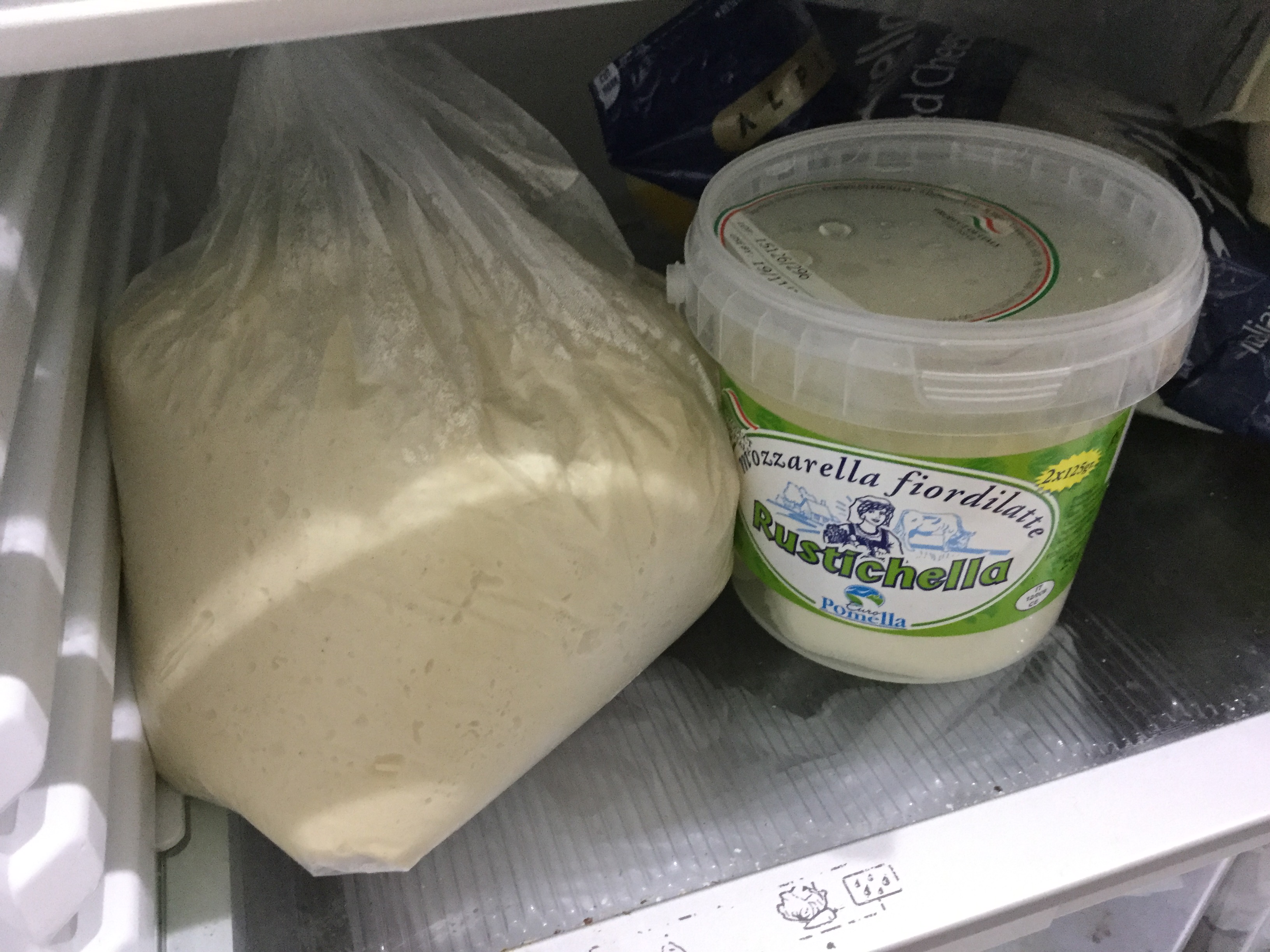
When you wake up the next morning, you’ll find those little yeasties have been doing their thing all night, and your fridge now looks like this (this is a real, untouched photo):
This recipe makes enough dough for two good-sized pizzas, so at this point, you want to take the now risen and VERY sticky dough out of its overnight bag, knead it down a few turns, and divide it into two more-or-less equal parts (the kitchen scale helps here):
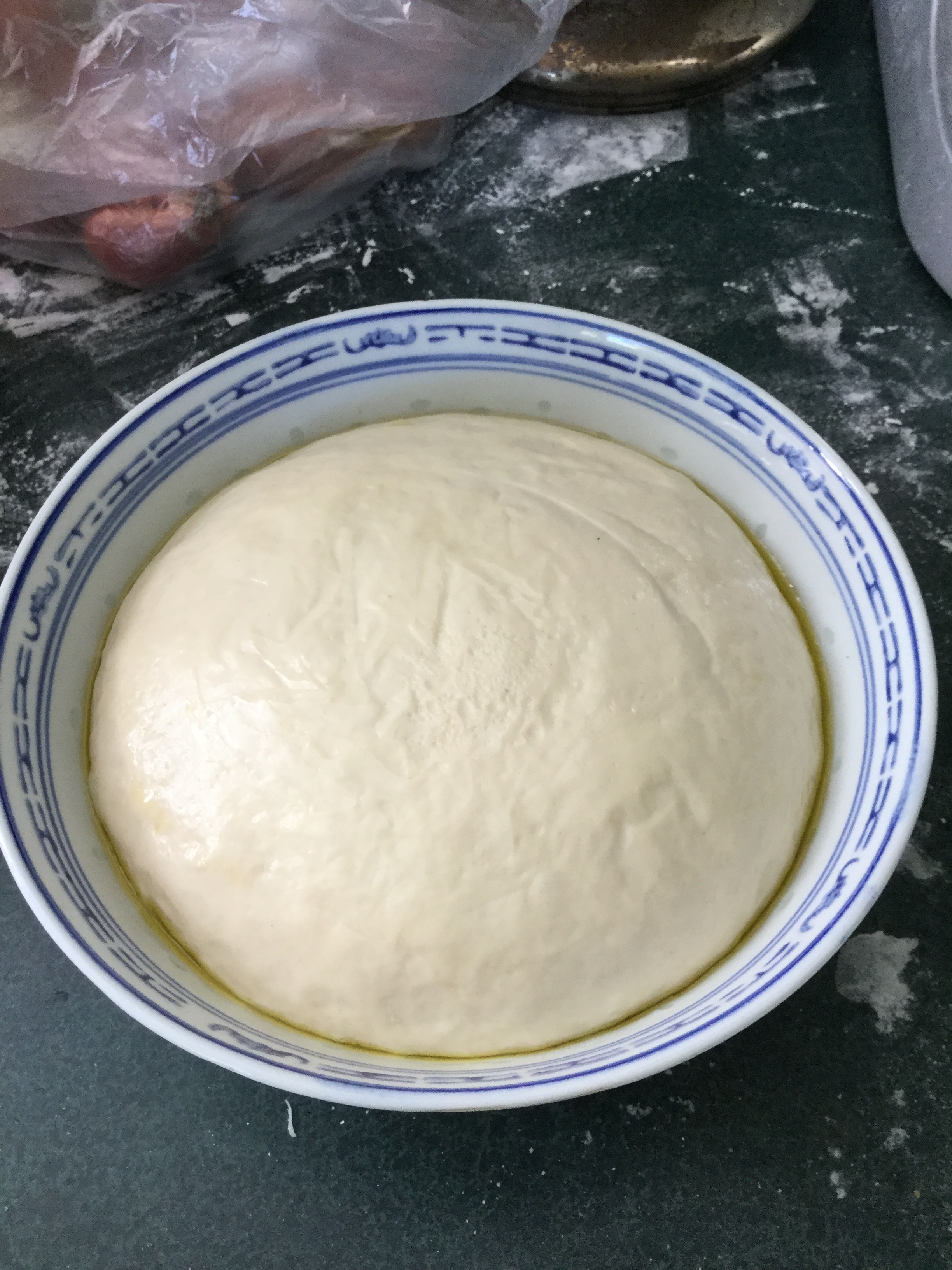
If you are only making one pizza today, put the second ball of dough back in its overnight bag and into the fridge to become pizza another day. Take the lucky ball of dough, that gets to be pizza today, and put it in an appropriately-sized bowl with a bit of EVO. Twirl the dough around in the EVO to get it nice and oiled up. Cover that baby up with some plastic wrap and put it in a nice warm place until about an hour and 30 minutes before you plan to bake your pizza.
By then, your dough will have risen away happily and look like this:
Turn your oven on to 260C or 500F, or as hot as it will go. Make sure your pizza stone is in the oven, if it doesn’t live there. You want that puppy HOT.
Turn the dough out of the bowl onto a well-floured surface and gently knead it a few more turns, just to incorporate the oil and get it back into a more compact ball. Then cover it with plastic wrap and let it rest for at least 30 minutes, and up to an hour.
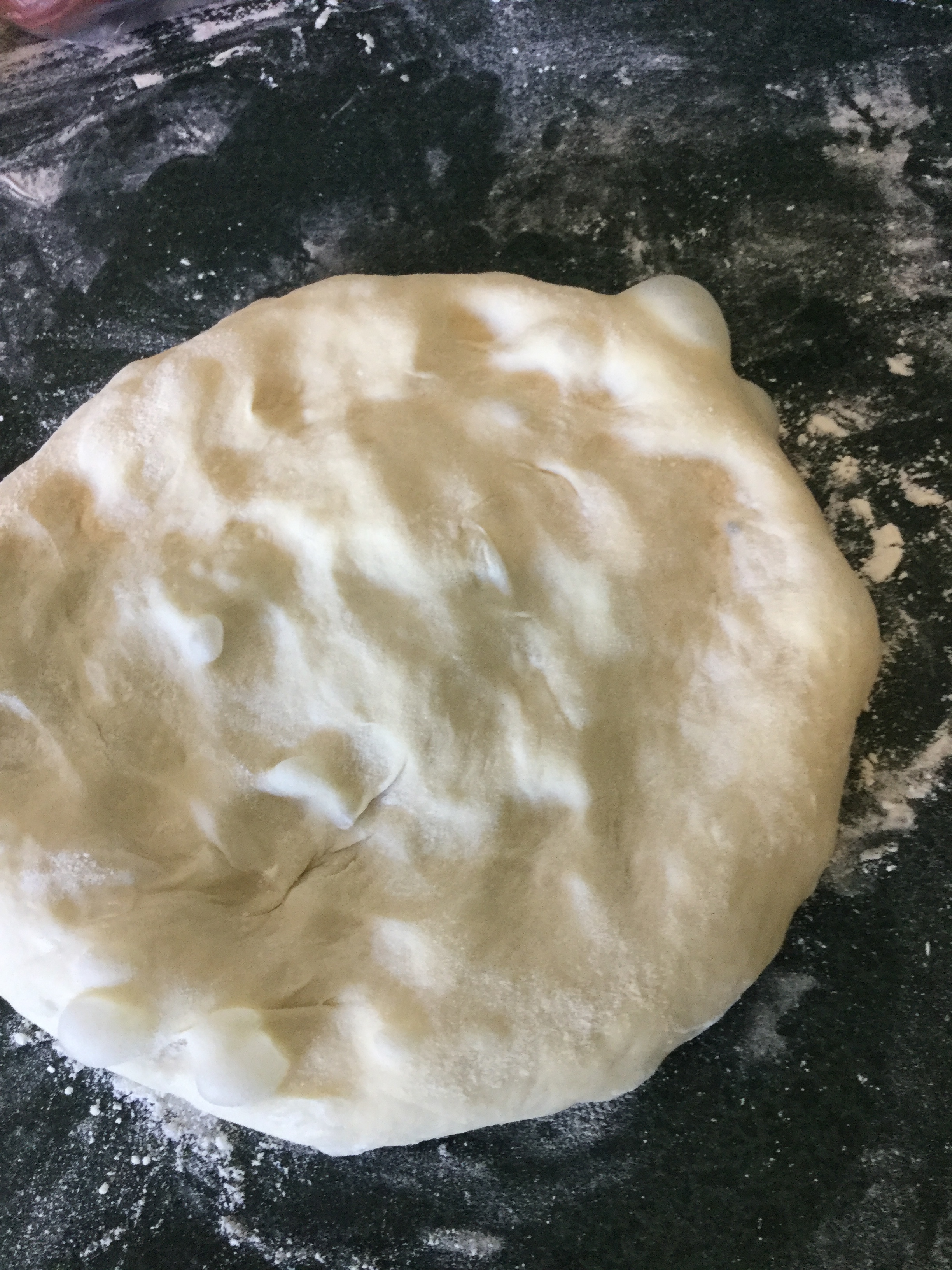
Now, it’s time to stretch your crust. Start with your nicely-rested dough and shape it into a rough circle, like this:
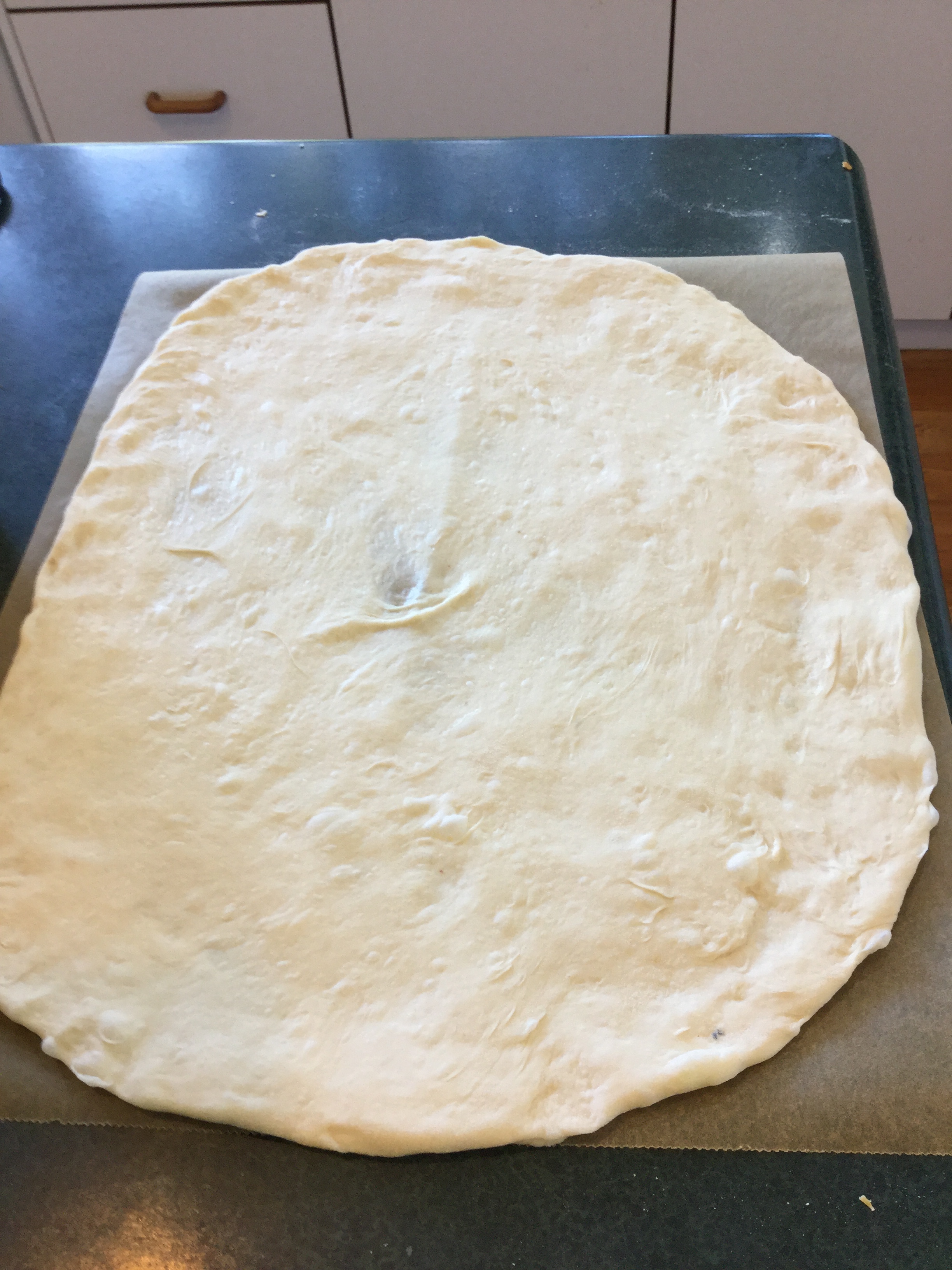
Then move it over to a sheet of parchment. Making generous use of flour, stretch the dough into the appropriate shape and size. Or you can toss it, but if you know how to toss pizza, you probably don’t need my help. If the dough is being stubborn, you can use a rolling pin, but try not to. My oven is tiny, so to achieve maximum pizza surface area, my pizzas are ovally rectangles:
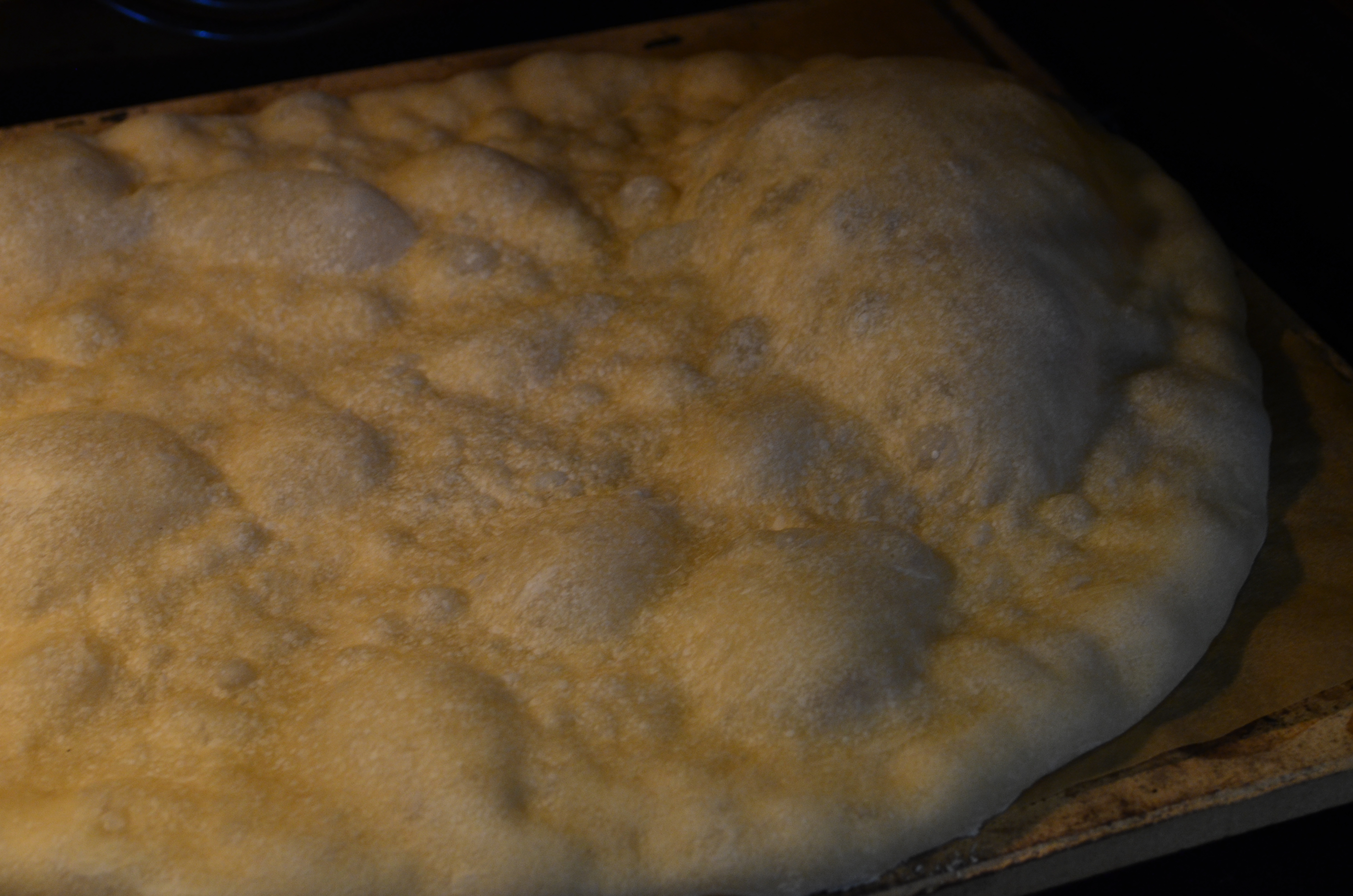
Now it needs to rest again, for 30 minutes or so. And it is ready to bake. I always pre-bake my crusts for about 5 (no more) minutes before I put on the toppings. It keeps the crust from getting soggy. You can brush it with olive oil, but I don’t. Just slip the crust and the parchment on to a flat baking sheet or pizza peel, then directly on to the baking stone. It will get lots of fun bubbles on the surface, but you can press those back down when you take it out to put on the toppings.
After this initial baking, you won’t need the parchment to move the crust around, so just slide it back on the baking sheet or pizza peel and put on your chosen toppings. I usually start with the thin layer of cheese, but you know what you like.
Put the assembled artistry back into the hot oven for another 8 minutes or so.
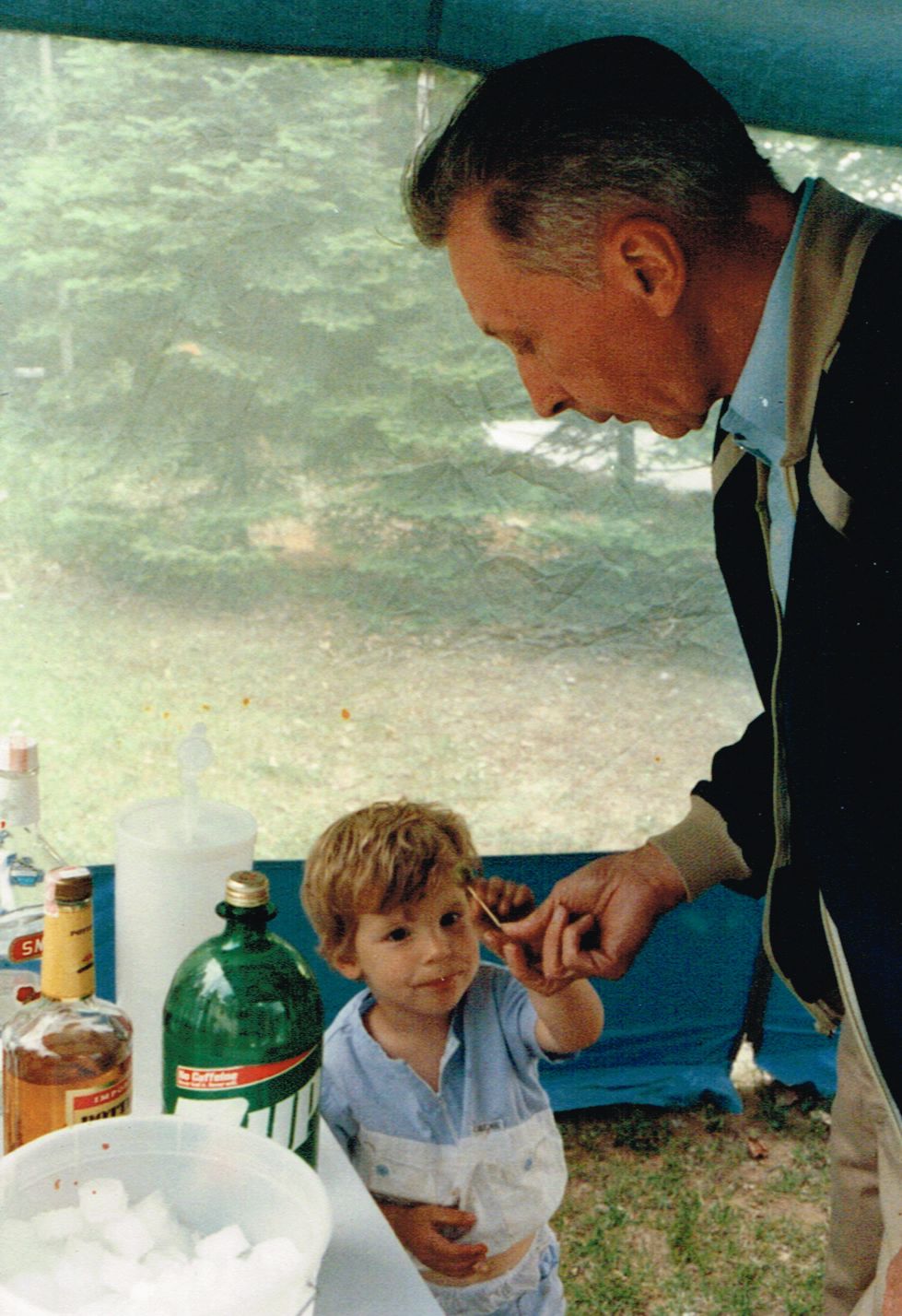
Yes, he generously shared martini olives with sweet little boys, and he was a one man Father Christmas, but when it came to Jack o’ Lanterns, he was all “Bah, Humbug!” Starting in early October, he would plan all car journeys carefully to avoid passing by the pumpkin patches that popped up around town. Most years, he would eventually, grudgingly give in but only late enough that I always ended up with the lopsided, practically un-carvable pumpkins from which to choose. The Charlie Brown Christmas Trees of pumpkins. One year, we waited so late that there weren’t even any sad, misshapen ones, and I had to make my Jack o’ Lantern out of a shoebox.
Are you crying yet?
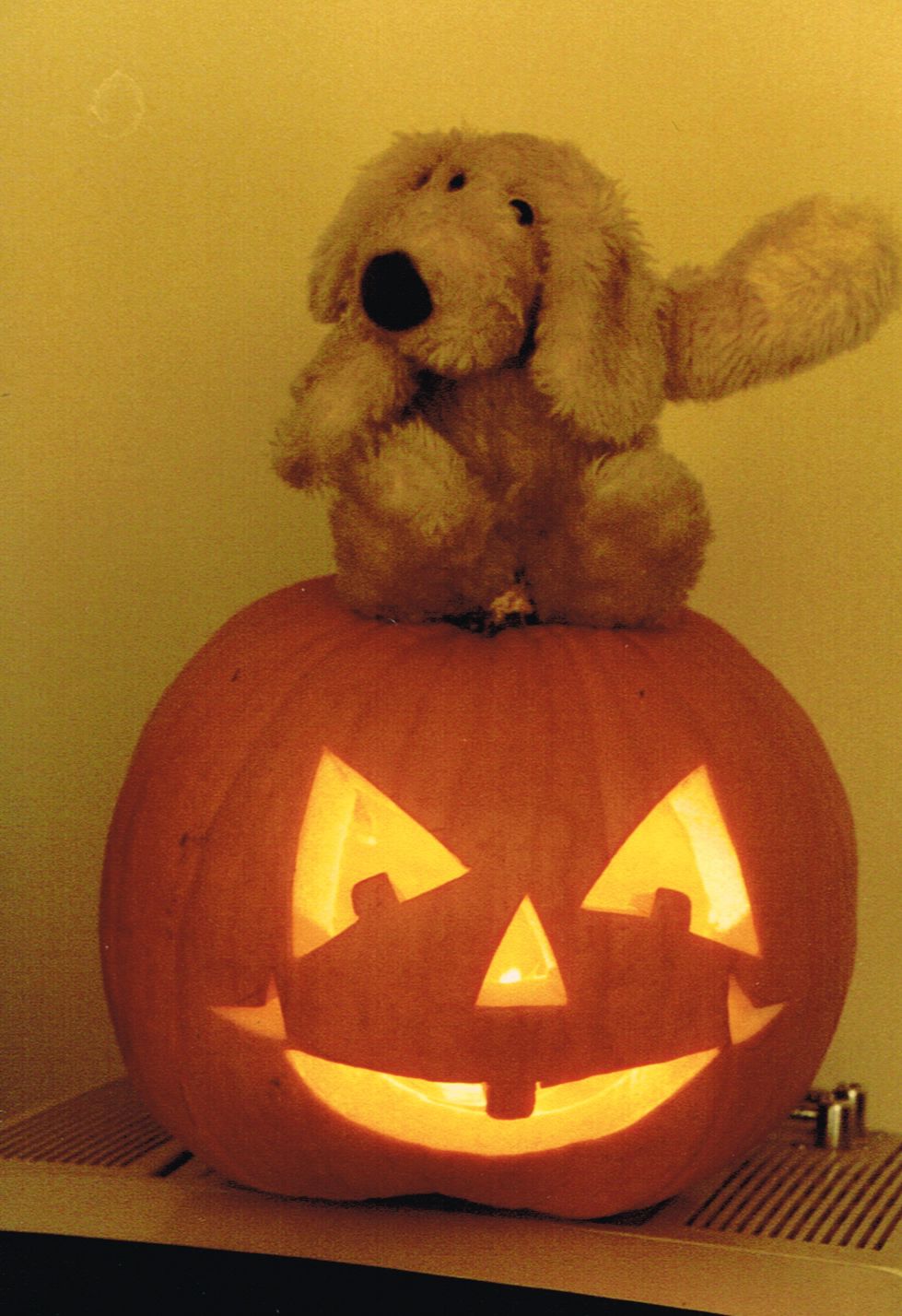
But, really, how hard does your heart have to be to hate this:
As a child, I didn’t understand Dad’s aversion to Halloween pumpkins. He had nothing against Trick or Treating, but he was death on pumpkins. It might have had something to do with how they looked on the day after Halloween: cooked from the inside out by the candles, and sort of stove in, like creepy shrunken heads. It could also have been the scary black fungus that grew in them after a few days. (He hated mushrooms, too. Coincidence? I think not!) As I got older — and gave in and bought a reusable, plastic Jack o’ Lantern — the whole Pumpkin Scrooge shtick became just another family joke. At bottom, though, I think there was something deeper at work. This lovely, otherwise holiday-loving Dad was — on the issue of Jack o’ Lanterns — shaped by his upbringing during the Great Depression. He just couldn’t wrap his brain around the idea of paying good money (and Halloween pumpkins are not cheap) for a oversized vegetable, only to cut holes in it, leave it on the stoop to rot, and not even eat it.
I have, from time to time, detected some bemusement on the part of New Zealanders concerning the American relationship with the pumpkin. While — as I have already noted with some chagrin — the pumpkin is a much beloved vegetable in New Zealand, on a trip to any farmers’ market here, one would not find a single “pumpkin” that an American would regard as worthy of the name. To kiwis, and most of the rest of the world, “pumpkin” is completely interchangeable with “squash”. So, if you look for pumpkin at the market here, you will find huge, green lumpy ones, smaller, cream-colored ones, and hard-shelled dark green ones with bright yellow flesh. What you won’t find is a bright orange, perfectly round, Halloween pumpkin. I’d be hard pressed to find anything suitable for carving, especially as October 31st falls right smack in the middle of spring — more asparagus than pumpkin season.
American-style Halloween traditions have gradually spread to other parts of the world. I’ve seen children headed out for Halloween parties, complete with witch costumes and plastic pumpkin buckets, in Hong Kong. One year, in Goa, I saw Indians move seamlessly from Halloween to the Hindu festival of Diwali. There are hip Halloween parties and Trick or Treaters in Paris. I’ve attended Halloween-themed nights in bars in Bali, Indonesia and Darwin, Australia. And New Zealand is no exception. While it is still, for the most part, an urban phenomenon, Trick or Treating has come to Aotearoa. While it is still overshadowed by the more traditional Guy Fawkes’ Night bonfires and fireworks a week or so later, Halloween has (thanks largely to the influence of U.S. marketing) earned its place on New Zealand’s celebratory calendar.
But these international Halloweens feel, somehow, as empty as a Jack o’ Lantern and as superficial as a plastic Hillary Clinton mask. While some cynics suggest that, even in the U.S., Halloween — with its pumpkins, candy, and costumes — is the stuff of canny marketing (Americans will spend almost $7 billion on Halloween this year), the real meaning of Halloween for Americans goes much deeper.
For American kids, Halloween is a sort of right of passage. American kids (and their parents) start planning their Halloween costumes right after school starts in September. Choosing a Halloween costume is one of the earliest opportunities American kids have to define themselves. My Mom made me some memorable Halloween costumes: I was a ghost, a bunny, a court jester, and Maid Marion (see the historian emerging?). In my fifth year, she made me a black cat costume that I wore every single day for most of the rest of the year (including the day I wandered through a graveside funeral at the cemetery behind our house). Sadly, one of the few photos I have of my later Halloween costumes comes from the one year my mother gave in to my (ill-considered) pleading for a store-bought costume because they seemed cooler than homemade. My plastic Mr. Ed mask made my face sweat, and I’m reasonably certain that if I had passed within range of a pumpkin candle my costume would have turned me into a Guy Fawkes bonfire of my own.
I suspect that for American parents, the year when a kid declares him or herself “too old for Trick or Treating” is, I as bittersweet for parents as when their kids start questioning Santa Claus.
You can track the demographic shifts in neighbourhoods by the trends in consumption of Trick or Treat candy. When we first moved to our house on Brookwood Drive, in 1967, my Mum bought many bags of candy. In my parents’ last years, there were Halloween nights that saw no Trick or Treaters at all. Kids grow up, trick or treating dies out, then parents downsize and a new generation of young couples with their young kids move in and Trick or Treating is born again. It’s the circle of life.
And Trick or Treating is truly multicultural. Over the years, I greeted Trick or Treaters of every shape, colour, and creed. Some were accompanied by parents from Korea, Vietnam, or El Salvador who barely spoke English but who embraced this strange custom of their new home. Others arrived in beautiful, multicoloured bouquets of Asian, Caucasian, Hispanic, and African faces. A few girls wore their costumes over their hijab. More than a few mothers wore puffy down jackets over their thin sarees and salwar kameez.
Halloween is also about neighbourhood and community. As a flaming introvert, I’m not a party goer. I am slow to meet people. What I love about Halloween is greeting the Trick or Treaters — and their parents — at the door. It made me — a shy single woman with dogs but no kids — feel part of a decidedly family-oriented neighbourhood. Halloween started, in my old neighbourhood, at about 6 pm when the wee ones came, dressed in their very first costumes and shyly holding out their plastic pumpkins with no idea what the whole thing is about. Then, about 7 pm, the big groups of older kids would come — five or six at a time, age appropriate and usually segregated by gender (because boys are icky and girls have cooties). Some brought their dogs, and I always kept treats for them, too. Finally, by 8 pm, you’d get the too-old-to-Trick or Treat crowd, the slightly surly teens who couldn’t be bothered to come up with a costume, are a little embarrassed, but still expect you to help them fill up their pillowcases. That’s when I’d blow out (or turn off) the pumpkin and retire to the basement.
For the record: my UK/Kiwi husband never got the charm of Trick or Treat and spent the entire evening in the basement with the dogs in those years when I was experiencing Halloween in Hong Kong, Bali, Goa, and Darwin.
So what is it about Halloween and pumpkins that works in the States but lacks soul anywhere else? On my recent trip back to the States, Kojo Nnamde (the noon – 2pm host of WAMU 88.5 in Washington DC and fount of all wisdom) hosted a segment on America’s seasonal crush on the pumpkin.
The star of the segment was Cindy Ott, author of Pumpkin: The Curious History of an American Icon. I was intrigued. I bought the e-book and found myself surprisingly enchanted with the history of the pumpkin in America. What Ott explained, and what most Americans probably instinctively understand is that for us, the pumpkin symbolises and romanticises the America’s agrarian past and taming of the wilderness. Early Jack o’ Lanterns had arms and legs and were depicted as frightening tricksters.
By the post-World War II era, Jack had lost his legs and became just a head, incapable, however ferocious, of causing mayhem. Pumpkin, even the mass produced pumpkin that goes into the Libby’s can, is not an industrial fruit. It is grown by small farmers and picked by hand. This pumpkin, repository of powerful American myth, bears precious little resemblance to any squash that occurs in nature. It has been engineered and hybridised into a (more or less) perfectly-round, evenly segmented, bright orange fruit with a flat bottom (for sitting on stoops), thick stem for easy carrying, a hard shell, and relatively thin pulp that lends itself more to carving than to eating.
Reese’s Peanut Butter Cups are the perfect candy. You don’t mess with perfection. Fie on the white chocolate, pumpkin-shaped, and dark chocolate versions. And don’t even talk to me about Reese’s Oreo cookies. Heresy!
For Americans, Halloween is about community and identity as much as it is about costumes and candy. So, in a sense, Trick or Treating in New Zealand makes about as much sense as a Guy Fawkes bonfire would in Peoria. While I miss the ritual of carving a pumpkin and passing out candy (not to mention the excuse to lay in a supply of Reese’s Peanut Butter Cups and Heath Bars), I wouldn’t want to reenact it here, in my new home. We will make new traditions here. And they probably won’t involve pumpkins because, when it comes down to it, I’m also a bit of a pumpkin scrooge.
Let me start by warning that, as much a I love him in SVU, I will not be writing about this guy:
We’re just talkin’ a different sort of Iced Tea here. But he does deserve a shout out.
When it comes to per capita tea drinking, New Zealanders are right up there with the British Motherland. I am an enthusiastic convert to the afternoon cuppa — my favourite is Yorkshire tea with a little milk, no sugar. It is a cup that aspires to be coffee, but without the jittery after effects. I like Earl Grey, too, but with lemon, no milk. My all time personal favourite is Lapsong Suchong, which is the closest thing to non-alcoholic Islay Single Malt. But as my beloved is a strict traditionalist, and since it is he that usually puts the kettle on in the afternoon, my usual is English Breakfast, milk, no sugar. It is important to note that Brits (and Kiwis, in general) believe that strong, hot, very sweet tea, is the cure to whatever ails you. And they’re usually right. I’m not a biscuit dunker, but, Judi Densch’s description of the process of Builder’s tea dunking in “The Best Exotic Marigold Hotel” has me thinking twice.
And, just for the record, an oreo cookie just screams for a glass of ice cold milk. I’m a twist-lick-dunk-dunk girl.
I now drink my tea almost exclusively hot, out of a mug. This is a great departure from the South of my upbringing, where tea is drunk only one way: iced and sweet. This shift doesn’t reflect any dampening of my love of iced tea; rather, it is a function of living in New Zealand, where iced tea is just another sugary drink sold in bottles with strange and unwelcome flavours like peach and mango. In most of the world, outside the Southeastern United States, you can’t walk into a restaurant or cafe, order iced tea, and just assume they know what you mean. You are likely to get brewed hot tea poured over ice with some sugar packets or Splenda on the side.
Even where I have to settle for unsweetened iced tea, it is my restaurant beverage of choice. It is more festive that just plain water, less intoxicating (and usually cheaper) than beer or wine, goes with almost any cuisine, and because you actually pay for it, waiters are less cross if you choose to linger over an additional glass after you’ve finished your meal. It plays the same important social function as that last little bit of wine in the bottle. And if you choose not to drink alcohol, you don’t feel quite so awkward hanging around. I costs next to nothing to make, so everyone wins!
Proper iced tea has three ingredients: water, tea, and optional sugar. A slice of lemon is acceptable, as long as I have the option of picking it out. No ginger. No lemonade. No peach, mango, raspberry, or — please GOD — frappe.
My Grandpa and Grandma Saltenberger had this plastic Kool Aid pitcher and cup set that made the Kool Aid taste even better
I didn’t grow up with iced tea. My family came from Europe via the Upper Midwest, where the whole point of drinking things was, for the most part, keeping warm. Or intoxicated. When we moved to Georgia, where it is hot . . . DAMN hot . . . for at least six months a year, the refreshing beverage of choice at our house was Kool-Aid. The old fashioned kind that didn’t come with sugar. And ours didn’t get sugar. It was, to say the least, tart.
I learned about iced tea from my southern friends, who drank the stuff by the gallons. And iced tea in Georgia is sweet. I mean really sweet. As in make your cavities SING sweet. While the iced tea nation pretty much starts at the Mason & Dixon Line (essentially the border between Pennsylvania and Maryland), the Sweet Tea Nation begins at the Virginia – North Carolina border). If you grew up in Virginia, and you’re accustomed to ordering iced tea and adding your own sugar, you’ll need to change your strategy in the Sweet Tea Nation. Here, tea is sweet. And cold. Even in winter. If you want that other stuff, you will have to ask for it. You will have to say, out loud, in front of God and everybody, ” I would like unsweetened tea, please” and immediately brand yourself as an Yankee. You can also order hot tea, but I won’t promise what you’ll get. It is (sort of) acceptable, and slightly less suspicious, to order half-and-half (iced tea, half sweet, half unsweet).
Now, I know I said I don’t approve of lemon-flavored iced tea, but there is an exception: the Arnold Palmer, which is half iced tea and half lemonade. This is best made with unsweetened tea and real (ONLY real, squeezed) lemonade (not the instant stuff, and not the pub lemonade you get in your shandy). This is not, however, southern. Arnold Palmer is from Pennsylvania.
If you happen to find yourself at Zeb Dean’s Bar-b-que in Danielsville, Georgia, you’ll get: a loaf of Sunbeam Bread (in the bag), a plastic pitcher of sweet tea (you can also get one of unsweetened tea, if you have the courage to ask for it — then you can make your own half-and-half), a serving of “Stew” (aka Brunswick stew, but made with the barbecue detritus instead of the traditional squirrel), a pitcher of Zeb’s peppery, vinegary sauce, and the best damned pulled pork barbecue in the whole wide world. Strictly speaking, however, Zeb’s barbecue is not vegetarian. So this is not an official Kale Whisperer endorsement. But really, if you are ever headed south on I-85, and you eat pork and/or are a slacker vegetarian like me (Shame on you!) it is well worth the 45 minute or so detour. (Sorry, Wee Charlie.)
So, what makes southern sweet tea unique? There are two key factors: the tea, and the sugar delivery system.
First, the tea. Most commercial teas — Lipton, Tetley, PG Tips, etc. — are for brewing and drinking hot with milk. So they are WAY to strong for iced tea. When you chill them, as you must do with iced tea, the tea turns cloudy. Not only does it look awful, but it makes the tea too tanniny. When I was growing up, the mainstream tea companies hadn’t caught on to this yet, so the iced tea brand of choice was Lusianne: “Alway clear as a bell.”
Nowadays, most of the big companies offer special iced tea blends that address the cloudiness issue, but for those who live in non-iced tea cultures, like New Zealand, there is still an alternative to those horrid iced teas in bottles. The answer is sun-brewed tea. I don’t understand the science, but it you brew regular tea in the sun, instead of with boiling water, it doesn’t get cloudy. It works like this:
Sun Tea:
Find a large glass container with a fairly tight lid and fill it with the desired amount of COLD water.
Add 2 or 3 regular teabags (or the equivalent amount of loose tea) per litre (or quart) of water.
Place the jar in the sun for no more than 4 hours (obviously, this only works on sunny days).
Then remove the teabags (or strain out the loose tea) and chill the brewed tea as soon as possible.
Sweeten (or not) to taste. This works with regular or green tea).
The sugar delivery system for proper sweet tea is easy peasy, and absolutely crucial. You can sweeten your sun tea with Sweet and Low or Splenda, but I don’t want to know about it. Unless you like your tea cloyingly sweet, you aren’t going to add that much sugar anyway. You may, however, add artificial sweetener if you send me a doctor’s note. Here’s the process:
Simple Sugar Syrup for Southern Iced Tea:
Put one cup of sugar and three cups of cold water in a saucepan that is high enough not to boil over.
Watch it carefully.
Bring the sugar and water to a boil and AS SOON as the water starts to boil, turn it down to a simmer.
Simmer the water and sugar, stirring constantly, until the sugar has completely dissolved. This usually takes about 5 minutes. Cool for 4 hours.
Done. But,
If you like flavoured tea, you can, at this point, add mint, basil, a little lemon or orange peel, or fresh ginger — whatever flavour you like — and steep until the syrup is cool. Again, about 4 hours. Pour the syrup through a sieve, and press the flavouring to get out all the essential oils and yumminess. This way, your sugar syrup will taste better and last a long time in the fridge without moulding.
You can use the mint syrup to make that other Southern Classic, the Mint Julep, which involves: a mint julep cup (or an old fashioned-sized glass) filled to the brim with crushed or shaved ice to which you add a TBS (or two if you have a sweet tooth or don’t like whiskey), and 1 1/2 jiggers of whiskey — Bourbon or Tennessee mash are traditional, but mild blended scotch works too. What you get is a sort of alcoholic shave-ice. I haven’t tried this with Single Malt because, why would you? But you can try it if you want.
Basil syrup makes a nice change, but then you are absolutely not allowed to call it a Mint Julep. Really, though, the cocktail possibilities are endless. Once you try it, you won’t want any other cocktail in the heat of summer, except, perhaps, a nice G & T (with bitters).
There are two major food groups: mashed potatoes, and everything else.
On Bethel Road in the 1960s, Sunday was all about mashed potatoes. Actually, to my mind, life is about mashed potatoes. Mashed potatoes are my perfect food. Mashed potatoes are my desert island food. I never get tired of them. When I’m celebrating, I eat mashed potatoes. When I’m sad, I eat mashed potatoes. Mashed potatoes are my stress food, my happiness food, and my just-regular-old-day food. I probably bleed mashed potatoes. I like them plain, with butter, with gravy, with olive oil, under creamed vegetables, stroganoff, or chili (weird, I know). In short, any day is better with mashed potatoes.
What are the roots of this mashed potato fixation? Well, the answer lies with St. Joan, the patron saint of mashed potatoes. While she has not yet been officially canonized, I’m working on her nomination. You see, St…
There are two major food groups: mashed potatoes, and everything else.
On Bethel Road in the 1960s, Sunday was all about mashed potatoes. Actually, to my mind, life is about mashed potatoes. Mashed potatoes are my perfect food. Mashed potatoes are my desert island food. I never get tired of them. When I’m celebrating, I eat mashed potatoes. When I’m sad, I eat mashed potatoes. Mashed potatoes are my stress food, my happiness food, and my just-regular-old-day food. I probably bleed mashed potatoes. I like them plain, with butter, with gravy, with olive oil, under creamed vegetables, stroganoff, or chili (weird, I know). In short, any day is better with mashed potatoes.
What are the roots of this mashed potato fixation? Well, the answer lies with St. Joan, the patron saint of mashed potatoes. While she has not yet been officially canonized, I’m working on her nomination. You see, St. Joan’s mashed potatoes cured all ills and performed miracles. And every time I make mashed potatoes, she is sitting on my shoulder whispering “remember the lumps.” If I had to name one person who most shaped my lifelong food preferences, it would be St. Joan of the mashed potatoes.
Lisa, the Kale Whisperer, and Jeannie, with Sharon Chapel in the background during one of our late ice-age blizzards
I passed the first nine years of my life on Bethel Road, a gravel dead end street in Northern Virginia. It was an ideal place to be a kid. There was an excellent climbing tree at the bottom of our driveway, and my friends and I spent hours building villages and making up stories with the stones on the street. The houses (all three of them) were at the tops of the hills, so rolling down hills was a major activity. So was jumping off front stoops. In those days, it snowed a fair amount in the DC area (it was just at the end of the last ice age), and we sledded and built enormous snow forts. My bestie, Jeannie, and I would swing on my swing set, as high as we could go, and sing the Beatles” “Help” at the tops of our lungs. I still remember all the words, and when I sing them, I’m back on that swing.
One of our neighbors was All Saints’ Sharon Chapel Episcopal church, which was – for the first few years we lived there – a charming, wood, Civil War era chapel with a wonderful stained glass window of the Good Shepherd. My father played the organ there, and my mother was on the altar guild. Jeannie and her family went there, too. And every Sunday, I went to her family’s house for Sunday dinner. Her Mom, Joan, made a traditional Sunday dinner – roast beast, various vegetables, and . . . wait for it . . . MASHED POTATOES. The absolutely most extraordinary mashed potatoes in the entire mashed potato universe. She always – at least in those early years – mashed them by hand, so they were the ideal combination of creamy and lumpy. Rules 1-10 of mashed potatoes: MASHED POTATOES HAVE LUMPS. On the rare Sunday when there were no mashed potatoes, my little world collapsed.
I was born with wonky tonsils, and I spent an inordinate amount of my childhood housebound with tonsillitis. On those Sundays when I was too sick to go to Jeannie’s for Sunday dinner, Saint Joan would appear at the door with a bowl of mashed potatoes. When my parents finally gave in to the inevitable and had my tonsils taken out, I was unimpressed with promises of ice cream. But when St. Joan promised as many mashed potatoes as I could eat, I was there! Where’s the operating room? Bring on the ether!
At the age of six – just a few weeks before I was to be the flower girl at my Auntie J’s wedding – I rode my bike down a steep hill into a ditch (I knew how to go, I didn’t know how to stop), slashed open my chin (six stitches), and knocked out my two front teeth. When I got home from the Emergency Room, who was there waiting? Saint Joan of the mashed potatoes! Oh, joy! Manna from heaven.
The Kale Whisperer and Jeannie in our backyard. I’d love to post a photo of St. Joan’s mashed potatoes, but they hadn’t invented digital cameras or foodies yet.
Who needs Lourdes when you have St. Joan’s mashed potatoes. They cured whatever ailed you.
When my family moved to Georgia in 1967, it seemed my mashed potato universe would implode. My Mom made nice smooth mashed potatoes with the mixer. I kept trying to explain that mashed potatoes have lumps. But she just couldn’t do lumpy mashed potatoes like St. Joan. It’s a gift. A calling. Happily, for years after we moved, I would take the Southern Crescent train from Georgia back to Alexandria: ostensibly to visit Jeannie, but really? It was a mashed potato pigrimmage.
Eventually, I grew up and Jeannie left home and the mashed potato pilgrimages ended. I still visited St. Joan from time to time, and she would look at me, and smile, and say “Awwww, little CARE – oh – line” in her distinctive West Virginia drawl and make me feel very loved. But the mashed potato days were over. The last time I saw St. Joan, she came to dinner with my folks at my townhouse in Annandale where I served, you guessed it, mashed potatoes. Were they up to snuff? Probably not, but St. Joan never criticized. She just smiled and said: “Awww! Little CARE-oh-line!”
There is a great deal of debate about mashed potatoes. Some experts insist they must be made with Russet (or, in the Southern Hemisphere, Agria) potatoes. Others advocate using waxy (Red Rose or Moonshine), or even new potatoes. I actually like a combination of floury and waxy: the waxy potatoes go all creamy and you can count on the floury potatoes (provided they aren’t over cooked) for some decent lumps.
St. Joan, as far as I remember, always peeled her potatoes, but I like to leave at least some unpeeled. This adds flavor, vitamins and all-important lumps.
As for mashing liquid, I’m agnostic regarding the relative merits of skim versus whole milk or cream. Just potato-cooking water will do in a pinch, or if you are vegan, but I never do it. The real key is to cook them just enough and not one bit more. And please, please, please, don’t let them sit in the cooking water. It won’t keep them warm, it will just make them watery. Better to go ahead and mash and then reheat in the oven. Mashed potatoes are very forgiving.
It’s all about the potatoes.
Mashed potatoes need fat. I’m a butter girl. I add butter before I mash, and more after I mash. Under certain circumstances, olive oil works. Margarine? You can if you want. I never touch the stuff.
I must confess to St. Joan that I never mastered hand mashing. I always watched her. She had this magical sort of round-and-round, full-body mashing technique. I’ve tried numerous types of potato mashers, and I just can’t get the right rhythm or that perfect cream / lump balance. I’ve used potato ricers and food mills. They make super fluffy, creamy, but, sadly, lump-free mashed potatoes. [They are good for mashing potatoes for other uses, like gnocchi.] A handheld electric mixer is the next-best thing to hand mashing, they aren’t powerful enough to over-mash and eliminate all the lumps. I had to re-home my hand mixer when I moved to New Zealand. I’ve tried the masher attachment on my immersion blender, but that didn’t work at all. So, I’ve had to resort to using my big, standing mixer. When I had a Kitchen Aide mixer, even with the paddle attachment, it was too efficient and eliminated the lumps. The one I have in New Zealand does pretty well, leaving a good amount of lumps. That is excellent for mashed potatoes, less wonderful for cake batter.
Never, ever, ever . . . really NEVER mash your lovely potatoes in the food processor. They will immediately turn into horrible gluey glop fit only for hanging wallpaper.
In the end, the perfect mashed potato is a very personal matter. My perfect mashed potato isn’t necessarily your perfect mashed potato. So experiment. And remember, St. Joan of the Mashed Potatoes is always smiling down on us!
Mashed potatoes, mixed with other vegetables, make terrific casseroles that can be either mains or sides. One of my all time favorites, and a regular at holiday dinners in our family, is Rumpledethumps (which is also known as Colcannon or Bubble-and-Squeek, but Rumpledethumps is the most fun to say out loud).
For years, I used the Rumpledethump recipe from Sundays at Moosewood Restaurant (Touchstone, 1990). They suggest a combination of white cabbage, broccoli, and leeks. These are yummy, and make a good, traditional side dish. They are really good with turkey gravy. But I wanted something livelier that could stand-alone as a vegetarian main.
I settled on kale, cauliflower, and leeks. The kale adds texture and a ton of flavor, the cauliflower balances that out with a milder, brassica flavor, and the leeks add a nice sweetness that balances out the slightly bitter kale. The Moosewood recipe uses cheddar cheese, and that works fine with the kale, too. But I prefer something nuttier and more assertive – a Gruyere or Parmesan. Gruyere can be hard to find and, in New Zealand, quite pricey, so my go-to cheese is a mixture of parmesan and cottage cheese.
The star here is the kale. For a recipe like this, I like it cut into thin ribbons and braised. Here’s what I do:
Start with a large bunch of kale, roughly 1.5lbs/1kg
Take the tough central stems out of the kale (I just grab the stem at the end and strip it off, like you would strip the leaves off a tree branch; you can also cut it out with a sharp knife or scissors), and slice into thin ribbons – no wider than 6mm/.25 inch. Rinse the ribbons several times in cold water to get off any sand, then let them drain in a colander.
Heat a Tablespoon of olive oil. When it is shimmering, add a clove or three of garlic, some hot pepper flakes if your like, and sauté for just a few seconds
Add the kale ribbons, with whatever water is clinging to them, to the hot oil with a sprinkling of salt. You’ll probably have to do this in batches. Just add a new handful as the previous batches wilt. You might need to add a pinch of salt to help it wilt along. When all the kale ribbons are in and wilted, sauté them a bit longer, just to ensure that they are all coated with oil and fully wilted.
Add about 120ml/4 fl.oz. braising liquid of your choice. I like red or white wine, but vegetable broth, potato cooking water, or just plain water will work too. You can even use chicken broth, just don’t tell me about it.
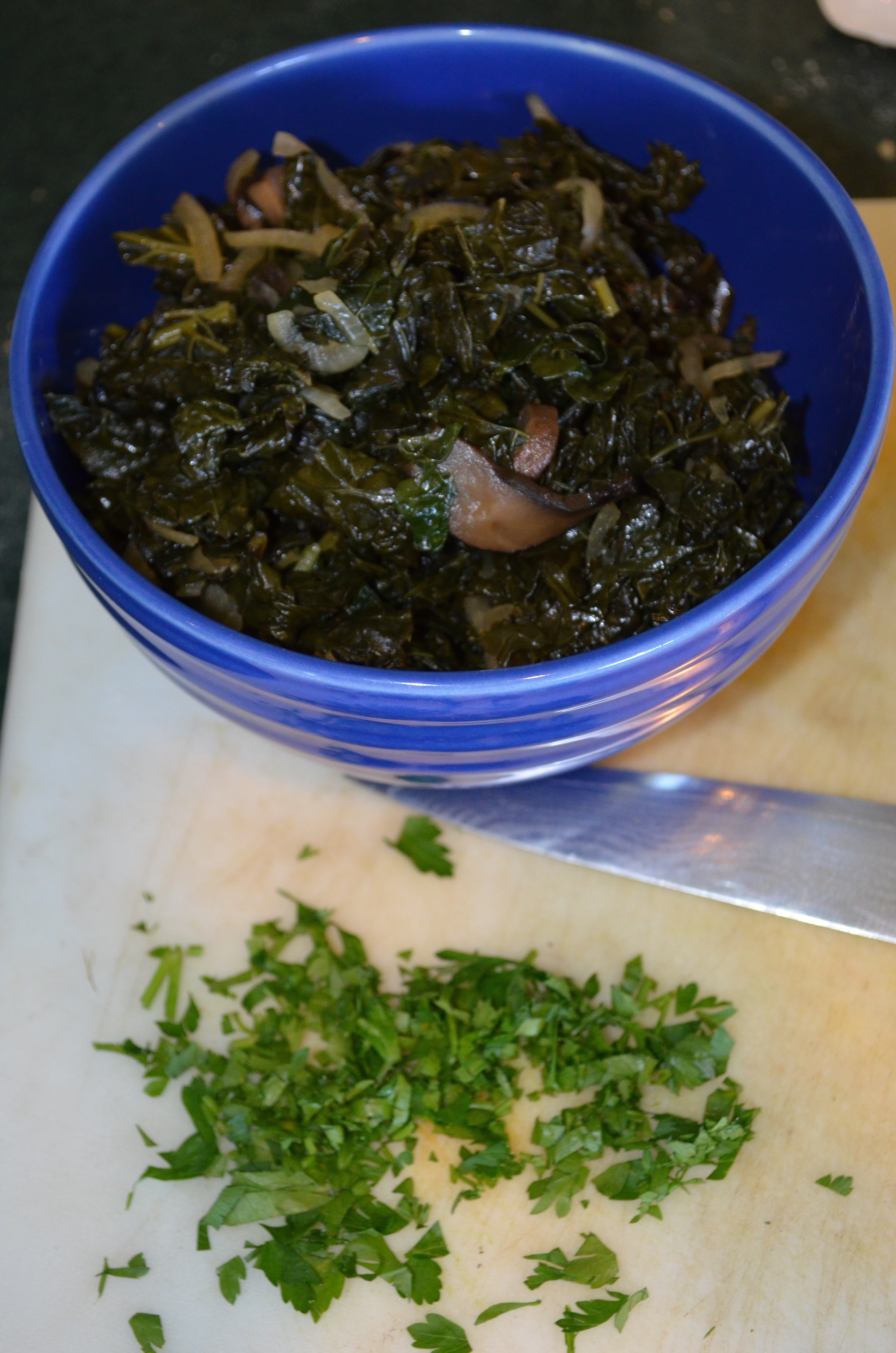
Other kale gurus will tell you to just braise it until its crisp-tender, but crisp tender kale still tastes raw to me. I braise mine for about 15 minutes, until it has turned a nice, dark green and is tender, but a bit chewy. Add more liquid if it gets dry. Season it with salt and pepper. Toss in the juice of a lemon or a teaspoon of white wine vinegar, or to taste. It ends up looking something like this:
You can use this kale for all sorts of things. Add it to marinara sauce for pasta. Toss it with chunky pasta (like penne) with a little high quality olive oil, chopped raw tomatoes, and toasted pine nuts or walnuts — This doesn’t need cheese, so it makes a nice vegan option. If you really need cheese, parmesan is good and gorgonzola is better. Use it to doctor up commercial bean and lentil soups. And, of course, it is an awesome pizza topping!
For the Rumpledepthumps, you’ll need:
6 cups of diced potato (I like a mix of floury and waxy; leave some of the waxy potatoes unpeeled. If you are a baked potato fan, by all means, leave some of the flour potatoes unpeeled), cooked until tender (save some of the cooking water) and mashed with:
2 TBS/25g butter or oil
2 oz/125g cottage cheese (large curd is best)
1 cup / 250 g mild white cheese (Monterey Jack or, in the Southern Hemisphere, Egmont works great here)
1 TBS Dijon or coarse ground mustard
1 large bunch of kale, preferably lacinato or blue / Russian, braised as per above (Curly kale is hard to cut into ribbons, but if that is all you have, you can chop it fairly fine — in this case, you’ll need to wash it first.
½ medium head of cauliflower, broken into small flowerets and lightly steamed
1 large or 2 small leeks, julienned or thinly sliced and sautéed in butter or olive oil until it is translucent. For a slightly sweeter, richer flavor, you can let the leeks caramelize a bit.
Mix the Kale, cauliflower, and leeks together with the mashed potatoes/cheeses; add a bit of potato cooking water or braising liquid if it seems dry.
Turn the whole yummy, gooey mess into a buttered 2qt/ 1.8 l casserole. Dot with a little more butter or olive oil, sprinkle with about 1 oz / 25g of shredded parmesan.
Bake in a 350F/180C oven until it’s piping hot and the cheese is lightly brown. That will take about 15 minutes if everything is fresh off the stove. Longer if it has cooled. This is even better assembled a few hours (or even a day) ahead. The flavors blend nicely, that way. It will take longer to reheat, and you’ll want to start off with it covered with foil: say, 15 minutes with foil, and 15 minutes without.
For a vegan/dairy free version, you can make a cream sauce for the kale:
Heat 2 cups of vegetable stock until it’s hot but not boiling (2 minutes on high in the microwave)
sauté a small shallot or 1/2 a small oinion, finely chopped, in 3 TBS olive oil or margarine (if you must) until translucent.
Whisk in 2 TBS regular flour and 2 TBS nutritional yeast and cook, stirring constantly, for a couple of minutes. It should be the consistency of wet sand.
Pour in the vegetable stock all at once and whisk like crazy until it is smooth. Then, bring it to a simmer and cook for a few minutes to let it thicken.
Add the creamy sauce to the kale, leave the cheese out of the potatoes (they might need some extra cooking water to get smooth), and proceed with the rest of the process. This version is good topped with a handful of whole wheat breadcrumbs and some finely chopped walnuts tossed with some olive oil and your favourite chopped herbs (rosemary, thyme, and chives are nice)– these will get nice and toasty while the Rumpledethumps bake.
Sunday night was pizza night in our family. We started, in the early 1960s, with Chef Boyardee Pizza kits. The picture on the box showed a generous pizza with a cracker-thin crust, just the right amount of tomato sauce, and plenty of stretchy cheese. The reality was less inspiring – especially the powdery cheese-like-food product that came out of a can and tasted like vomit. But if you used only half of the overly salty sauce and added your own cheese, they weren’t too bad. We didn’t know you could put exotic things like sausage and olives on pizza. Mushrooms were a no go. Dad didn’t eat fungus. I think we did, sometimes, go wild and add hamburger. I vaguely remember slices of hot dogs, but I’m hoping that was just a nightmare.
So, my first visit to the Capri Pizzeria in Athens Georgia was the Big Bang of my pizza universe. The pies came on huge, battered old pizza pans – the size of trash can lids. And the crusts were life changing. They were crisp but chewy; and under the toppings, you’d find a lunar landscape of bubbles and craters.
Capri made their Italian sausage. It was a revelation. It had fennel seeds in it! FENNEL SEEDS! And the pizza was topped with real mozzarella and slightly smoky Provolone that made those long, stretchy strings that you see in the movies. We didn’t dine out much, and I can’t say my Dad was a great pizza fan. Fortunately, my mother and her best friend, Denise, loved the Capri’s roast beef sandwiches and went there often for lunch. Sometimes, if I was out of school, I tagged along. I cannot vouch for the quality of the sandwiches because: Why would you go to the Capri and NOT EAT PIZZA???!!! I don’t remember that the Capri sold pizza by the slice. But it must have, because I always had pizza. And I couldn’t possibly have eaten one of those massive pies by my scrawny lonesome. Then, again. . . .
Sadly, the Capri closed around 1980 or so. This catastrophe ushered in what I now know were to be my years of pizza exodus – wandering the pizza desert in search of manna (which, I’m pretty sure, the Old Testament describes as “as delicious as the perfect pizza crust). A Food Truck owner, Bob Petrillose, had invented the Poor Man’s (later French bread) Pizza in Ithica, New York in the 1960s. He licensed the idea to Stouffer’s, which introduced its frozen French Bread pizza to the American market in 1974. I don’t know precisely when Mom cottoned on to French bread pizza, but she was definitely an early adopter. But they weren’t cheap – and Mom was – so she explored various other options for putting tomato sauce and melted cheese on bread: frozen bagels (which qualify neither as bagels, nor as pizza crust), English muffins (Thomas’s are passable, if you are trapped on a desert island; otherwise, don’t bother), Bisquick and Pillsbury crescent roll dough (no comment).
My first exposure to Tombstone frozen pizza came during my trips to visit my family in Eagle River, Wisconsin, where Sunday night is also pizza night. My Auntie Anita has always been a culinary trailblazer in our family. My mother got her very first pizza recipe in, like, 1958, from Anita. Tombstone pizza was invented in Wisconsin, you see, so it was a patriotic duty. And because it was invented in Wisconsin, it was all about the cheese. Before it was mass-marketed across the US (after the original family company sold out to Kraft), it was only available in Wisconsin. If you ordered a pizza at a tavern or bar pretty much anywhere in Northern Wisconsin, what you got was a Tombstone. It was marketed as the next best thing to homemade:
And in the pre-Kraft days, it sort of was.
Auntie always kept a dozen or so Tombstones in her freezer, ready for an impromptu “pizza doctoring” party. A proper pizza doctoring party – and, yes, you can do this at home – involves some key ingredients:
Coolers loaded with several suitcases of beer, preferably Old Style and Miller Light (or your local equivalent, cheap, quaffing beer), Diet Pepsi and A&W Root Beer for the kids. In later years, family beer preferences shifted to Icehouse and Budweiser Light (which, as far as I’m concerned, isn’t beer, but one humours ones relatives). Now that we are all grown-ups, we have also ventured into craft brews, such as Leinenkugel’s. And WINE!!
This is a suitcase of beer. Not Old Style, but at least a Milwaukee beer.
Gin, vermouth (sweet and dry), brandy, Spanish olives (unless Auntie had some of her dilled green beans), and maraschino cherries so the grown-ups can make martinis and manhattans.
Several pounds of grated pizza cheese (Did I say Tombstones were all about the cheese? Well, not enough cheese for us!)
Peperoni, sliced mushrooms, ripe black olives, crumbled pre-cooked hamburger or sausage meat (because even had the Tombstones had enough cheese, they never had enough other stuff; and everyone wanted different other stuff.)
Dill pickle spears
Potato chips
Lots of Aunties, Uncles, Cousins, Cousins-in-law, and other assorted hangers-on
An oven
Scissors (to cut the pizza; we never had anything as flash as a pizza wheel)
Oh, and lots and lots of Tombstones.
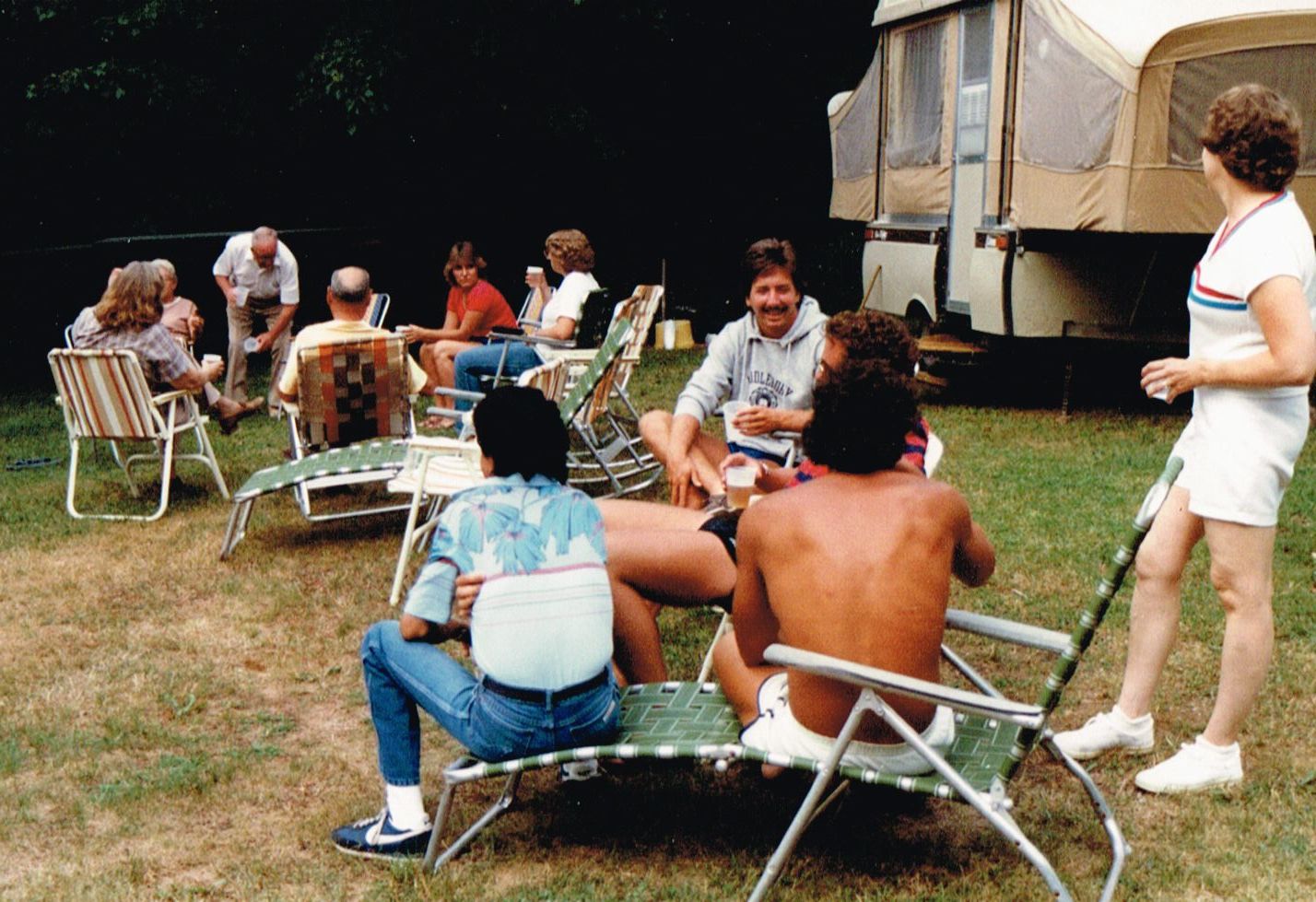
I cannot swear that this was actually a pizza doctoring party. The vintage (1980s) is right, however, as is the general vibe.
Do I really need to tell you what to do next? OK:
Open a beer, or
If you were born before 1945, wait for Earl and Chuck to mix the martinis and brandy manhattans
Open a Tombstone, add additional toppings as desired, but at the bare minimum lots and lots of extra cheese,
Open another beer,
Bake the Tombstone according to package directions, or until your toppings are nice an bubbly
Listen while Cousin Randy tells hysterical bear hunting stories
Let the Tombstone cool briefly, then cut into slices with the sewing shears,
Grab another beer
Eat with pickle spears and chippies until you can’t move.
Dill pickles? Potato chips? Yes. Tombstones need dill pickles and potato chips. There is debate in our family as to who established this rule. The smart money is on my Mom. Maybe the Eagle River clan has been goofing me all these years, and when I’m not around, they leave out the pickles.
*********
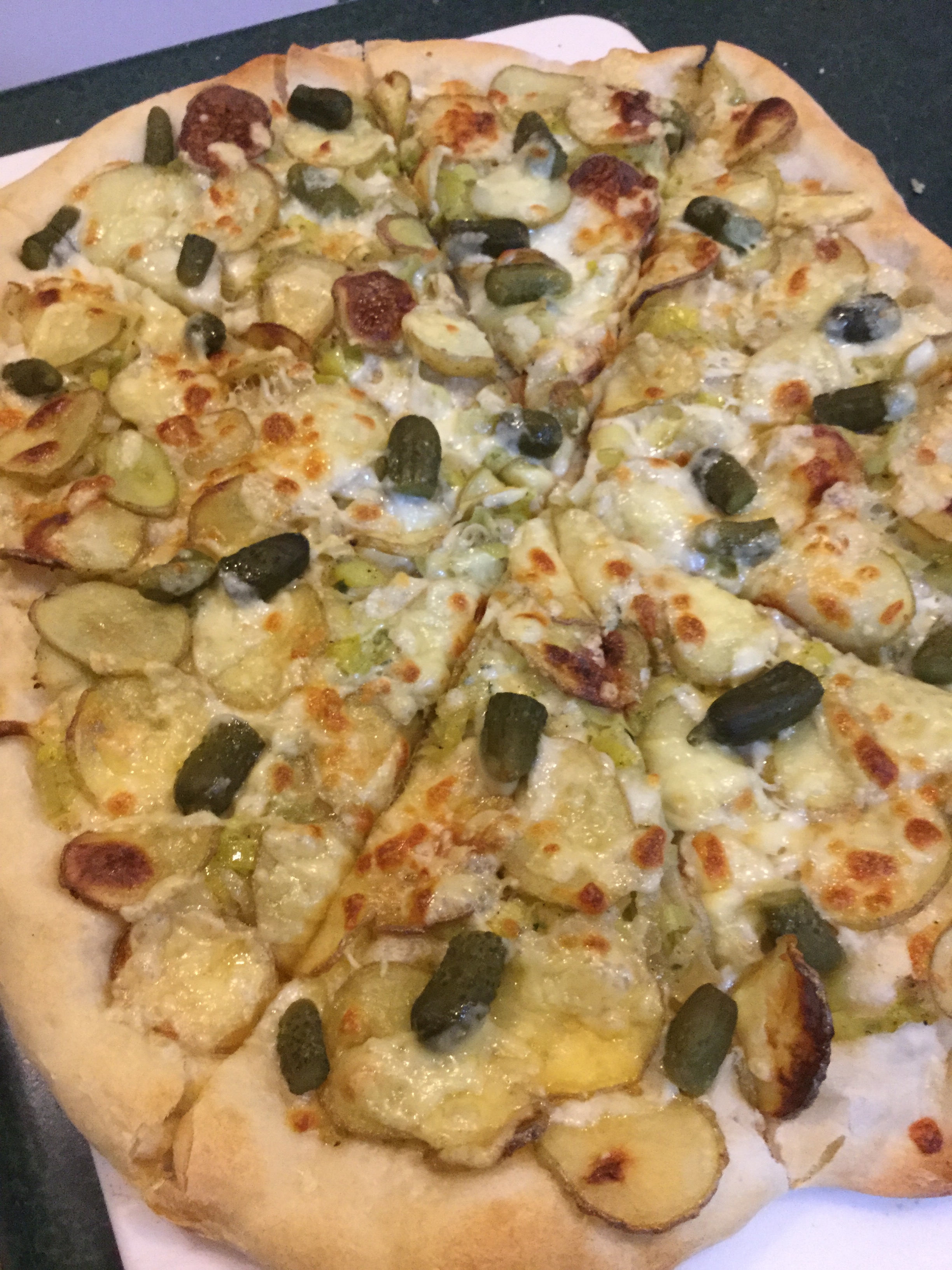
This week’s slice: Dill Pickle and Potato Chip Pizza
The inspiration for this pizza is two-fold. First, a few years ago, my Auntie J gave me a raclette grill for Christmas. Simon and I enjoyed raclette, which is an excellent excuse to eat potatoes, pickles, sweet onions, and lots and lots of melted cheese. I had to rehome the raclette grill when we moved because, as I did all my other electric appliances. So I felt a pang of homesickness when I discovered that the Stinky Cheese Man at the farmers’ market had raclette cheese. Why not, I asked myself, put the raclette ingredients on a pizza? Genius!
Second, genuinely sour, dilly, kosher dill pickles (the only pickles really worth eating) are rarer than hens’ teeth in New Zealand. The closest approximation to the flavor of dilly pickles is French cornichon, or gherkins, which are available here. But they are tiny, difficult to pick up, and generally ill-suited to the role of side dish pickles. They do, however, look pretty adorable on a pizza, and complement sweet onions (or in this case, leeks) and new potatoes that all cuddle up under a layer of nutty raclette cheese. And with the potatoes, there is no need for chips on the side!
Raclette Pizza
500g (1 lb.) smallish new potatoes(about the size of a chicken egg), red or gold
1 large or two small leeks,
12 or so sour gherkins or cornichons
120g (1/4 lb.) raclette cheese (or any mild swiss cheese)
225g (1/2 lb.) grated mozzarella
olive oil, salt, and pepper
Crust for a 30cm (12 inch) pizza
Preheat your oven to 220C or 425F
Thinly slice the potatoes and soak them for 30 minutes or so in ice water. If you slice them very thin (3mm or 1/8 in.), they will be potato-chippier; if you slice them a little thicker, (4.5mm or 3/16 in.) they are more like the boiled potatoes common in raclatte spreads. I like them both ways, depending on my mood.
I slice the potatoes and leeks on my mandolin. If you do that, try not to do this!
Drain the spuds and dry them as best you can (I give mine a ride in the salad spinner), drizzle a little olive oil on a foil-lined baking sheet, and spread the slices out in a single layer (or as close as you can manage, they’ll shrink a bit) and smoosh them around in the oil a bit, and sprinkle them with salt.
Roast the potatoes for about 20 minutes. Turn them over (or just stir them around) about halfway through. When you take the potatoes out of the oven, nicely brown and crispy, turn the oven up to 260C or 500F.
Slice the leeks, white and light green parts, crosswise, very thin. Alternatively, you can cut them lengthwise into thin shreds. Sauté them in a Tbs. of olive oil, sprinked with a bit of salt, until they are tender but not browned.
Top your pizza (I always start with a slightly prebaked crust):
start with the grated mozzarella (I use mozzarella for the base because raclette cheese is pretty $$$, and your run of the mill mozzarella won’t compete – try not to use “pizza cheese”, which usually includes some provolone, fontina, and parmesan, which might distract from the nutty, Swiss cheesy flavor of the raclette).
Then add the sautéed leeks in an even layer
Then arrange your roasted potato chips artistically on top of the leeks.
Dot the pizza with gherkins. If they are very tiny, you can use them whole. I cut the bigger ones in half.
Finally, spread the raclette cheese over the whole thing, because it is the star.
If your crust is prebaked, bake the pizza for about 8 minutes. If you are starting with a raw crust, then you’ll want to leave the gherkins and raclette off for the first few minutes, and add them when you have about 7 or 8 minutes to go.
New Zealand is my new home. I felt at home here almost from the start. Kiwis get my sense of humor in ways that my fellow Americans never did. Simon and I can live 20 minutes from the center of the nation’s capital and keep pigs, alpacas, and (coming soon), chickens. Work-life balance is a real thing here, not just an aspiration. It is possible to drive from our home in the hills to the beach in 20 minutes or less. Almost nobody here goes back to work on January 2nd. New Zealand is closed in January. The January “blahs” that used to knock me sideways every year just aren’t a thing.
There has been much to learn: driving on the “wrong” side; the metric system; Kiwi English; spelling; that horizontal rain makes umbrellas pretty much pointless; that July isn’t summer, and January isn’t winter; that there are 18 hours of daylight on Christmas and 8 hours of daylight on the 4th of July; the rules of cricket; that the number 10 is pronounced “tin” while 7 is pronounced “seevin.” Footy games are “matches”, the field is the “pitch”, and it takes rugby players roughly 80 minutes to play an 80-minute match. And there are no TV time-outs, special teams, shoulder pads or helmets. So you’d better have your beer and chips ready before play starts.
New Zealand is my home. For me, though, the notion of home is bit slippery. You see, I have many “homes” in places where I’ve never actually lived. In addition to my actual homes (Virginia, Georgia and Wisconsin, New Zealand), I get homesick for, inter alia: New Orleans, Edinburgh, Paris, the Masai Mara, and Antarctica. In pondering how this is possible, I’ve come to understand for me, “home” is about memorable experiences and the people with whom I shared them.
And I remember those experiences in terms of food.
I discovered my love for jazz and zydeco over coffee and biegnets with my parents at the Café du Monde. My friend Anita and I kicked off a long-weekend sharing our love of art with glasses of red wine and the best omelets ever for breakfast (well, an early lunch) at a sidewalk café on the Rive Gauche after an all-night flight to Paris. My two chosen sisters – Susan and Elizabeth – and I ate great piles of mussels and chips (but not haggis) after exploring ruined castles in Scotland, and drank gallons of vino verde in the hot, dusty Alentejo in Portugal. I ate delicious grilled langoustines in Bali while my venerable Elder Sister, Katy, fed her grilled fish to the street cats. Simon and I drank gorgeous Argentine and Chilean wines while watching the penguins and icebergs in Antarctica. And I reveled in quaffing Tusker beers with my fellow campers after a hard day tracking wildlife with my intrepid Masai guide, Josh, at Freeman Safaris in Kenya.
In fact, sharing memorable meals is, for me, the way I end up expanding my chosen family. Conversations and experiences can create acquaintances, but for me, breaking bread creates family. And family is home.
Taste is my most evocative sense. Music is a distant second. Christmas isn’t Christmas until I’ve had one of Auntie Janice’s nutmeg logs and a slice of my mother’s stöllen. Passion fruit (a key ingredient in New Orleans’ famous hurricane cocktail and also popular in New Zealand) makes me hear Dixieland jazz and zydeco. My cheese and nut loaf evokes Thanksgiving dinner with Pete, Anita, Mike and Mary Beth, even in New Zealand in July. Peaches take me take me back to the battered old formica kitchen table at my grandparents’ farm where Tanta comforted me with peach küchen after a run-in with the wasps in the outdoor privvy. Every time I eat oatmeal, I hear Grandpa Saltenberger saying: “If you don’t eat your oatmeal, you won’t grow hair on your chest.” Somehow, that arugment worked for him: I ate the oatmeal. It never occurred to me, at 7, that I might not want hair on my chest.
Not all the memories are happy. I was eating baklava the moment my appendix ruptured, and I still can’t face the stuff. When I was about 6, I ate whipped cream until I was sick (they warned me), and it still gives me pause. At about the same age, I went to the fridge and took a big slug out of what I thought was ice water. It was martinis. Please, never order me a martini! And tuna casserole will forever take me back to the hours and days I spent by my father’s bedside when he was dying in hospice.
Dad’s winter greenhouse, circa 1969.
With absolutely no disrespect to my loving and all-around-wonderful mother, my Dad was (and remains, eight years after his death) the center of my universe. He was a World War II veteran, a brilliant scholar, and a venerated teacher. But in his heart of hearts, he was a farmer. Not a gardener – he had no truck with roses or posies. That was my mother’s realm. He grew food. Every summer we drowned in bell peppers (capiscums), green beans, snap peas, shelly beans, okra, eggplants, radishes, spinach, and lettuces. He even grew summer squash (courgettes) – crooknecks and zucchini – even though he hated it, because he knew I loved it. Half of the back yard was covered in raspberries – because Mom loved them. His fig tree was legendary – it was the fig tree equivalent of the loaves and fishes. It fed the ten thousand hungry southerners with figs. And with my mom’s famous fig pizzas. Yum.
But what I most associate with my father and, hence, with love and family, is tomatoes: his huge, ugly, sweet, juicy heirloom tomatoes. When I moved away from home, he would pick them green, wrap them in newspaper, and ship them to me. One bite of a vine-ripened tomato, warm from the sun, transports me right back to summertime Saturday afternoons, when we three sat down with a couple of big, fat tomatoes, a jar of mayo, salt, pepper, and a loaf of squishy white bread – no lettuce, no bacon – and ate tomato sandwich after tomato sandwich, washed down with unsweetened grape Kool-Aid. I’m sure, when I die, my last thought of my father will be those tomato sandwiches.
I only know how to tell my story, and my family’s story, through food. Family, love, life, and home are all embodied, for me, in food: in the making of it and the sharing of it. In this blog, I will share what I have learned about living and cooking as a vegetarian, and living and cooking as a vegetarian in New Zealand. I will also share my stories: the ones I remember from my past homes and the ones I am making here in my new home. Some are funny, others are sad. All are, for me, full of the kind of meaning that makes ordinary food a meal, makes meals into memories, and makes memories into home.


























 The Kale Whisperer